. 2019 Oct 30;10(1):4948.
doi: 10.1038/s41467-019-12857-4.

Conductive 2D metal-organic framework for high-performance cathodes in aqueous rechargeable zinc batteries

Affiliations

Conductive 2D metal-organic framework for high-performance cathodes in aqueous rechargeable zinc batteries

Kwan Woo Nam et al. Nat Commun. .

Abstract

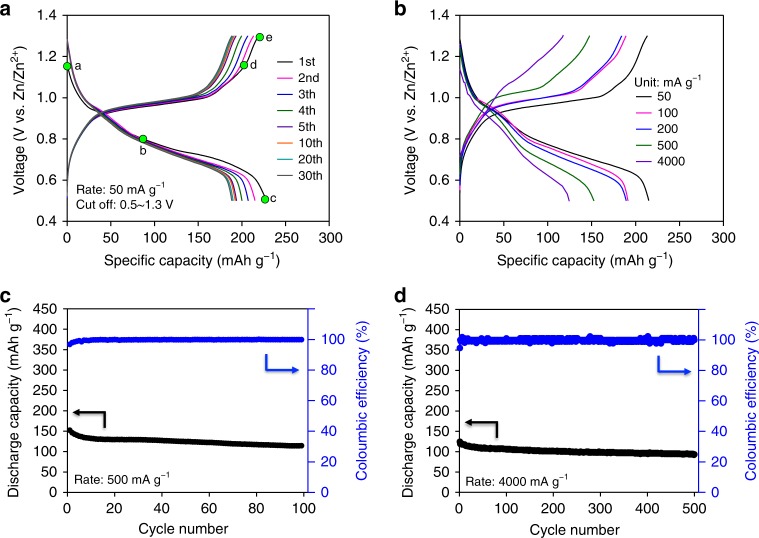
Currently, there is considerable interest in developing advanced rechargeable batteries that boast efficient distribution of electricity and economic feasibility for use in large-scale energy storage systems. Rechargeable aqueous zinc batteries are promising alternatives to lithium-ion batteries in terms of rate performance, cost, and safety. In this investigation, we employ Cu3(HHTP)2, a two-dimensional (2D) conductive metal-organic framework (MOF) with large one-dimensional channels, as a zinc battery cathode. Owing to its unique structure, hydrated Zn2+ ions which are inserted directly into the host structure, Cu3(HHTP)2, allow high diffusion rate and low interfacial resistance which enable the Cu3(HHTP)2 cathode to follow the intercalation pseudocapacitance mechanism. Cu3(HHTP)2 exhibits a high reversible capacity of 228 mAh g-1 at 50 mA g-1. At a high current density of 4000 mA g-1 (~18 C), 75.0% of the initial capacity is maintained after 500 cycles. These results provide key insights into high-performance, 2D conductive MOF designs for battery electrodes.


Conflict of interest statement

The authors declare no competing interests.

Figures
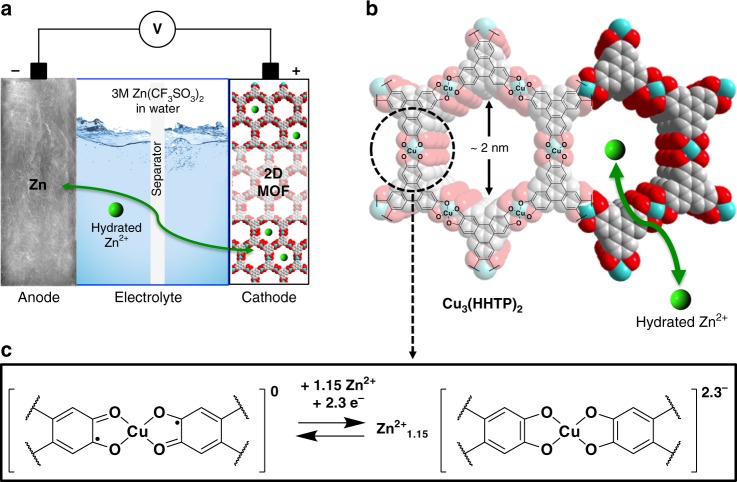
Fig. 1
Fig. 1
Zn-Cu3(HHTP)2 chemistry. a Schematic illustration of the rechargeable Zn-2D MOF cell. b Structure of Cu3(HHTP)2, which when viewed down the c axis, exhibits slipped-parallel stacking of 2D sheets with a honeycomb lattice. The cyan, red, and gray spheres represent Cu, O, and C atoms, respectively. The H atoms are omitted for the sake of clarity. c Expected redox process in the coordination unit of Cu3(HHTP)2
Fig. 2
Fig. 2
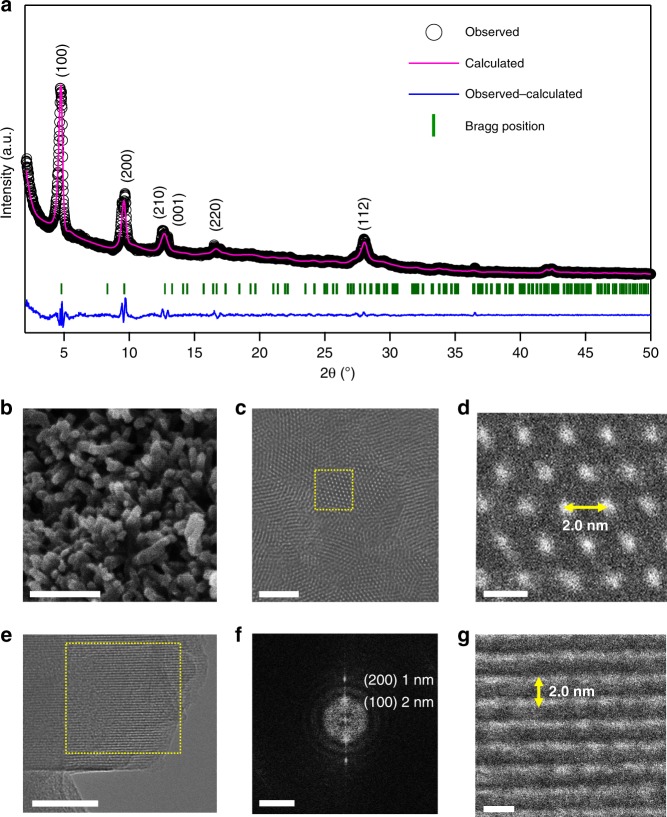
2D Chemical structure and structural analysis of Cu3(HHTP)2. a Rietveld refinement of PXRD patterns. b FE-SEM image of Cu3(HHTP)2, scale bar: 200 nm. c LD-HRTEM image of Cu3(HHTP)2 at a low resolution, scale bar: 20 nm. d LD-HRTEM image of Cu3(HHTP)2 along the [001] zone axis, indicating a hexagonal pore packing with d100 = 2.0 nm, scale bar: 2 nm. eg LD-HRTEM images at (e) low and (g) high resolution along the [010] direction. Scale bars in (e) and (g) are 50 and 2 nm, respectively. f An FFT pattern of the yellow square in (e), scale bar: 2 nm−1
Fig. 3
Fig. 3
Electrochemical performance of Cu3(HHTP)2. a, b Discharge–charge voltage profiles of Cu3(HHTP)2 at a 50 mA g−1 and b various current densities. The green dots labeled with (a–e) in (a) are states where XPS analysis in Fig. 4b, c was conducted. c, d Cycling performance of Cu3(HHTP)2 at current densities of c 500 mA g−1 and d 4000 mA g−1
Fig. 4
Fig. 4
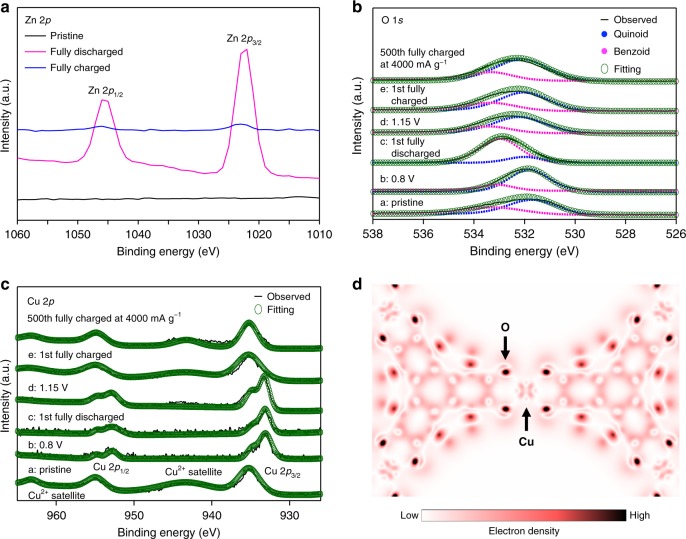
Electronic states analysis during discharge–charge. ac Ex situ XPS spectra of a Zn 2p, b O 1 s, and c Cu 2p. d Changes of electron density upon the reduction of Cu3(HHTP)2
Fig. 5
Fig. 5
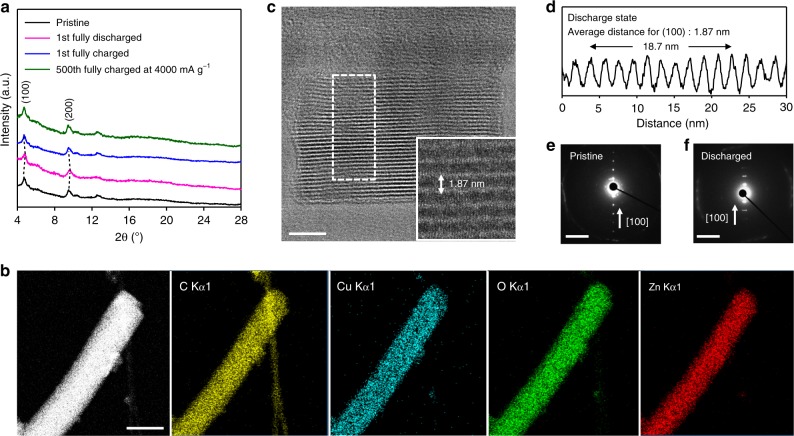
Structure analysis during discharge–charge. a PXRD patterns of the Cu3(HHTP)2 electrode in the pristine, first fully discharged/charged states at a rate of 50 mA g−1, and 500th fully charged states at a rate of 4000 mA g−1. b Scanning transmission electron microscopy (STEM) image of the fully discharged Cu3(HHTP)2 alongside its EDX elemental mapping with respect to C, Cu, O, and Zn, suggesting uniform Zn insertion over the electrode, scale bar: 100 nm. c An LD-HRTEM image of discharged Cu3(HHTP)2 viewed down the [010] zone axis. An inset in (c) shows a magnified area depicting the (100) plane, scale bar: 20 nm. d Measurements of the (100) interplanar distances from the white boxed area in (c) indicate the average d100 = 1.87 nm. e, f SAD patterns from Cu3(HHTP)2 at (e) pristine and (f) discharged states used to confirm the interplanar distances of (100). The arrows and scale bar indicate the [100] direction and 2 nm1, respectively
Fig. 6
Fig. 6
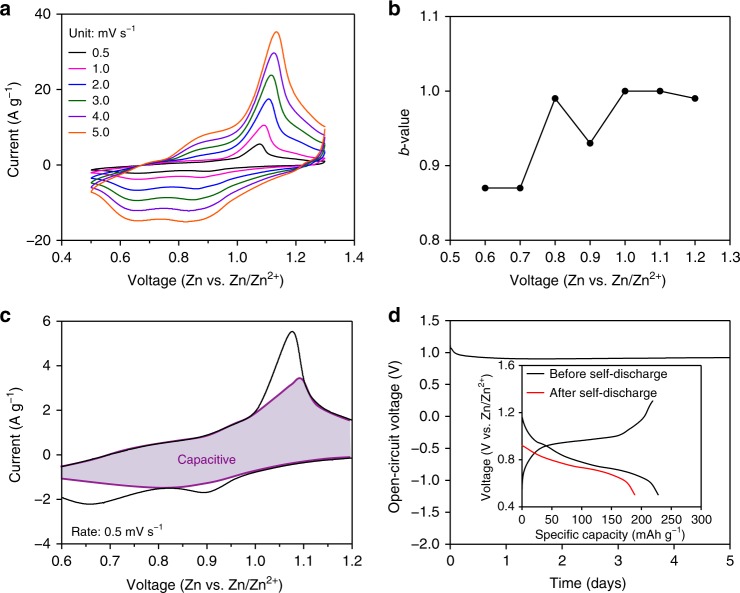
Charge-storage mechanism of Cu3(HHTP)2. a Cyclic voltammograms of Cu3(HHTP)2 recorded at different scan rates. b b-values for the Cu3(HHTP)2 electrodes plotted as a function of the potential for cathodic scans. c Capacitive and diffusion currents contributed to the charge-storage of Cu3(HHTP)2 at the rate of 0.5 mV s−1. d A self-discharge profile of Cu3(HHTP)2. The inset shows voltage profiles for the self-discharge test before and after storage

References

    1. Dunn B, Kamath H, Tarascon J-M. Electrical energy storage for the grid: a battery of choices. Science. 2011;334:928–935. doi: 10.1126/science.1212741. - DOI - PubMed
    1. Yang Z, et al. Electrochemical energy storage for green grid. Chem. Rev. 2011;111:3577–3613. doi: 10.1021/cr100290v. - DOI - PubMed
    1. Larcher D, Tarascon JM. Towards greener and more sustainable batteries for electrical energy storage. Nat. Chem. 2015;7:19–29. doi: 10.1038/nchem.2085. - DOI - PubMed
    1. Li W, Dahn JR, Wainwright DS. Rechargeable lithium batteries with aqueous electrolytes. Science. 1994;264:1115–1118. doi: 10.1126/science.264.5162.1115. - DOI - PubMed
    1. Luo J-Y, Cui W-J, He P, Xia Y-Y. Raising the cycling stability of aqueous lithium-ion batteries by eliminating oxygen in the electrolyte. Nat. Chem. 2010;2:760–765. doi: 10.1038/nchem.763. - DOI - PubMed

Publication types