


Risk of gastric cancer in the second decade of follow-up after Helicobacter pylori eradication
- PMID: 31667586
- PMCID: PMC7026240
- DOI: 10.1007/s00535-019-01639-w
Risk of gastric cancer in the second decade of follow-up after Helicobacter pylori eradication
Erratum in
-
Correction to: Risk of gastric cancer in the second decade of follow-up after Helicobacter pylori eradication.J Gastroenterol. 2020 Mar;55(3):289-290. doi: 10.1007/s00535-019-01654-x. J Gastroenterol. 2020. PMID: 31820091 Free PMC article.
Abstract
Background and aims: Eradication of Helicobacter pylori reduces the risk of gastric cancer. In this study, we investigated the risk beyond 10 years after eradication of H. pylori.
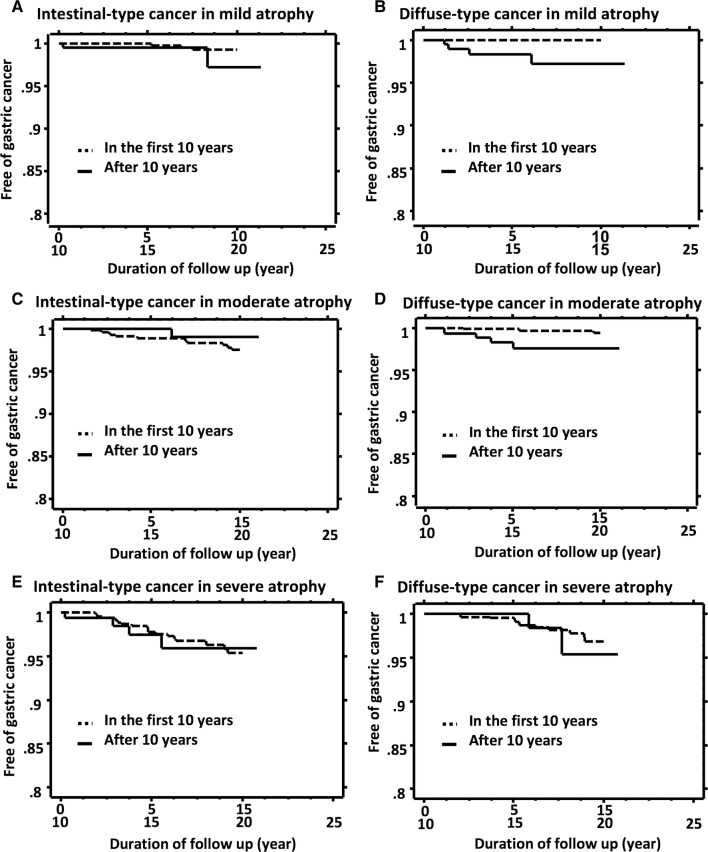
Methods: We conducted a retrospective cohort study of 2737 patients who had yearly endoscopic follow-up after cure of H. pylori infection. For comparison of gastric cancer risk in the second decade of follow-up with that in the first decade, we calculated standardized incidence ratios (SIRs) by dividing the number of observed cases of gastric cancer in the second decade of follow-up by that of expected cases which was estimated using the incidence rate ratio of age in the first decade.
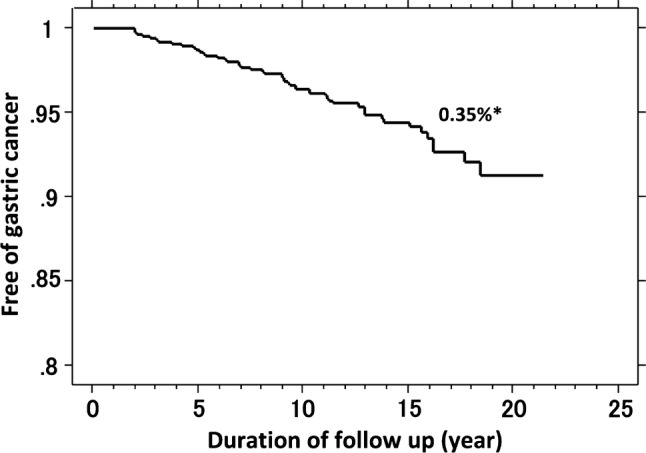
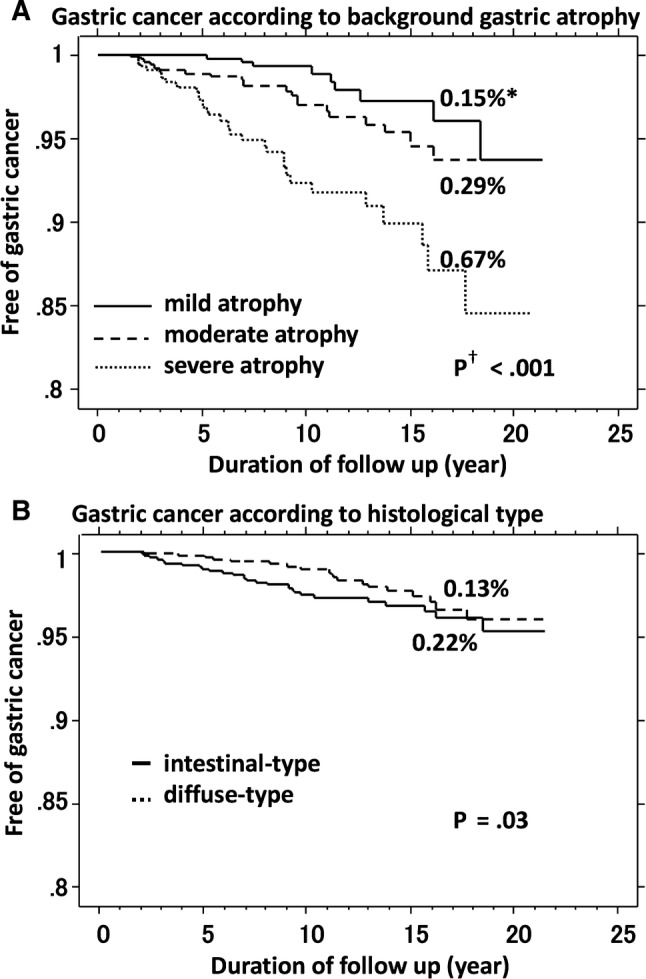
Results: During the follow-up for as long as 21.4 years (mean 7.1 years), gastric cancer developed in 68 patients (0.35% per year). The SIRs for diffuse-type gastric cancer was infinity (0 expected case and 4 observed cases) in patients with mild gastric mucosal atrophy and 10.9 (95% confidence interval 4.53-26.1) with moderate atrophy, whereas no significant increase of SIRs was observed in intestinal-type cancer regardless of the grade of baseline gastric atrophy or in diffuse-type cancer in patients with severe atrophy even though who had the highest risk.
Conclusions: The longer the follow-up, the greater the risk of developing diffuse-type gastric cancer becomes in patients with mild-to-moderate gastric atrophy at baseline. Endoscopic surveillance should be continued beyond 10 years after cure of H. pylori irrespective of the severity of gastric atrophy.
Keywords: Diffuse-type gastric cancer; Eradication therapy; Gastric atrophy; Helicobacter pylori.
Conflict of interest statement
The authors have nothing to disclose.
Figures
Comment in
-
How long should patients be surveyed for gastric cancer risk after Helicobacter pylori eradication therapy? 10 years is no longer enough.J Gastroenterol. 2020 May;55(5):577-578. doi: 10.1007/s00535-020-01674-y. Epub 2020 Feb 5. J Gastroenterol. 2020. PMID: 32025816 No abstract available.
References
MeSH terms
LinkOut - more resources
Full Text Sources
Medical
