Incidence and Management Trends of Osteoporotic Vertebral Compression Fractures in South Korea: A Nationwide Population-Based Study
- PMID: 31668050
- PMCID: PMC7113475
- DOI: 10.31616/asj.2019.0051
Incidence and Management Trends of Osteoporotic Vertebral Compression Fractures in South Korea: A Nationwide Population-Based Study
Abstract
Study design: A nationwide population-based study.
Purpose: Osteoporotic vertebral compression fracture (OVCF) is a major public health issue. This study examined the incidence and management trends of OVCF in South Korea.
Overview of literature: The incidence rates, management trends, and patterns of OVCF differ in different parts of the world. The age-standardized OVCF incidence rate in 2015 was higher in the United States and Asia than in Europe.
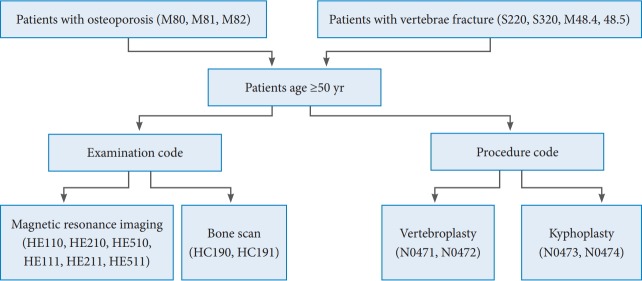
Methods: A nationwide database (2012-2016) acquired from the Korean Health Insurance Review and Assessment Service was analyzed. International disease categories in the 10th revision of the International Statistical Classification of Diseases and Related Health Problems codes, medical procedure codes, and examination codes were used to identify and sort OVCF patients aged >50 years.
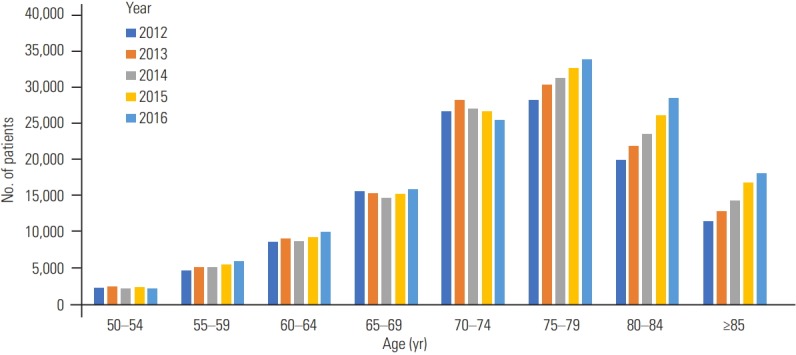
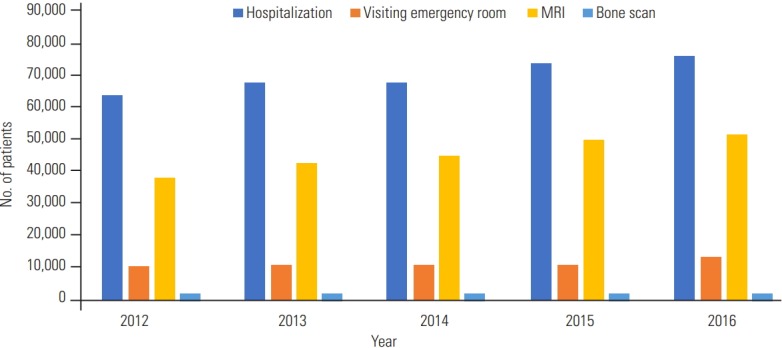
Results: There were 644,500 OVCF cases from 2012 to 2016. OVCF was most common in patients in their seventies (45%) and the number of patients increased from 117,361 in 2012 to 139,889 in 2016 (p <0.001). During 2012-2016, 8.9% of patients visited the emergency department; of those, 54.3% were hospitalized and 35% underwent magnetic resonance imaging. In OVCF treatment, bone cement augmentation rates increased from 23.4% in 2012 to 25.2% in 2016 (p <0.001), while conservative treatment rates slightly decreased from 76.5% in 2012 to 74.7% in 2016 (p <0.001). The total health insurance cost was $193,210,353.55 in 2012 and $281,968,877.65 in 2016.
Conclusions: The 5-year incidence of OVCF per 100,000 persons was 852.24 cases, and 45% of OVCF in South Korea occurred in patients in their seventies. The bone cement augmentation rate and total cost of OVCF are continuously increasing.
Keywords: Compression fractures; Republic of Korea Copyright; Senile osteoporosis; Thoracolumbar spine; Trends.
Conflict of interest statement
No potential conflict of interest relevant to this article was reported.
Figures
References
-
- Gallagher J, Riggs B, Eisman J. Diagnosis, prophylaxis, and treatment of osteoporosis. Am J Med. 1994;90:646–50.
-
- Kim SS, Lee DH, Kim JH, et al. Risk factors for subsequent vertebral compression fracture following osteoporotic compression fracture. J Korean Orthop Assoc. 2016;51:479–85.
-
- Ballane G, Cauley JA, Luckey MM, El-Hajj Fuleihan G. Worldwide prevalence and incidence of osteoporotic vertebral fractures. Osteoporos Int. 2017;28:1531–42. - PubMed
-
- Sakuma M, Endo N, Oinuma T, et al. Incidence of osteoporotic fractures in Sado, Japan in 2010. J Bone Miner Metab. 2014;32:200–5. - PubMed
-
- European Prospective Osteoporosis Study (EPOS) Group. Felsenberg D, Silman AJ, et al. Incidence of vertebral fracture in Europe: results from the European Prospective Osteoporosis Study (EPOS) J Bone Miner Res. 2002;17:716–24. - PubMed
LinkOut - more resources
Full Text Sources
Research Materials