Review
. 2020 Feb 5:726:144223.
doi: 10.1016/j.gene.2019.144223. Epub 2019 Oct 26.

The roles and regulation of TBX3 in development and disease

Affiliations
Review

The roles and regulation of TBX3 in development and disease

Saif F Khan et al. Gene. .

Abstract

TBX3, a member of the ancient and evolutionary conserved T-box transcription factor family, is a critical developmental regulator of several structures including the heart, mammary glands, limbs and lungs. Indeed, mutations in the human TBX3 lead to ulnar mammary syndrome which is characterized by several clinical malformations including hypoplasia of the mammary and apocrine glands, defects of the upper limb, areola, dental structures, heart and genitalia. In contrast, TBX3 has no known function in adult tissues but is frequently overexpressed in a wide range of epithelial and mesenchymal derived cancers. This overexpression greatly impacts several hallmarks of cancer including bypass of senescence, apoptosis and anoikis, promotion of proliferation, tumour formation, angiogenesis, invasion and metastatic capabilities as well as cancer stem cell expansion. The debilitating consequences of having too little or too much TBX3 suggest that its expression levels need to be tightly regulated. While we have a reasonable understanding of the mutations that result in low levels of functional TBX3 during development, very little is known about the factors responsible for the overexpression of TBX3 in cancer. Furthermore, given the plethora of oncogenic processes that TBX3 impacts, it must be regulating several target genes but to date only a few have been identified and characterised. Interestingly, while there is compelling evidence to support oncogenic roles for TBX3, a few studies have indicated that it may also have tumour suppressor functions in certain contexts. Together, the diverse functional elasticity of TBX3 in development and cancer is thought to involve, in part, the protein partners that it interacts with and this area of research has recently received some attention. This review provides an insight into the significance of TBX3 in development and cancer and identifies research gaps that need to be explored to shed more light on this transcription factor.

Keywords: Cancer; Co-factors; Heart development; Limb development; Lung development; Mammary gland development; Obesity; Rheumatoid arthritis; Signalling; Stem cells; T-box factors; TBX3; Target genes; Transcription factor; Ulnar mammary syndrome.


Conflict of interest statement

Declaration of Competing Interest

The authors declare that they have no known competing financial interests or personal relationships that could have appeared to influence the work reported in this paper.

Figures
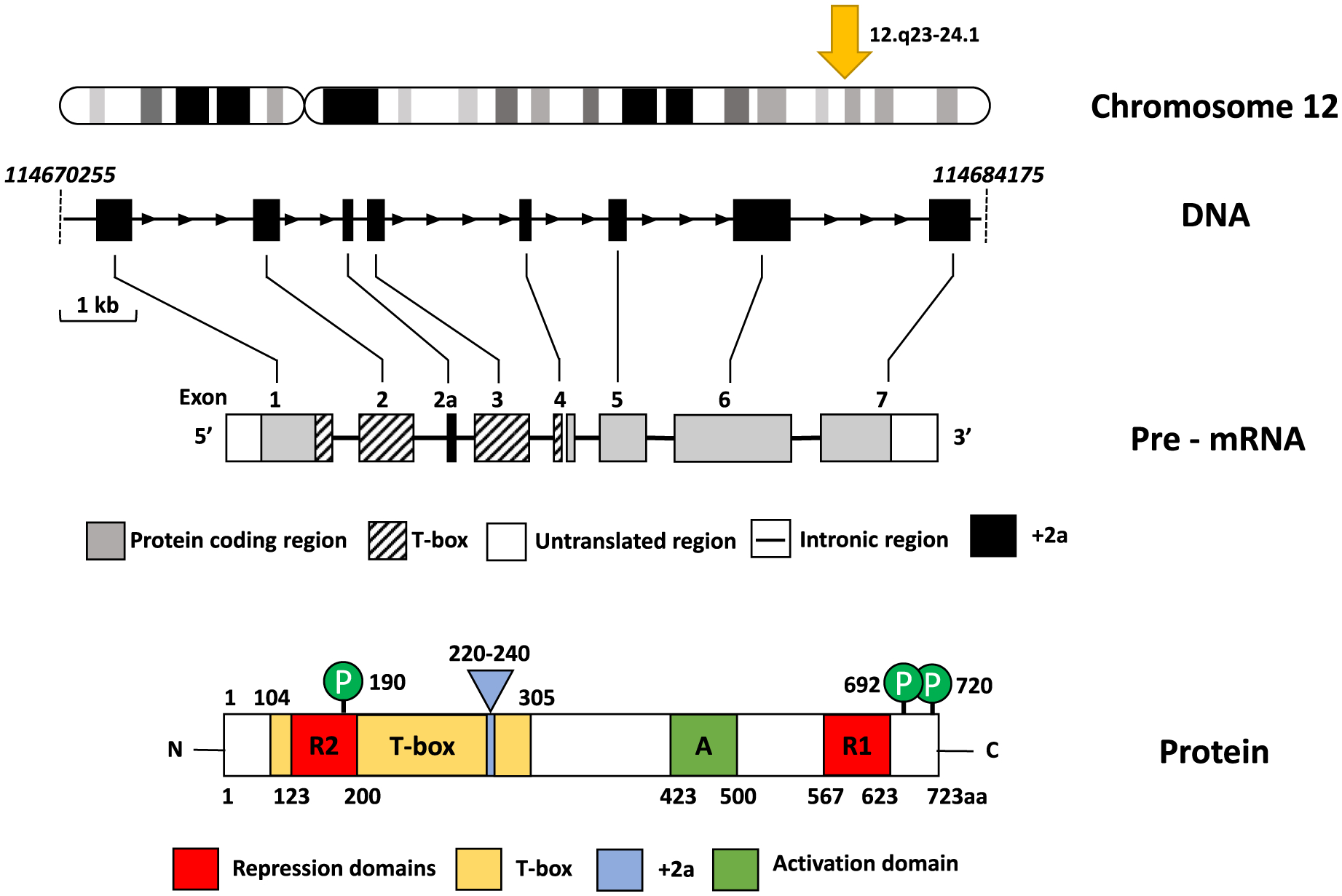
Fig. 1.
Fig. 1.
Schematic representation of the human TBX3 gene, pre-mRNA and protein structure. The location of TBX3 on chromosome 12 is depicted with the yellow arrow. The 4.7 kb DNA region is shown with coding regions (exons 1–7) represented by black boxes and the horizontal arrows indicate the direction of transcription. Representative size of region is depicted by thin bracketed horizontal line segment beneath the gene. The exons are linked to the pre-mRNA region depicting relative size, position of exons and the +2a splice variant of TBX3. The diagram depicting the TBX3 protein shows the DNA binding domain (T-box, yellow boxes), two repression domains (R1 and R2, red boxes), activation domain (A, green box) and the +2a splice variant (blue box). The amino acid residue number is displayed below each box and green circles above the protein diagram correspond to phosphorylation sites (adapted from Willmer et al, 2017).
Fig. 2.
Fig. 2.
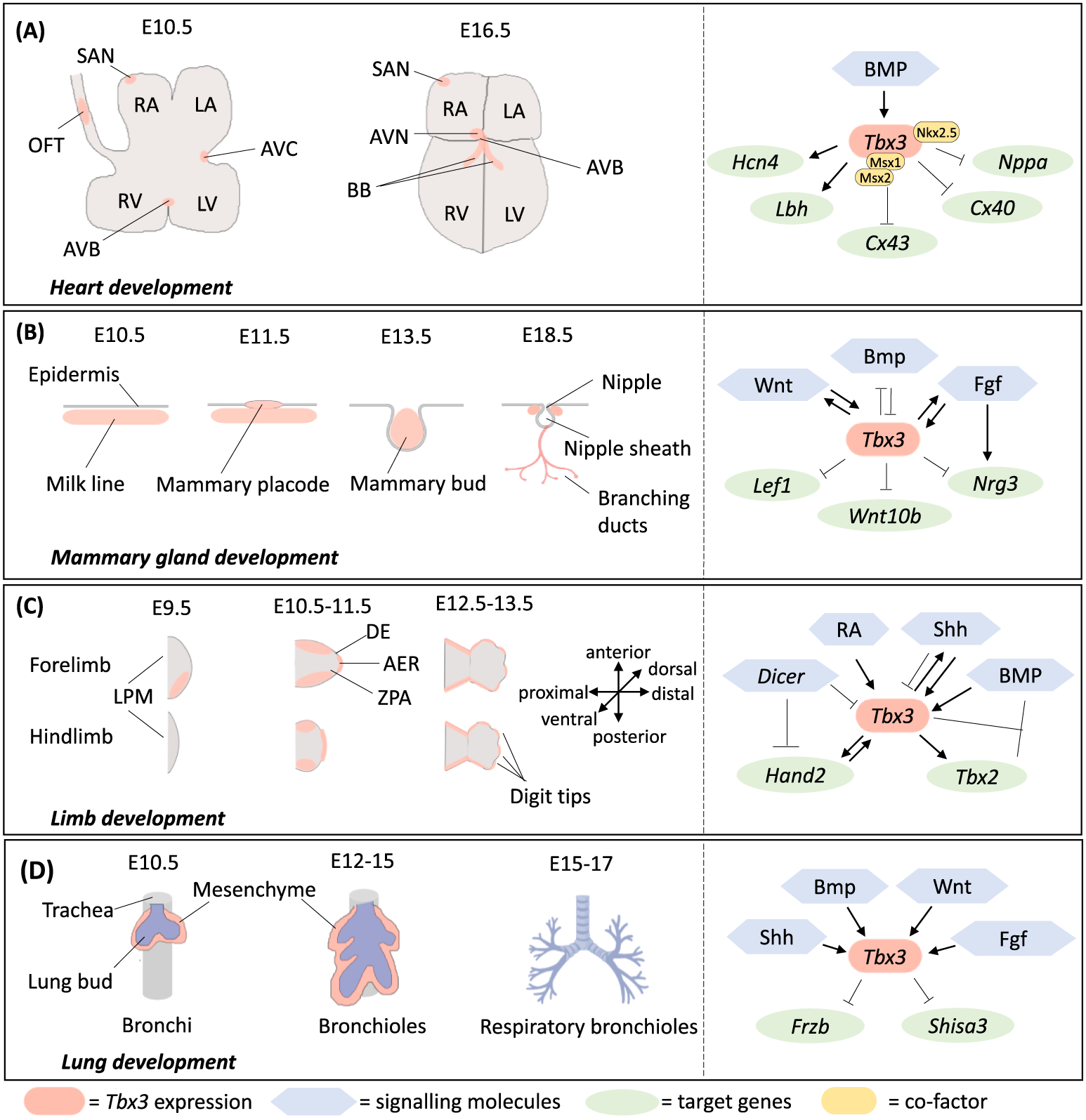
Left panels: Expression of Tbx3 (red) during the development of the mouse (A) heart, (B) mammary gland, (C) limb and (D) lung. (A) At E10.5, Tbx3 is expressed in the SAN, OFT, AVB and AVC, whereas at E16.5 the topography of Tbx3 expression delineates the CCS with expression in the SAN, AVN, AVB and BB. (B) Tbx3 first appears in the mesenchymal milk line at E10.5 and is then expressed in the mammary placodes at E11.5. Tbx3 expression continues during mammary bud formation at E13.5 and the formation of the branching ductal system at E18.5. Furthermore, Tbx3 is expressed in the mesenchyme surrounding the nipples.(C) At E10.5, Tbx3 is expressed in the posterior and anterior margins of the fore and hindlimb buds, as well as the AER. By E12.5, Tbx3 expression is limited to the tips of the digits. (D) Tbx3 is expressed in the lung mesenchyme from E10.5 (embryonic stage) to E14.5 (late pseudoglandular stage). Some of the diagrams in this figure are adapted from Washkowitz et al. (2012) and permission was granted by the corresponding author Prof Virginia Papaioannou. Right panels (A)–(D): Signalling molecules and targets that modulate Tbx3 activity during the relevant developmental processes indicated on the left.
Fig. 3.
Fig. 3.
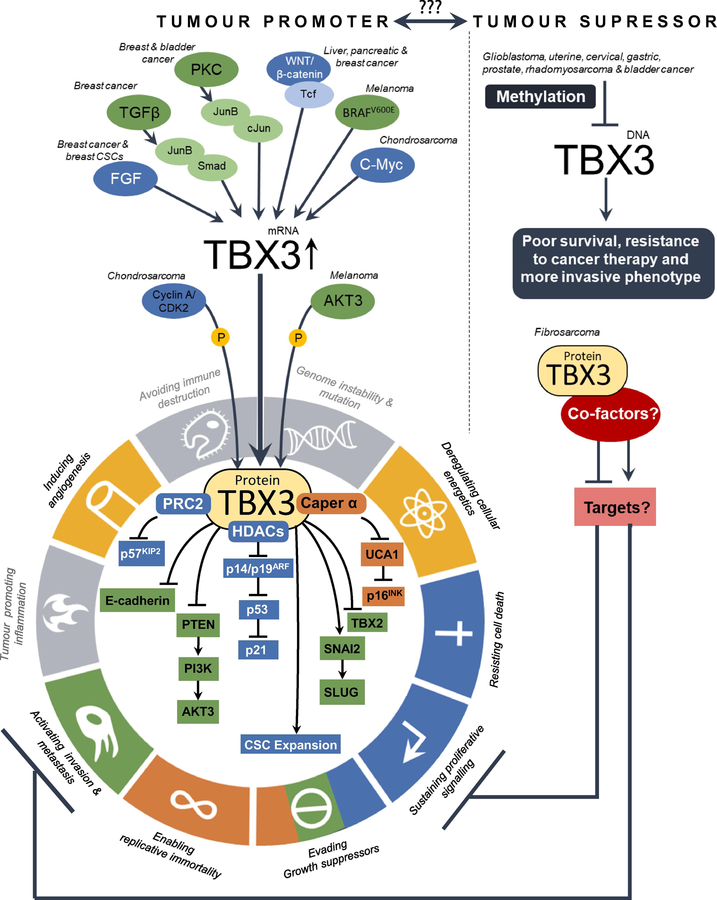
Summary of the regulation and roles of TBX3 in cancer. TBX3 is overexpressed in numerous cancers where it promotes several hallmarks of cancer as identified by Hanahan and Weinberg (2011) including (1) sustaining proliferative signalling; (2) evading growth suppressors; (3) resisting cell death; (4) enabling replicative immortality; (5) inducing angiogenesis; (6) activating invasion and metastasis and (7) deregulating cellular energetics. The key signalling molecules responsible for this overexpression and the co-factors and downstream targets that mediate the oncogenic functions of TBX3 are depicted in the figure adapted from Hanahan and Weinberg (2011) with colour coding that matches the appropriate hallmarks of cancer. Right panel: TBX3 also exhibits tumour suppressor activity. As indicated in this panel, it is silenced by methylation in certain cancers and it negatively impacts some hallmarks of cancer in fibrosarcoma and rhabdomyosarcoma. The factors that upregulate TBX3 in fibrosarcoma as well as the co-factors and target genes that mediate the tumour suppressor functions of TBX3 are yet to be elucidated.
Fig. 4.
Fig. 4.
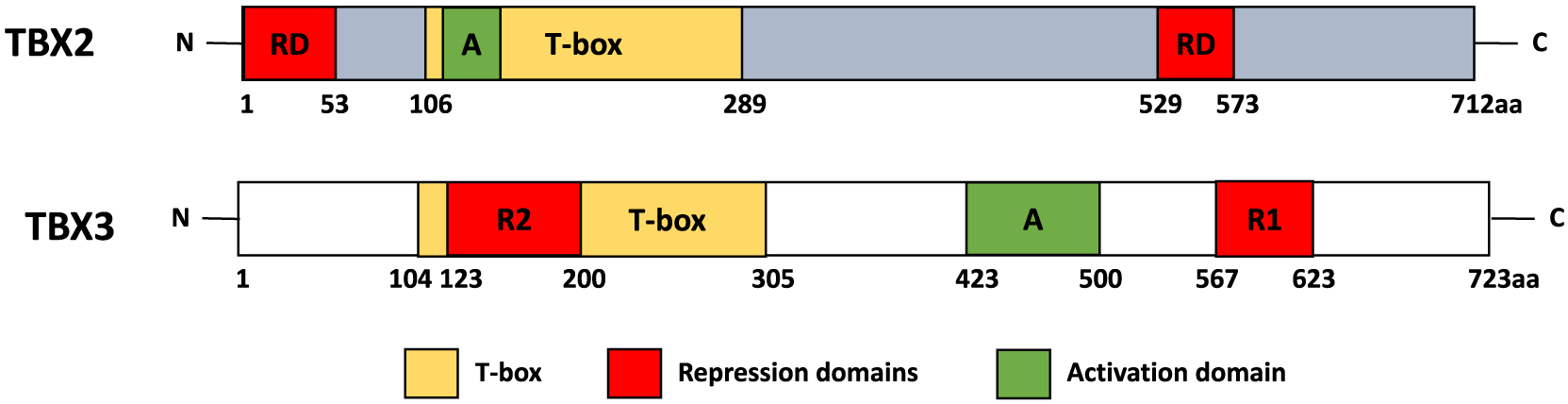
Diagrams depict the structural organisation of the human TBX2 and TBX3 proteins. The DNA binding domains (T-box, yellow boxes), repression domain (R1, R2 and RD, red boxes) and activation domains (A, green boxes) are shown and the amino acid residue number is displayed below each box.

References

    1. Andersson ER, Sandberg R, Lendahl U, 2011. Notch signaling: simplicity in design, versatility in function. Development 138, 3593–3612. 10.1242/dev.063610. - DOI - PubMed
    1. Andl T, Reddy ST, Gaddapara T, Millar SE, 2002. WNT signals are required for the initiation of hair follicle development. Dev. Cell 2, 643–653. 10.1016/S1534-5807(02)00167-3. - DOI - PubMed
    1. Bakker ML, Boukens BJ, Mommersteeg MTM, Brons JF, Wakker V, Moorman AFM, Christoffels VM, 2008. Transcription factor Tbx3 is required for the specification of the atrioventricular conduction system. Circ. Res 102, 1340–1349. 10.1161/CIRCRESAHA.107.169565. - DOI - PubMed
    1. Bakker ML, Boink GJJ, Boukens BJ, Verkerk AO, van den Boogaard M, den Haan AD, Hoogaars WMH, Buermans HP, de Bakker JMT, Seppen J, Tan HL, Moorman AFM, ť Hoen PAC, Christoffels VM, 2012. T-box transcription factor TBX3 reprogrammes mature cardiac myocytes into pacemaker-like cells. Cardiovasc. Res 94, 439–449. 10.1093/cvr/cvs120. - DOI - PubMed
    1. Ballim RD, Mendelsohn C, Papaioannou VE, Prince S, 2012. The ulnar-mammary syndrome gene, Tbx3, is a direct target of the retinoic acid signaling pathway, which regulates its expression during mouse limb development. Mol. Biol. Cell 23, 2362–2372. 10.1091/mbc.e11-09-0790. - DOI - PMC - PubMed

MeSH terms

Substances

LinkOut - more resources