Review
. 2019 Dec 1;142(12):3672-3693.
doi: 10.1093/brain/awz286.

Chronic traumatic encephalopathy neuropathology might not be inexorably progressive or unique to repetitive neurotrauma

Affiliations
Review

Chronic traumatic encephalopathy neuropathology might not be inexorably progressive or unique to repetitive neurotrauma

Grant L Iverson et al. Brain. .

Abstract

In the 20th century, chronic traumatic encephalopathy (CTE) was conceptualized as a neurological disorder affecting some active and retired boxers who had tremendous exposure to neurotrauma. In recent years, the two research groups in the USA who have led the field have asserted definitively that CTE is a delayed-onset and progressive neurodegenerative disease, with symptoms appearing in midlife or decades after exposure. Between 2005 and 2012 autopsy cases of former boxers and American football players described neuropathology attributed to CTE that was broad and diverse. This pathology, resulting from multiple causes, was aggregated and referred to, in toto, as the pathology 'characteristic' of CTE. Preliminary consensus criteria for defining the neuropathology of CTE were forged in 2015 and published in 2016. Most of the macroscopic and microscopic neuropathological findings described as characteristic of CTE, in studies published before 2016, were not included in the new criteria for defining the pathology. In the past few years, there has been steadily emerging evidence that the neuropathology described as unique to CTE may not be unique. CTE pathology has been described in individuals with no known participation in collision or contact sports and no known exposure to repetitive neurotrauma. This pathology has been reported in individuals with substance abuse, temporal lobe epilepsy, amyotrophic lateral sclerosis, multiple system atrophy, and other neurodegenerative diseases. Moreover, throughout history, some clinical cases have been described as not being progressive, and there is now evidence that CTE neuropathology might not be progressive in some individuals. Considering the current state of knowledge, including the absence of a series of validated sensitive and specific biomarkers, CTE pathology might not be inexorably progressive or specific to those who have experienced repetitive neurotrauma.

Keywords: concussion; hyperphosphorylated tau; mild TBI; neurodegenerative disease; sports.


Figures

Figure 1
Figure 1
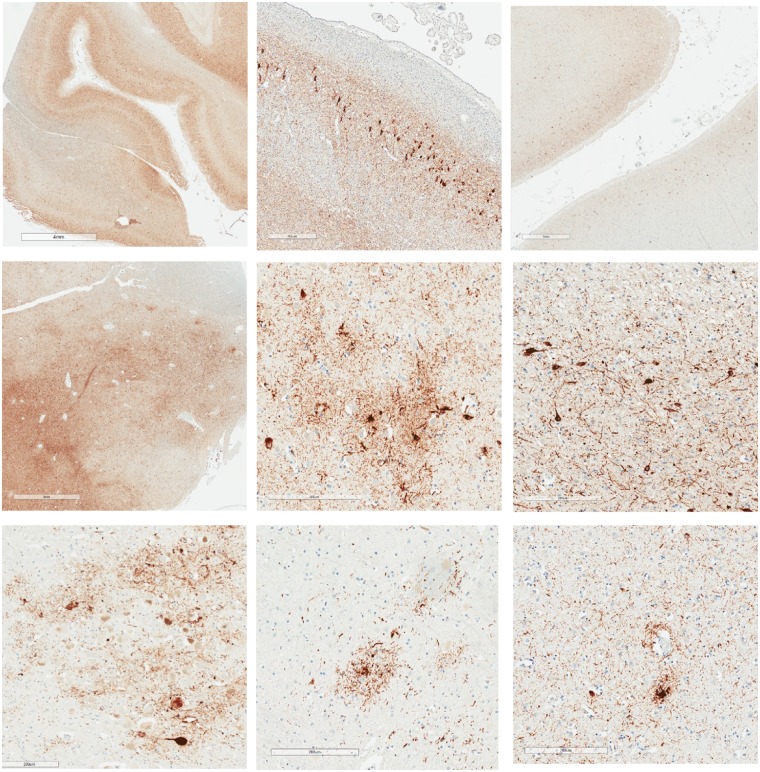
P-tau accumulates with ageing and in neurodegenerative diseases in diverse brain regions including depths of cortical sulci, in hippocampus, amygdala, mammillary bodies, thalamus, locus coeruleus, raphe nucleus, and around small blood vessels. Images of p-tau accumulations from three males with no known history of TBI, repetitive neurotrauma, or participation in contact or collision sports (Iverson et al., 2019) (Cases 2, 3, and 5). Case 2 was an 82-year-old male who was not reported to be cognitively impaired at the time of death. He might have had mental health problems at some point during later adulthood, although this was not clearly documented. His cause of death was aortic valve stenosis. His APOE genotype was ε4-3. This case was rated as Braak NFT stage V, Thal amyloid-β phase 3-4, with moderate CERAD neuritic plaques, and NIA-AA designation A3B3C2. Case 3 was an 80-year-old male who was not reported to be cognitively impaired at the time of death. His cause of death was cardiomyopathy. His APOE genotype was ε3-3. This case was rated as Braak NFT stage IV, Thal amyloid-β phase 0, with no CERAD neuritic plaques, and NIA-AA Designation A0B2C0. PART and ARTAG pathology were present. Case 5 was a 73-year-old male who was not reported to be cognitively impaired at the time of death. His cause of death was cardiomyopathy. His APOE genotype was ε3-3. This case was rated as Braak NFT stage IV, Thal amyloid-β phase 1, with sparse CERAD neuritic plaques, and NIA-AA designation A1B2C1. PART and ARTAG pathology were present. Top row: Left = extensive, diffusely distributed p-tau with NFT at low magnification (illustrating uniform involvement of neocortex including sulcal depths that occurs with ageing and with Alzheimer’s disease; scale bar = 4 mm; Case 5, age = 73); middle = CA-2 region of Ammon’s horn with extensive p-tau including NFTs (scale bar = 400 µm; Case 2, age = 82); right = low magnification showing extensive p-tau including NFTs with preferential involvement of neocortical layers 2 and 3 (scale bar = 1 mm; Case 5, age = 73). Middle row: Left = abundant p-tau in amygdala at low magnification (scale bar = 3 mm; Case 5, age = 73); middle = irregularly distributed p-tau involving neurons and astrocytes in amygdala (scale bar = 200 µm; Case 3, age = 80); right = extensive p-tau with NFT involving the mamillary body (scale bar = 200 µm; Case 5, age = 73). Bottom row: Left = p-tau involving the locus coeruleus (scale bar = 200 µm; Case 3, age = 80); middle = p-tau involving the pontine raphe nucleus (scale bar = 200 µm; Case 3, age = 80); right = p-tau within cell processes near a small blood vessel (scale bar = 200 µm; Case 2, age = 82).

References

    1. Agoston D, Arun P, Bellgowan P, Broglio S, Cantu R, Cook D, et al.Military blast injury and chronic neurodegeneration: research presentations from the 2015 International State-of-the-Science Meeting. J Neurotrauma 2017; 34: S6–17. - PMC - PubMed
    1. Aldag M, Armstrong RC, Bandak F, Bellgowan PSF, Bentley T, Biggerstaff S, et al.The biological basis of chronic traumatic encephalopathy following blast injury: a literature review. J Neurotrauma 2017; 34: S26–43. - PMC - PubMed
    1. Alonso AD, Cohen LS, Corbo C, Morozova V, ElIdrissi A, Phillips G, et al.Hyperphosphorylation of tau associates with changes in its function beyond microtubule stability. Front Cell Neurosci 2018; 12: 338. - PMC - PubMed
    1. American Psychiatric Association. Diagnostic and statistical manual of mental disorders. 4th edn. Washington, DC: American Psychiatric Association; 2000.
    1. American Psychiatric Association. Diagnostic and statistical manual of mental disorders. 5th edn. Arlington, VA: American Psychiatric Publishing; 2013.

MeSH terms