. 2019 Oct 31;14(10):e0223688.
doi: 10.1371/journal.pone.0223688. eCollection 2019.

Elucidating optical field directed hierarchical self-assembly of homogenous versus heterogeneous nanoclusters with femtosecond optical tweezers

Affiliations

Elucidating optical field directed hierarchical self-assembly of homogenous versus heterogeneous nanoclusters with femtosecond optical tweezers

Dipankar Mondal et al. PLoS One. .

Abstract

Insights into the morphology of nanoclusters would facilitate the design of nano-devices with improved optical, electrical, and magnetic responses. We have utilized optical gradient forces for the directed self-assembly of colloidal clusters using high-repetition-rate femtosecond laser pulses to delineate their structure and dynamics. We have ratified our experiments with theoretical models derived from the Langevin equation and defined the valid ranges of applicability. Our femtosecond optical tweezer-based technique characterizes the in-situ formation of hierarchical self-assembled clusters of homomers as well as heteromers by analyzing the back focal plane displacement signal. This technique is able to efficiently distinguish between nano-particles in heterogeneous clusters and is in accordance with our theory. Herein, we report results from our technique, and also develop a model to describe the mechanism of such processes where corner frequency changes. We show how the corner frequency changes enables us to recognize the structure and dynamics of the coagulation of colloidal homogeneous and heterogeneous clusters in condensed media over a broad range of nanoparticle sizes. The methods described here are advantageous, as the backscatter position-sensitive detection probes the in-situ self-assembly process while other light scattering approaches are leveraged for the characterization of isolated clusters.


Conflict of interest statement

The authors have declared that no competing interests exist.

Figures

Fig 1
Fig 1. Schematic diagram of our experimental femtosecond optical tweezers setup.
WP: Half-wave plate; PBS: Polarizing beam splitter; L1: Concave lens; L2: collimating convex lens; DM: Dichroic mirror; O: Objective lens; SS: Sample stage; C: Condenser lens; GF: Green filter; L3: Focusing lens; QPD: Quadrant photodiode; SM: Silver mirror; RF: Red filter; CCD: Camera (Charge-coupled device) PC: personal computer.
Fig 2
Fig 2. Size distribution of the polystyrene beads measured by Dynamics light scattering.
Fig 3
Fig 3. Typical raw data (at 17.5 mW average laser power) and its corresponding fitted data for a reversible dimer formation event in the sequence.
(a) Experimentally measured trapped bead displacement raw data showing different regions of trapping event. (b) Light null spectrum: Power spectrum when no microsphere is trapped but trapping light imposing onto QPD. (c) Power spectrum of the region 3 from the raw data (green square) and its Lorentzian fitting (orange line) gives fC = 111 Hz for a single trapped particle. (d) The power spectrum of region 4 of the raw data (olive square) and its Lorentzian fitting (blue line) gives fC = 70 Hz corresponding to the dimer. (e) Power spectrum of mark 5 of the raw data (green square) and its Lorentzian fitting (orange line) gives fC = 107 Hz. (f) Power spectrum showing the power spectrum of region 3, 4 and 5 altogether for comparison purpose.
Fig 4
Fig 4
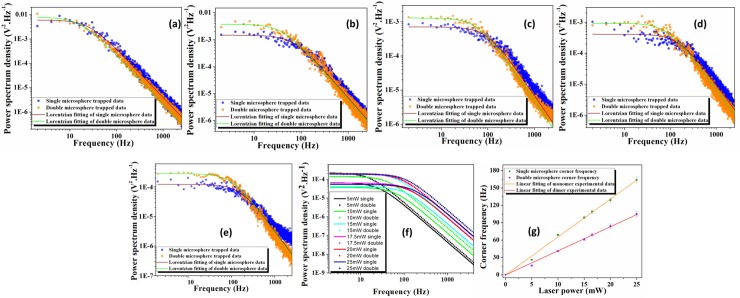
Experiments, fits and comparisons (a-e) The experimentally measured one-sided power spectrum (blue sold circle for single microsphere and orange sold circle for double microsphere) and the respective Lorentzian fit to data (brown line for single microsphere and green line for double microsphere) for 500 nm radius fluorophore coated polystyrene bead at increasing laser powers. (f) The experimentally measured all fitted one-sided power spectrum of 500 nm radius polystyrene beads merged in a same plot (g) The comparison between single and double polystyrene microsphere.
Fig 5
Fig 5
Power spectrum and corner frequency: (a) The experimentally measured fitted one-sided power spectrum of 250 nm radius polystyrene beads under varying gradient fields, and (b) power dependent corner frequency of monomer, dimer and trimer of 250 nm radius trapped bed.
Fig 6
Fig 6
The experimentally measured data depicting (a) the fitted one-sided power spectrum of 100 nm radius polystyrene beads under different gradient field and (b) power dependent corner frequency of monomer and dimer of 100 nm radius trapped bed.
Fig 7
Fig 7
The experimentally measured one-sided power spectrum of monomers and heterodimers of (a) 500 nm and 250 nm radius polystyrene beads under different gradient fields (b) power dependent corner frequency of monomer and dimer of 250 nm and 500 nm radius heterodimer trapped bead.

References

    1. Stradner A, Sedgwick H, Cardinaux F, Poon WCK, Egelhaaf SU, Schurtenberger P. Equilibrium Cluster Formation in Concentrated Protein Solutions and Colloids. Nature. 2004; 432(7016):492–495. 10.1038/nature03109 - DOI - PubMed
    1. Camazine S, Deneubourg JL, Franks NR, Sneyd J, Bonabeau E, Theraula G. Self-Organization in Biological Systems. Princeton University Press; 2003.
    1. Schilling T, Scho¨pe HJ, Oettel M, Opletal G, Snook I. Precursor-Mediated Crystallization Process in Suspensions of Hard Spheres. Phys Rev Lett. 2010; 105(2):025701 10.1103/PhysRevLett.105.025701 - DOI - PubMed
    1. Morris AM, Watzky MA, Finke RG. Protein Aggregation Kinetics, Mechanism, and Curve-Fitting: A Review of the Literature. Biochimica et Biophysica Acta (BBA)—Proteins and Proteomics. 2009; 1794(3):375–397. doi: 10/djk6mq - PubMed
    1. van Aalten DM, Conn DA, de Groot BL, Berendsen HJ, Findlay JB, Amadei A.Protein Dynamics Derived from Clusters of Crystal Structures. Biophysical Journal. 1997; 73(6):2891–2896. 10.1016/S0006-3495(97)78317-6 - DOI - PMC - PubMed

Publication types