. 2019 Oct 29;8(11):531.
doi: 10.3390/foods8110531.

Integrated Process for Sequential Extraction of Bioactive Phenolic Compounds and Proteins from Mill and Field Olive Leaves and Effects on the Lignocellulosic Profile

Affiliations

Integrated Process for Sequential Extraction of Bioactive Phenolic Compounds and Proteins from Mill and Field Olive Leaves and Effects on the Lignocellulosic Profile

María Del Mar Contreras et al. Foods. .

Abstract

The extraction of bioactive compounds in a biorefinery context could be a way to valorize agri-food byproducts, but there is a remaining part that also requires attention. Therefore, in this work the integrated extraction of phenolic compounds, including the bioactive oleuropein, and proteins from olive mill leaves was addressed following three schemes, including the use of ultrasound. This affected the total phenolic content (4475.5-6166.9 mg gallic acid equivalents/100 g), oleuropein content (675.3-1790.0 mg/100 g), and antioxidant activity (18,234.3-25,459.0 µmol trolox equivalents/100 g). No effect was observed on either the protein recovery or the content of sugars and lignin in the extraction residues. Concerning the recovery of proteins, three operational parameters were evaluated by response surface methodology. The optimum (63.1%) was achieved using NaOH 0.7 M at 100 °C for 240 min. Then, the selected scheme was applied to olive leaves from the field, observing differences in the content of some of the studied components. It also changed the lignocellulosic profile of the extraction residues of both leaf types, which were enriched in cellulose. Overall, these results could be useful to diversify the valorization chain in the olive sector.

Keywords: bioactive compounds; biorefinery; oleuropein; olive leaves; phenolic compounds; ultrasound; vegetable protein.


Conflict of interest statement

The authors declare no conflict of interest.

Figures
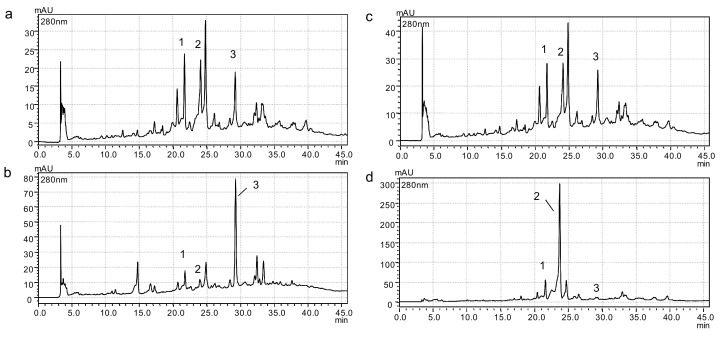
Figure 1
Figure 1
Chromatograms (280 nm) of ethanol extracts obtained by: (a) maceration of olive mill leaves (OML) before protein extraction (Scheme 1), (b) ultrasound-assisted extraction of OML after protein extraction (Scheme 2), (c) ultrasound-assisted extraction of OML before protein extraction (Scheme 3), and (d) ultrasound-assisted extraction of olive leaves before protein extraction (Scheme 3). (1) Luteolin 7-O-glucoside, (2) oleuropein, and (3) luteolin.
Figure 2
Figure 2
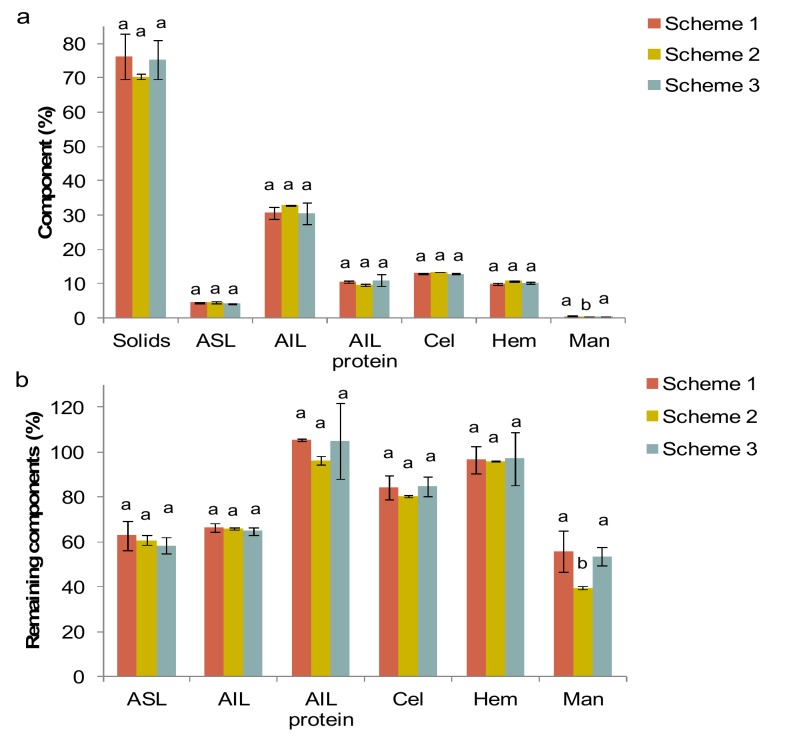
(a) Yield of solids (%) and content (%) of acid-soluble lignin (ASL), acid-insoluble lignin (AIL), protein in AIL, cellulose (Cel), hemicellulose (Hem), and mannitol (Man) in the remaining fraction from olive mill leaves (OML) after extraction using Schemes 1–3. (b) Corresponding recovery values (%) with respect to the initial amounts in OML.
Figure 3
Figure 3
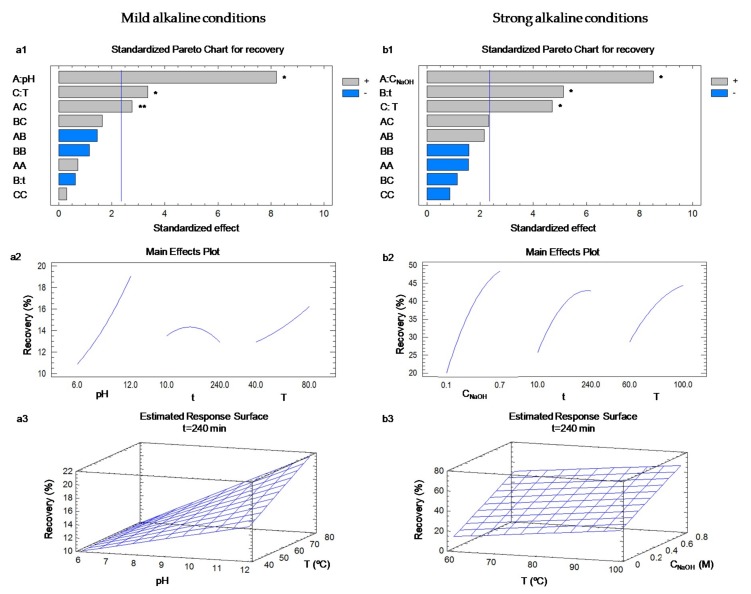
Pareto charts indicating the weight of each factor on the protein recovery and corresponding main effects plots using (a1 and a2, respectively) mild and (b1 and b2, respectively) strong alkaline conditions. The surface plots are represented take into account the significant factors: (a3) mild and (b3) strong alkaline conditions. CNaOH, NaOH concentration; T, temperature; t, extraction time. * Significant at p-value < 0.05; ** significant at p-value < 0.1.
Figure 4
Figure 4
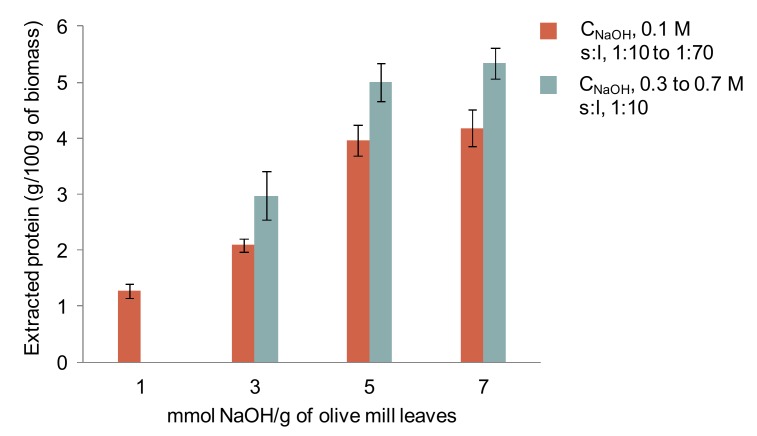
Amount of protein extracted using different ratio of alkali to solid, which was obtained using different NaOH concentration (CNaOH) and solid-to-liquid ratio (s:l) values.
Figure 5
Figure 5
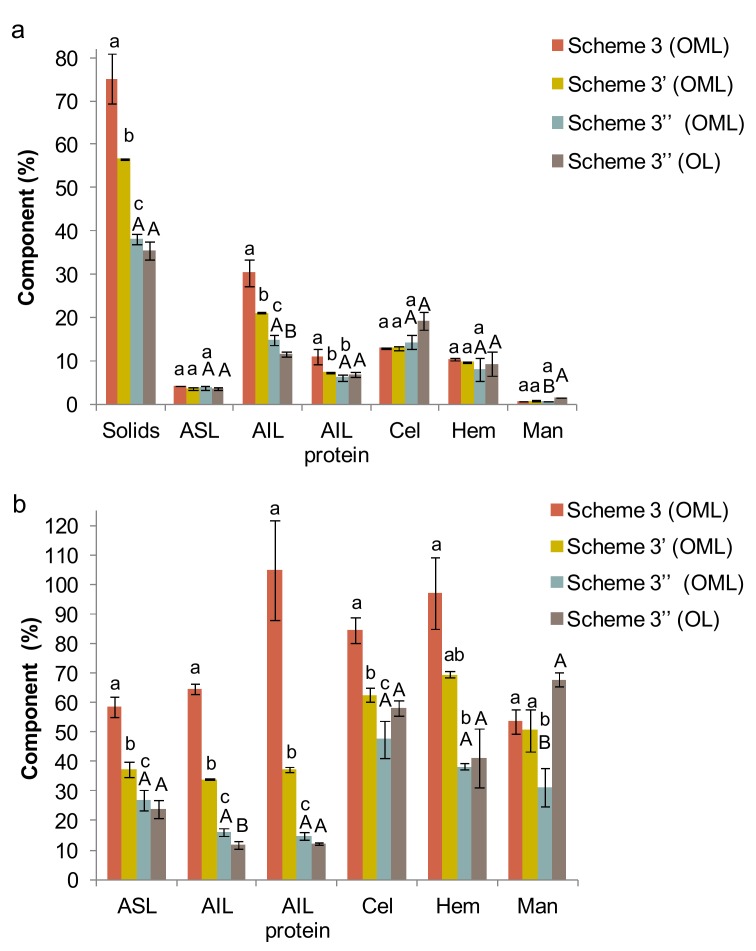
(a) Yield of solids (%) and content (%) of acid-soluble lignin (ASL), acid-insoluble lignin (AIL), protein in AIL, cellulose (Cel) and hemicellulose (Hem) and mannitol (Man) in the remaining fraction from olive mill leaves (OML) and olive leaves (OL) after phenolic extraction followed by alkaline extraction using NaOH 0.03 M, 60 °C, 125 min (Scheme 3), NaOH 0.4 M, 80 °C, 4 h (Scheme 3′), and NaOH 0.7 M, 100 °C, 4 h (Scheme 3′′, optimum conditions). (b) Corresponding recovery values (%) with respect to the initial amounts in both byproducts.

References

    1. FAOSTAT. [(accessed on 13 February 2019)]; Available online: http://www.fao.org/faostat/en/#data.
    1. Gullón B., Gullón P., Eibes G., Cara C., De Torres A., López-Linares J.C., Ruiz E., Castro E. Valorisation of olive agro-industrial by-products as a source of bioactive compounds. Sci. Total Environ. 2018;645:533–542. doi: 10.1016/j.scitotenv.2018.07.155. - DOI - PubMed
    1. Romero-García J.M., Niño L., Martínez-Patiño C., Álvarez C., Castro E., Negro M.J. Biorefinery based on olive biomass. State of the art and future trends. Bioresour. Technol. 2014;159:421–432. doi: 10.1016/j.biortech.2014.03.062. - DOI - PubMed
    1. Romero-García J.M., Lama-Muñoz A., Rodríguez-Gutiérrez G., Moya M., Ruiz E., Fernández-Bolaños J., Castro E. Obtaining sugars and natural antioxidants from olive leaves by steam-explosion. Food Chem. 2016;210:457–465. doi: 10.1016/j.foodchem.2016.05.003. - DOI - PubMed
    1. Talhaoui N., Taamalli A., Gómez-Caravaca A.M., Fernández-Gutiérrez A., Segura-Carretero A. Phenolic compounds in olive leaves: Analytical determination, biotic and abiotic influence, and health benefits. Food Res. Int. 2015;77:92–108. doi: 10.1016/j.foodres.2015.09.011. - DOI

LinkOut - more resources