. 2020 Jan;101(1):96-104.
doi: 10.1099/jgv.0.001344.

Agua Salud alphavirus defines a novel lineage of insect-specific alphaviruses discovered in the New World

Affiliations

Agua Salud alphavirus defines a novel lineage of insect-specific alphaviruses discovered in the New World

Kyra Hermanns et al. J Gen Virol. 2020 Jan.

Abstract

The genus Alphavirus harbours mostly insect-transmitted viruses that cause severe disease in humans, livestock and wildlife. Thus far, only three alphaviruses with a host range restricted to insects have been found in mosquitoes from the Old World, namely Eilat virus (EILV), Taï Forest alphavirus (TALV) and Mwinilunga alphavirus (MWAV). In this study, we found a novel alphavirus in one Culex declarator mosquito sampled in Panama. The virus was isolated in C6/36 mosquito cells, and full genome sequencing revealed an 11 468 nt long genome with maximum pairwise nucleotide identity of 62.7 % to Sindbis virus. Phylogenetic analyses placed the virus as a solitary deep rooting lineage in a basal relationship to the Western equine encephalitis antigenic complex and to the clade comprising EILV, TALV and MWAV, indicating the detection of a novel alphavirus, tentatively named Agua Salud alphavirus (ASALV). No growth of ASALV was detected in vertebrate cell lines, including cell lines derived from ectothermic animals, and replication of ASALV was strongly impaired above 31 °C, suggesting that ASALV represents the first insect-restricted alphavirus of the New World.

Keywords: insect-restricted alphavirus; mosquito; recombination; repeated sequence elements.


Conflict of interest statement

The authors declare that there are no conflicts of interest.

Figures
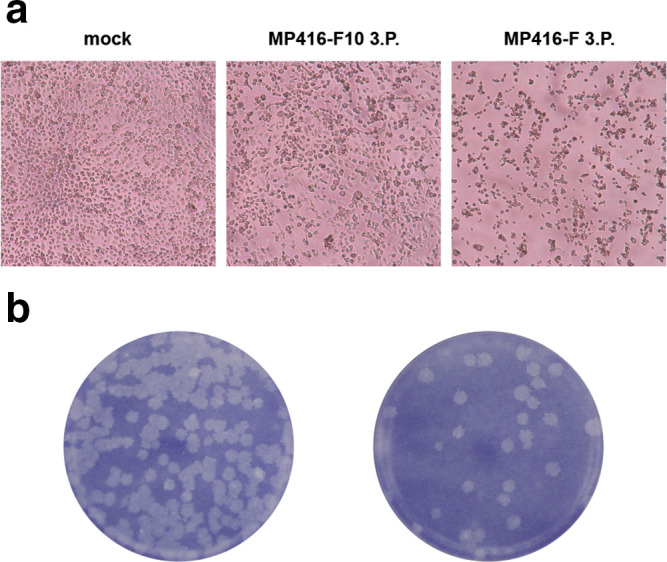
Fig. 1.
Fig. 1.
Virus isolation. (a) Photographs of mock-infected C6/36 cells and cells infected either with filtrated homogenate (MP416-F) or filtrated and 1 : 10 diluted homogenate (MP416-F10) 3 dpi. (b) Plaque morphology of the plaque-purified strain ASALV-PP in C6/36 cells 6 dpi.
Fig. 2.
Fig. 2.
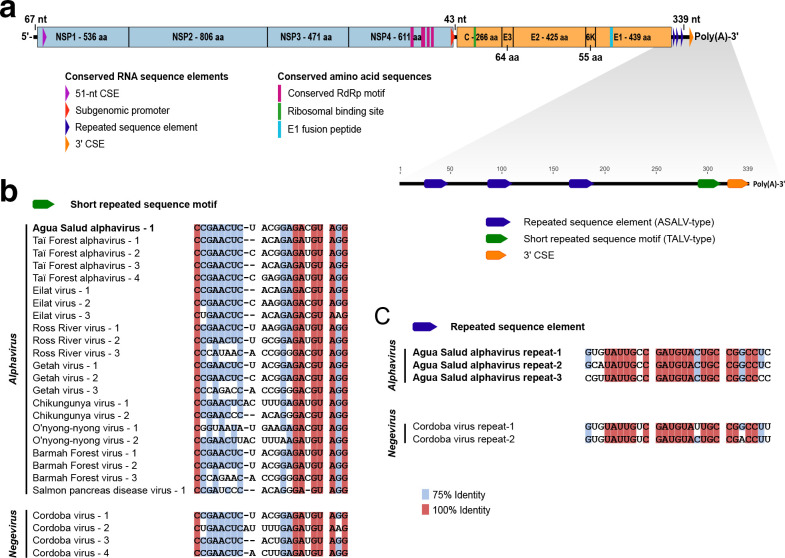
Genome analyses of ASALV. (a) Schematic illustration of the ASALV genome including motifs and CSEs. The ORFs are indicated in blue (NSP) and orange (SP). Amino acid length of the mature peptides and UTR nucleotide length are displayed. (b) MAFFT-E alignment of the SRS motif of ASALV, representative alphaviruses and Cordoba virus (NC_034156 – unclassified negevirus [25]). For GenBank accession numbers of the alphaviruses see Fig. 3. (c) MAFFT-E alignment of the RSE of ASALV and Cordoba virus.
Fig. 3.
Fig. 3.
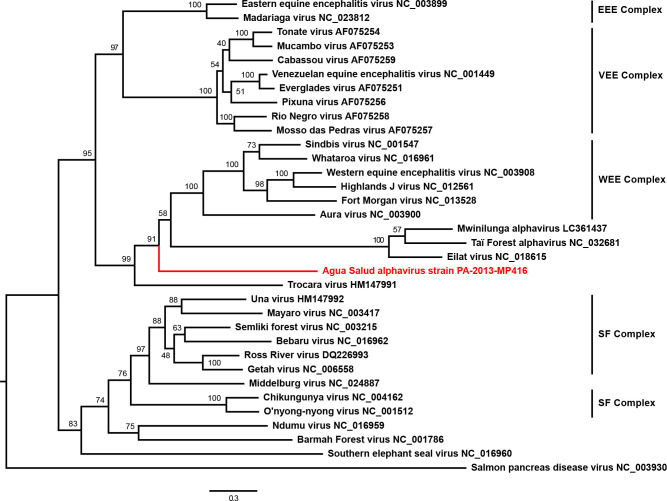
Phylogenetic relationship of ASALV. The phylogenetic tree was inferred based on a MAFFT-E translational alignment of the nucleotide sequences of the region of the structural protein ORF encoding the E2, 6K and E1 protein of all established alphavirus species, TALV, MWAV and ASALV strain PA-2013-MP416. An optimized maximum-likelihood phylogenetic tree with the GTR substitution model and 1000 bootstrap replicates was calculated using PhyML. The tree was rooted to the midpoint. GenBank accession numbers are shown next to the virus names. EEE, eastern equine encephalitis; VEE, Venezuelan equine encephalitis; WEE, western equine encephalitis; SF, Semliki Forest.
Fig. 4.
Fig. 4.
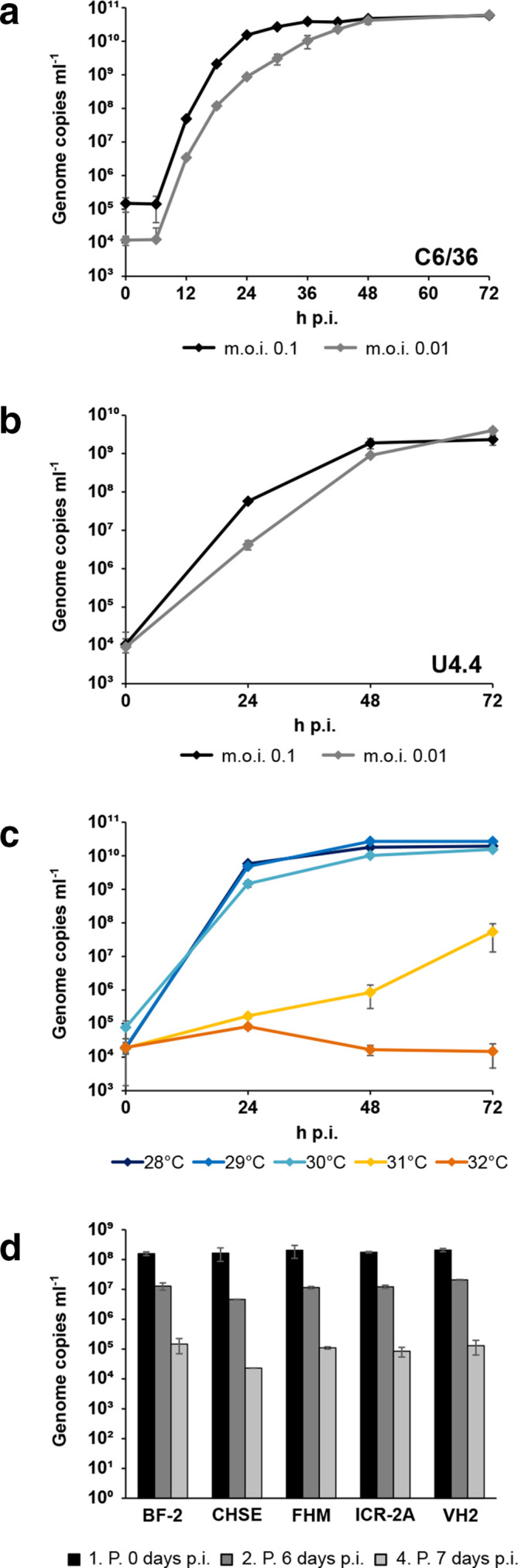
In vitro host range. (a) Growth kinetics of ASALV-PP in C6/36 cells. (b) Growth of ASALV-PP in U4.4 cells. (c) Temperature-dependent replication of ASALV-PP in C6/36 cells infected with an m.o.i. of 0.1. (d) Infection trials with ASALV-PP in cell lines from ectothermic animals with an m.o.i. of 1. Each data point represents the mean of duplicates with standard deviation.
Fig. 5.
Fig. 5.
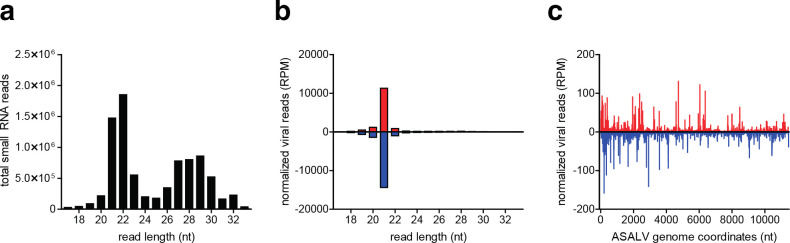
Small RNA responses targeting ASALV in U4.4 cells. (a) Total number of small RNA reads in libraries from ASALV-infected U4.4 cells. (b) Size distribution of ASALV-derived small RNAs mapping to the viral positive (red) or negative (blue) RNA strand. (c) Location of ASALV-derived 21 nt siRNAs across the genome. Small RNAs were mapped to the viral genome allowing one mismatch and normalized to library size (reads per million, RPM). The 5′ positions of viral siRNAs are plotted.

References

    1. Chen R, Mukhopadhyay S, Merits A, Bolling B, Nasar F, et al. ICTV virus taxonomy profile: Togaviridae . J Gen Virol. 2018 - PMC - PubMed
    1. Hermanns K, Zirkel F, Kopp A, Marklewitz M, Rwego IB, et al. Discovery of a novel alphavirus related to Eilat virus. J Gen Virol. 2017;98:43–49. doi: 10.1099/jgv.0.000694. - DOI - PubMed
    1. Torii S, Orba Y, Hang'ombe BM, Mweene AS, Wada Y, et al. Discovery of Mwinilunga alphavirus: a novel alphavirus in Culex mosquitoes in Zambia. Virus Res. 2018;250:31–36. doi: 10.1016/j.virusres.2018.04.005. - DOI - PubMed
    1. Chen W, Foo S-S, Sims NA, Herrero LJ, Walsh NC, et al. Arthritogenic alphaviruses: new insights into arthritis and bone pathology. Trends Microbiol. 2015;23:35–43. doi: 10.1016/j.tim.2014.09.005. - DOI - PubMed
    1. Zacks MA, Paessler S, alphaviruses E. Encephalitic alphaviruses. Vet Microbiol. 2010;140:281–286. doi: 10.1016/j.vetmic.2009.08.023. - DOI - PMC - PubMed

Publication types