. 2019 Nov 1;10(1):5002.
doi: 10.1038/s41467-019-12966-0.

Rapid mechanochemical encapsulation of biocatalysts into robust metal-organic frameworks

Affiliations

Rapid mechanochemical encapsulation of biocatalysts into robust metal-organic frameworks

Tz-Han Wei et al. Nat Commun. .

Abstract

Metal-organic frameworks (MOFs) have recently garnered consideration as an attractive solid substrate because the highly tunable MOF framework can not only serve as an inert host but also enhance the selectivity, stability, and/or activity of the enzymes. Herein, we demonstrate the advantages of using a mechanochemical strategy to encapsulate enzymes into robust MOFs. A range of enzymes, namely β-glucosidase, invertase, β-galactosidase, and catalase, are encapsulated in ZIF-8, UiO-66-NH2, or Zn-MOF-74 via a ball milling process. The solid-state mechanochemical strategy is rapid and minimizes the use of organic solvents and strong acids during synthesis, allowing the encapsulation of enzymes into three prototypical robust MOFs while maintaining enzymatic biological activity. The activity of encapsulated enzyme is demonstrated and shows increased resistance to proteases, even under acidic conditions. This work represents a step toward the creation of a suite of biomolecule-in-MOF composites for application in a variety of industrial processes.


Conflict of interest statement

The authors declare no competing interests.

Figures
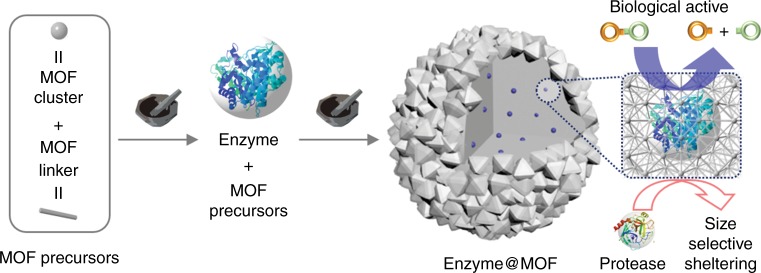
Fig. 1
Fig. 1
Schematic illustration of the mechanochemical method. The obtained biocomposites via the two-step approach for embedding glycosidases into MOF is shown, illustrating the biological activity and protective effect
Fig. 2
Fig. 2
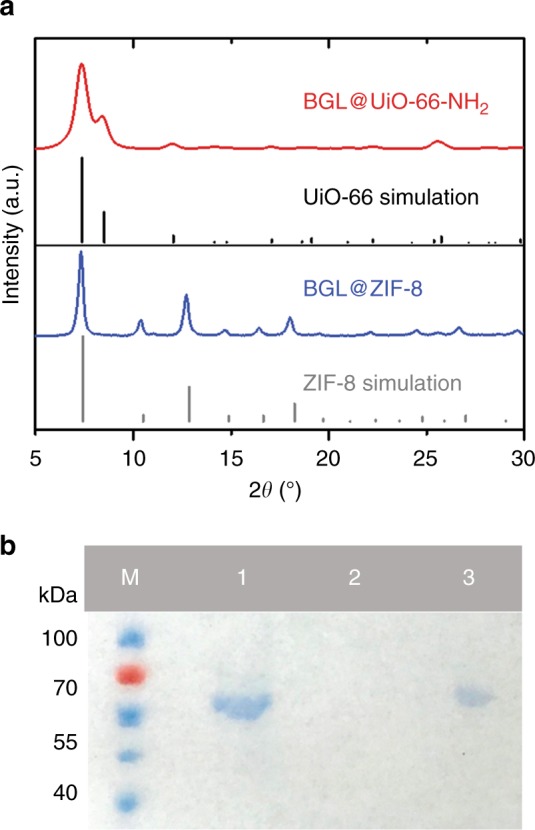
Characteristics of BGL@ZIF-8 and BGL@UiO-66-NH2. a PXRD patterns of BGL@UiO-66-NH2 (two-step approach) and BGL@ZIF-8 and simulations of UiO-66 and ZIF-8. b SDS–PAGE gel (M: protein marker, lane 1: free BGL, lane 2: washed BGL-on-UiO-66-NH2, and lane 3: BGL@UiO-66-NH2). Source data are provided as a Source Data file
Fig. 3
Fig. 3
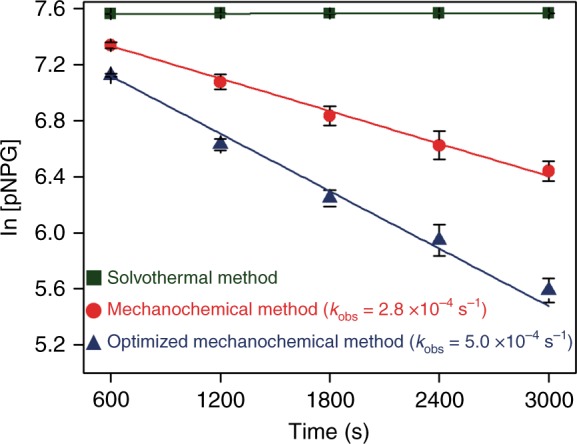
The biological activity of BGL@UiO-66-NH2. The biocomposites synthesized via the optimized two-step mechanochemical method (blue), one-step mechanochemical method (red), and solvothermal method (olive). Error bars are standard deviations (n = 3). Source data are provided as a Source Data file
Fig. 4
Fig. 4
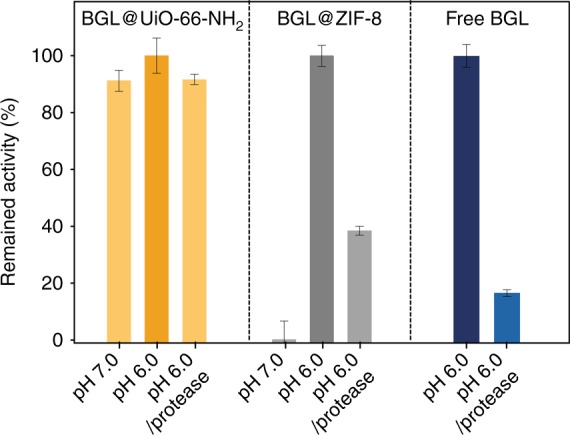
Biological activity of BGL@MOFs and free BGL. The BGL@UiO-66-NH2, BGL@ZIF-8, and free BGL at neutral conditions, acidic conditions, and acidic conditions with protease treatment. For the protease treatment, BGL@MOF samples were incubated with protease under acidic conditions for 2 h at 37 °C and then activity was characterized by assaying at the same temperature. The decomposition of ZIF-8 composites was observed at pH levels below 6.0. Error bars are standard deviations (n = 3), except for BGL@ZIF-8 at pH = 6.0 (n = 2). Source data are provided as a Source Data file
Fig. 5
Fig. 5
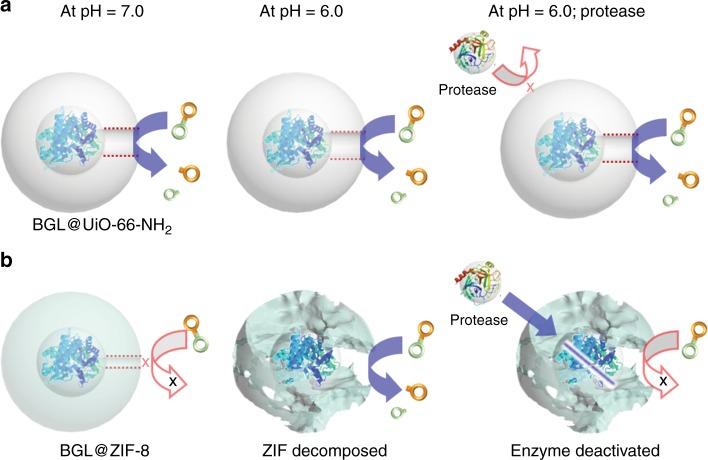
Schematic illustrations of the composite structure change. a BGL@UiO-66-NH2 and b BGL@ZIF-8 biocomposites are under different conditions

References

    1. Breslow R. Biomimetic chemistry and artificial enzymes: catalysis by design. Acc. Chem. Res. 1995;28:146–153. doi: 10.1021/ar00051a008. - DOI
    1. Wang H, et al. Biomimetic enzyme cascade reaction system in microfluidic electrospray microcapsules. Sci. Adv. 2018;4:eaat2816. doi: 10.1126/sciadv.aat2816. - DOI - PMC - PubMed
    1. Green JJ, Elisseeff JH. Mimicking biological functionality with polymers for biomedical applications. Nat. 2016;540:386. doi: 10.1038/nature21005. - DOI - PMC - PubMed
    1. Choi J-M, Han S-S, Kim H-S. Industrial applications of enzyme biocatalysis: current status and future aspects. Biotechnol. Adv. 2015;33:1443–1454. doi: 10.1016/j.biotechadv.2015.02.014. - DOI - PubMed
    1. Ariga K, et al. Enzyme nanoarchitectonics: organization and device application. Chem. Soc. Rev. 2013;42:6322–6345. doi: 10.1039/c2cs35475f. - DOI - PubMed

Publication types

MeSH terms