. 2019 Nov;51(11):1574-1579.
doi: 10.1038/s41588-019-0519-3. Epub 2019 Nov 1.

Genome-wide association analysis of venous thromboembolism identifies new risk loci and genetic overlap with arterial vascular disease

Affiliations

Genome-wide association analysis of venous thromboembolism identifies new risk loci and genetic overlap with arterial vascular disease

Derek Klarin et al. Nat Genet. 2019 Nov.

Abstract

Venous thromboembolism is a significant cause of mortality1, yet its genetic determinants are incompletely defined. We performed a discovery genome-wide association study in the Million Veteran Program and UK Biobank, with testing of approximately 13 million DNA sequence variants for association with venous thromboembolism (26,066 cases and 624,053 controls) and meta-analyzed both studies, followed by independent replication with up to 17,672 venous thromboembolism cases and 167,295 controls. We identified 22 previously unknown loci, bringing the total number of venous thromboembolism-associated loci to 33, and subsequently fine-mapped these associations. We developed a genome-wide polygenic risk score for venous thromboembolism that identifies 5% of the population at an equivalent incident venous thromboembolism risk to carriers of the established factor V Leiden p.R506Q and prothrombin G20210A mutations. Our data provide mechanistic insights into the genetic epidemiology of venous thromboembolism and suggest a greater overlap among venous and arterial cardiovascular disease than previously thought.


Figures
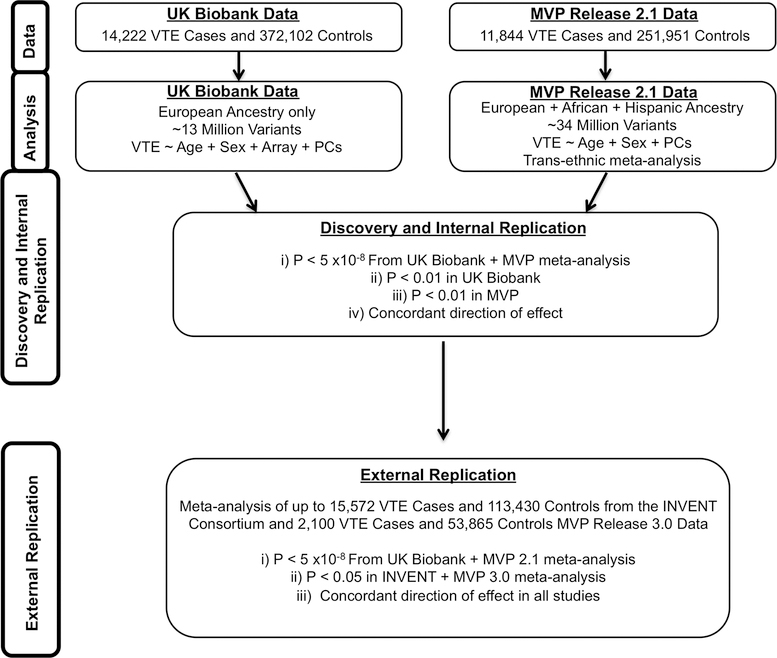
Figure 1.
Figure 1.. Venous thromboembolic disease genetic discovery and replication study design.
In UK Biobank, we performed an association analysis for DNA sequence variants in 14,222 VTE cases and 372,102 controls of European ancestry using logistic regression. These results were combined with association statistics from DNA sequence variants across 3 mutually exclusive ancestry groups in the Million Veteran Program release 2.1 data representing 11,844 VTE cases and 251,951 controls. Data from UK Biobank and MVP were meta-analyzed using an inverse-variance weighted fixed effects method. We set a significance threshold of two-sided P < 5 ×10⁻⁸ (genome-wide significance), and also required an internal replication two-sided P < 0.01 in each of the MVP and UK Biobank analyses, with concordant direction of effect, to minimize false positive findings. We subsequently performed external replication using summary data from the INVENT consortium (up to 15,572 VTE cases and 113,430 controls) meta-analyzed with data from MVP 3.0 (2,100 VTE cases and 53,865 controls), requiring an external replication P < 0.05 with a consistent direction of effect. Abbreviations: MVP, Million Veteran Program; VTE, Venous thromboembolism; PCs, Principal Components
Figure 2.
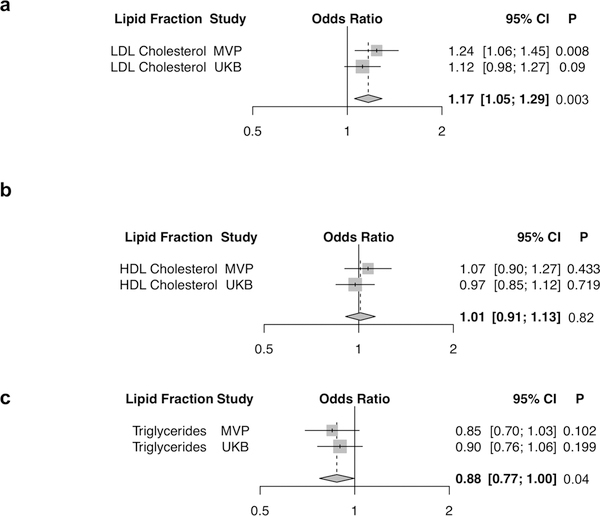
Figure 2.. Blood lipids and VTE risk.
Association of the 222 variant lipid genetic risk score with VTE in a multivariable Mendelian randomization analysis. Logistic regression odds ratios are displayed per 1-standard deviation genetically increased a) LDL cholesterol, b) HDL cholesterol, and c) triglycerides. Wald statistic two-sided values of P are displayed. Summary-level lipids data from up to 319,677 participants of the Global Lipids Genetics Consortium, and VTE association data from MVP (N = 8,929 cases; 181,337 controls) and UK Biobank (N = 14,222 cases; 372,102 controls) were used for this analysis. Gray boxes reflect the inverse-variance weight for each study. Abbreviations: HDL, High-Density Lipoprotein; LDL, Low-Density Lipoprotein; MVP, Million Veteran Program; UKB, UK Biobank
Figure 3.
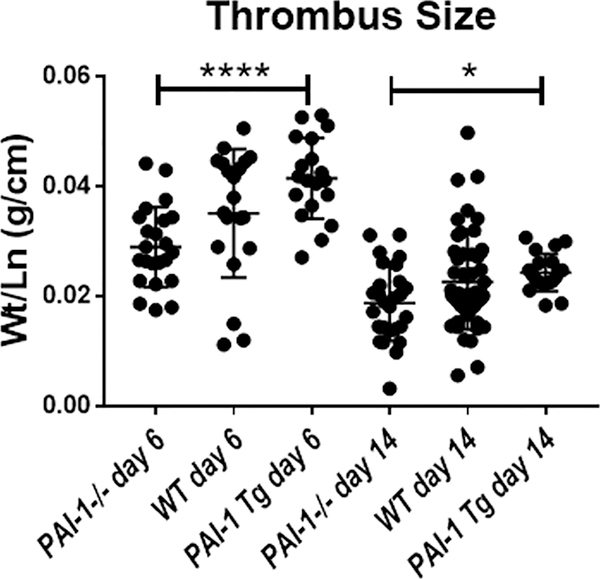
Figure 3.. Functional assessment of PAI-1 in murine models.
Inferior vena cava venous thrombus size was measured at day 6 and day 14 after inferior vena cava ligation in PAI-1 Tg (day 6 N = 19; day 14 N = 20), wild type (day 6 N = 20; day 14 N = 49), and PAI-1 −/− mice (day 6 N =23; day 14 N =27). Thrombus size was observed to be larger in the PAI-1 Tg mice compared to PAI-1−/− mice (one-way analysis of variance followed by Tukey’s multiple comparisons post hoc test, *p=0.02, ****p<0.0001). A scatter dot plot depicting mean thrombus size ± standard deviation is shown. Abbreviations: PAI-1, Plasminogen Activator Inhibitor-1; Tg, Transgenic; WT, Wild Type
Figure 4.
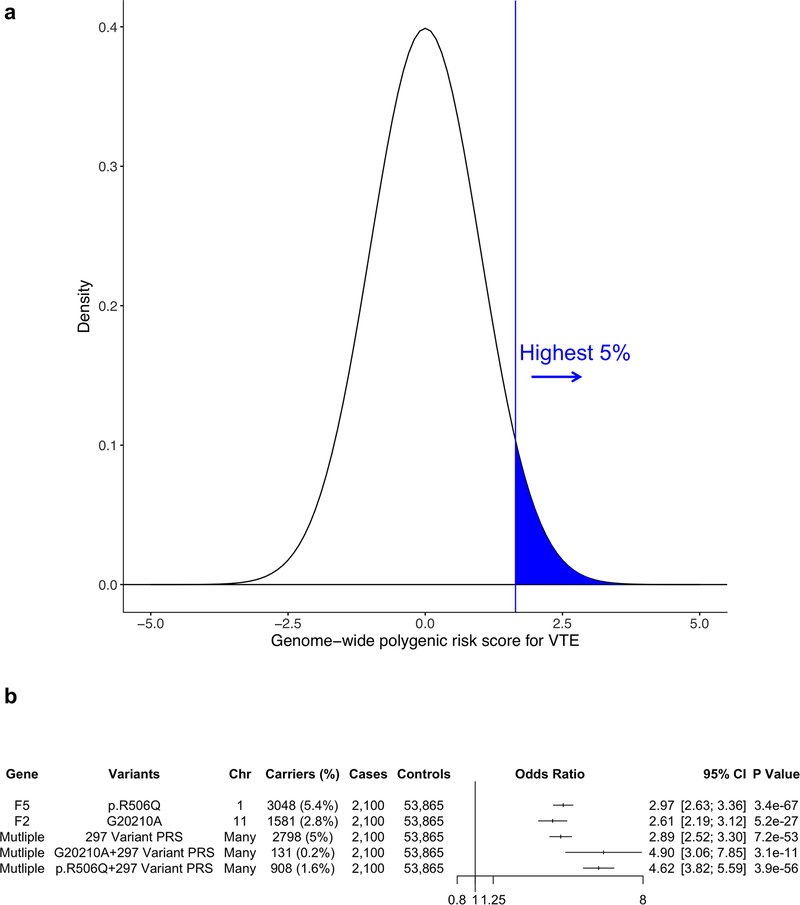
Figure 4.. Genome-wide polygenic risk score for VTE.
a) Distribution of the PRSVTE in the MVP release 3.0 dataset (n = 55,965). The x-axis represents the PRS with values transformed to have a mean of 0 and standard deviation of 1. The region shaded in blue represents those with the highest 5% of PRSVTE values. b) VTE odds ratios in MVP release 3.0 data for carriers of the F5 p.R506Q and F2 G20210A mutations. In addition, the odds ratio for individuals with the highest 5% PRSVTE compared to individuals among the lower 95% of PRSVTE, as well as for carriers of the F5 p.R506Q and F2 G20210A mutations within the highest 5% PRSVTE are depicted. Wald statistic two-sided values of P are displayed. Abbreviations: VTE, Venous Thromboembolism; PRS, Polygenic Risk Score; Chr, Chromosome; MVP, Million Veteran Program; CI, Confidence Interval
Figure 5.
Figure 5.. Genome-wide polygenic risk score and incident VTE events.
Hazard ratios calculated from the Cox Proportional hazards model for incident VTE events in the Women’s Health Initiative study for carriers of the F5 p.R506Q and F2 G20210A mutations. The hazard ratio for individuals with the highest 5% PRSVTE compared to individuals among the lower 95% of PRSVTE is also depicted. Two-sided values of P are displayed. Abbreviations: VTE, Venous Thromboembolism; PRS, Polygenic Risk Score; Chr, Chromosome; CI, Confidence Interval

Comment in

References

    1. Heit JA Epidemiology of venous thromboembolism. Nat Rev Cardiol 12, 464–74 (2015). - PMC - PubMed
    1. Bertina RM et al. Mutation in blood coagulation factor V associated with resistance to activated protein C. Nature 369, 64–7 (1994). - PubMed
    1. Poort SR, Rosendaal FR, Reitsma PH & Bertina RM A common genetic variation in the 3’-untranslated region of the prothrombin gene is associated with elevated plasma prothrombin levels and an increase in venous thrombosis. Blood 88, 3698–703 (1996). - PubMed
    1. Klarin D, Emdin CA, Natarajan P, Conrad MF & Kathiresan S Genetic Analysis of Venous Thromboembolism in UK Biobank Identifies the ZFPM2 Locus and Implicates Obesity as a Causal Risk Factor. Circ Cardiovasc Genet 10(2017). - PMC - PubMed
    1. Hinds DA et al. Genome-wide association analysis of self-reported events in 6135 individuals and 252 827 controls identifies 8 loci associated with thrombosis. Hum Mol Genet (2016). - PMC - PubMed

Online Methods References

    1. The Women’s Health Initiative Study Group. Design of the Women’s Health Initiative clinical trial and observational study. Control Clin Trials 19, 61–109 (1998). - PubMed
    1. Loh PR, Palamara PF & Price AL Fast and accurate long-range phasing in a UK Biobank cohort. Nat Genet 48, 811–6 (2016). - PMC - PubMed
    1. Howie B, Fuchsberger C, Stephens M, Marchini J & Abecasis GR Fast and accurate genotype imputation in genome-wide association studies through pre-phasing. Nat Genet 44, 955–9 (2012). - PMC - PubMed
    1. Price AL et al. Principal components analysis corrects for stratification in genome-wide association studies. Nat Genet 38, 904–9 (2006). - PubMed
    1. Klarin D et al. Genetics of blood lipids among ~300,000 multi-ethnic participants of the Million Veteran Program. Nature Genetics (2018). - PMC - PubMed

Publication types

MeSH terms

Substances