


Polyunsaturated fatty acids and risk of Alzheimer's disease: a Mendelian randomization study
- PMID: 31676950
- PMCID: PMC7230050
- DOI: 10.1007/s00394-019-02126-x
Polyunsaturated fatty acids and risk of Alzheimer's disease: a Mendelian randomization study
Abstract
Purpose: Observational studies have suggested that polyunsaturated fatty acids (PUFAs) may decrease Alzheimer's disease (AD) risk. In the present study, we examined this hypothesis using a Mendelian randomization analysis.
Methods: We used summary statistics data for single-nucleotide polymorphisms associated with plasma levels of n-6 PUFAs (linoleic acid, arachidonic acid) and n-3 PUFAs (alpha-linolenic acid, eicosapentaenoic acid, docosapentaenoic acid, docosahexaenoic acid), and the corresponding data for AD from a genome-wide association meta-analysis of 63,926 individuals (21,982 diagnosed AD cases, 41,944 controls).
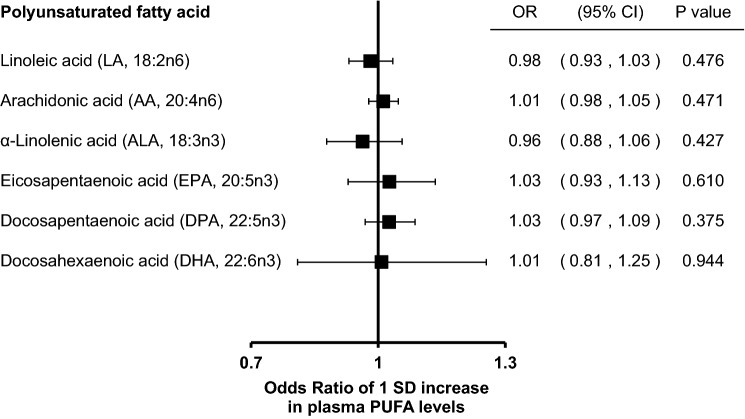
Results: None of the genetically predicted PUFAs was significantly associated with AD risk; odds ratios (95% confidence interval) per 1 SD increase in PUFA levels were 0.98 (0.93, 1.03) for linoleic acid, 1.01 (0.98, 1.05) for arachidonic acid, 0.96 (0.88, 1.06) for alpha-linolenic acid, 1.03 (0.93, 1.13) for eicosapentaenoic acid, 1.03 (0.97, 1.09) for docosapentaenoic acid, and 1.01 (0.81, 1.25) for docosahexaenoic acid.
Conclusions: This study did not support the hypothesis that PUFAs decrease AD risk.
Keywords: Alzheimer’s disease; Mendelian randomization analysis; Polyunsaturated fatty acids.
Conflict of interest statement
All authors did not have any potential conflicts of interest related to the manuscript.
Figures
References
-
- Ammann EM, Pottala JV, Robinson JG, et al. Erythrocyte omega-3 fatty acids are inversely associated with incident dementia: secondary analyses of longitudinal data from the Women’s Health Initiative Memory Study (WHIMS) Prostaglandins Leukot Essent Fatty Acids. 2017;121:68–75. doi: 10.1016/j.plefa.2017.06.006. - DOI - PMC - PubMed
MeSH terms
Substances
Grants and funding
LinkOut - more resources
Full Text Sources
Medical
