


A household-level score to predict the risk of tuberculosis among contacts of patients with tuberculosis: a derivation and external validation prospective cohort study
- PMID: 31678031
- PMCID: PMC6928575
- DOI: 10.1016/S1473-3099(19)30423-2
A household-level score to predict the risk of tuberculosis among contacts of patients with tuberculosis: a derivation and external validation prospective cohort study
Abstract
Background: The epidemiological impact and cost-effectiveness of social protection and biomedical interventions for tuberculosis-affected households might be improved by risk stratification. We therefore derived and externally validated a household-level risk score to predict tuberculosis among contacts of patients with tuberculosis.
Methods: In this prospective cohort study, we recruited tuberculosis-affected households from 15 desert shanty towns in Ventanilla and 17 urban communities in Callao, Lima, Peru. Tuberculosis-affected households included index patients with a new diagnosis of tuberculosis and their contacts who reported being in the same house as the index patient for more than 6 h per week in the 2 weeks preceding index patient diagnosis. Tuberculosis-affected households were not included if the index patient had no eligible contacts or lived alone. We followed contacts until 2018 and defined household tuberculosis, the primary outcome, as any contact having any form of tuberculosis within 3 years. We used logistic regression to identify characteristics of index patients, contacts, and households that were predictive of household tuberculosis, and used these to derive and externally validate a household-level score.
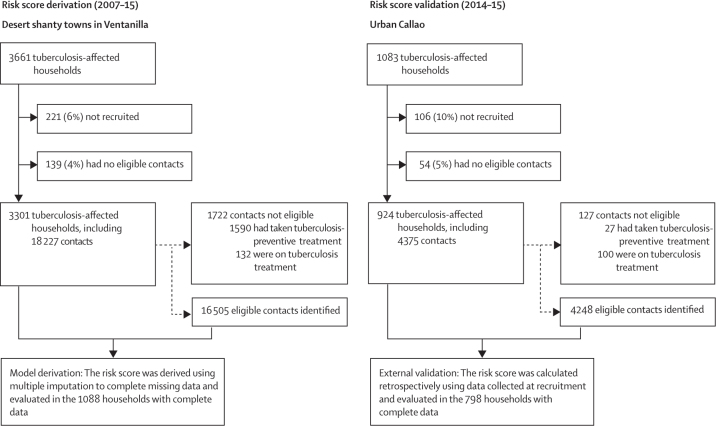
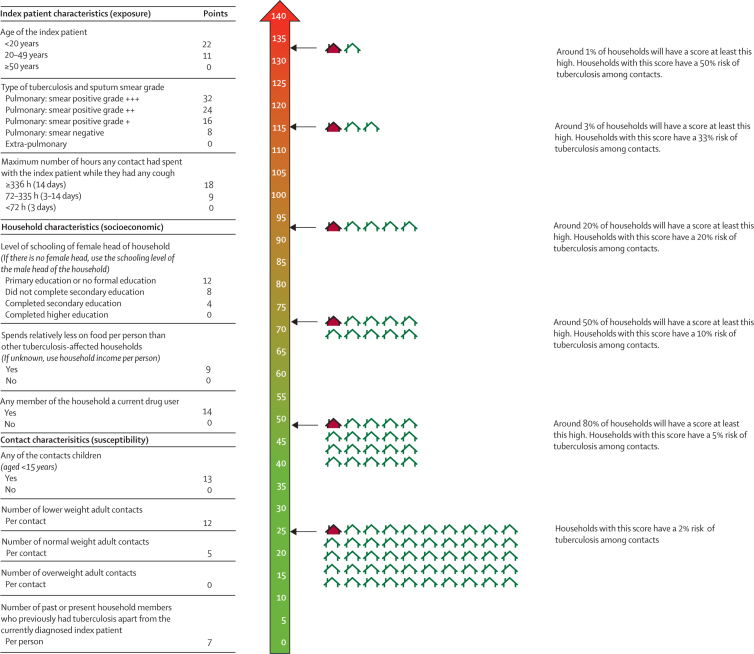
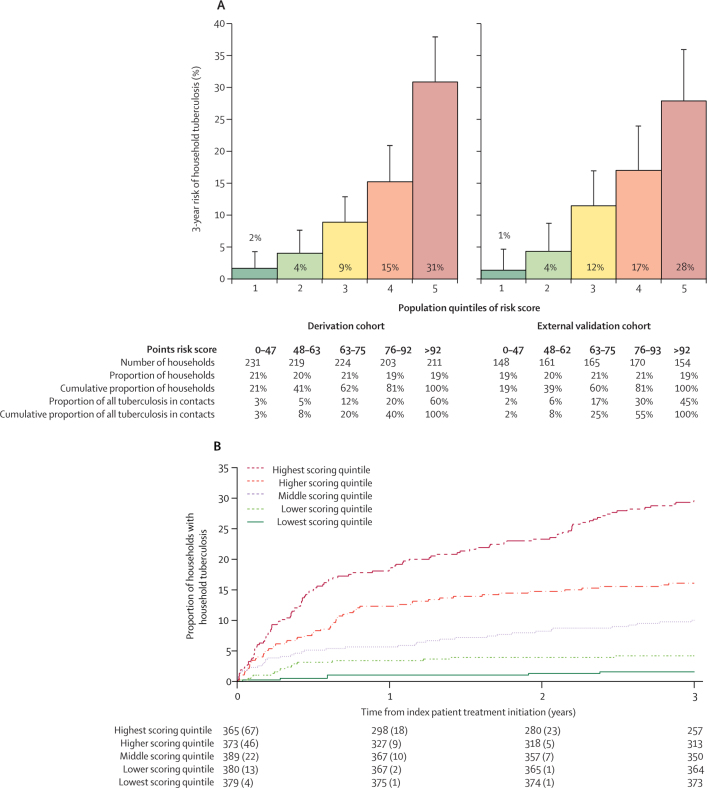
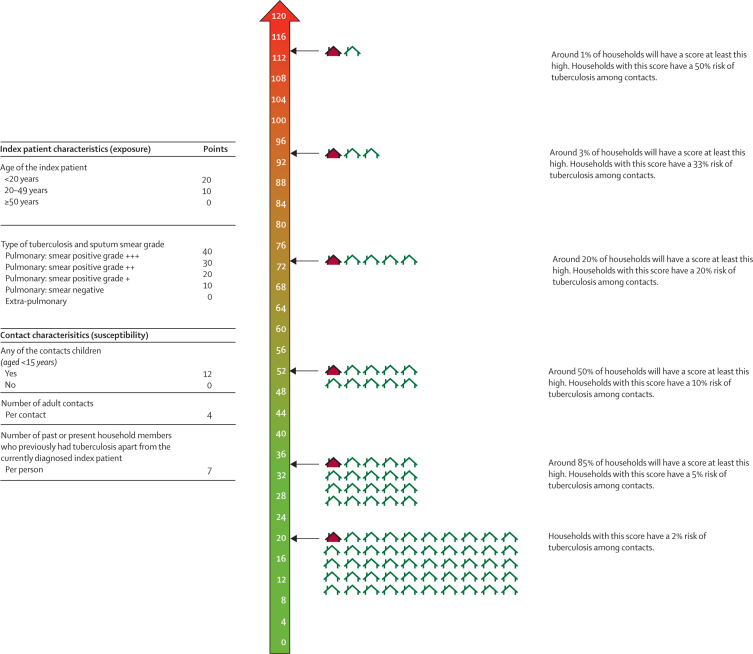
Findings: Between Dec 12, 2007, and Dec 31, 2015, 16 505 contacts from 3 301 households in Ventanilla were included in a derivation cohort. During the 3-year follow-up, tuberculosis occurred in contacts of index patients in 430 (13%, 95% CI 12-14) households. Index patient predictors were pulmonary tuberculosis and sputum smear grade, age, and the maximum number of hours any contact had spent with the index patient while they had any cough. Household predictors were drug use, schooling of the female head of a household, and lower food spending. Contact predictors were if any of the contacts were children, number of lower-weight (body-mass index [BMI] <20·0 kg/m2) adult contacts, number of normal-weight (BMI 20·0-24·9 kg/m2) adult contacts, and number of past or present household members who previously had tuberculosis. In this derivation cohort, the score c statistic was 0·77 and the risk of household tuberculosis in the highest scoring quintile was 31% (95% CI 25-38; 65 of 211) versus 2% (95% CI 0-4; four of 231) in the lowest scoring quintile. We externally validated the risk score in a cohort of 4248 contacts from 924 households in Callao recruited between April 23, 2014, and Dec 31, 2015. During follow-up, tuberculosis occurred in contacts of index patients in 120 (13%, 95% CI 11-15) households. The score c statistic in this cohort was 0·75 and the risk of household tuberculosis in the highest scoring quintile was 28% (95% CI 21-36; 43 of 154) versus 1% (95% CI 0-5; two of 148) in the lowest scoring quintile. The highest-scoring third of households captured around 70% of all tuberculosis among contacts. A simplified risk score including only five variables performed similarly, with only a small reduction in performance.
Interpretation: This externally validated score will enable comprehensive biosocial, household-level interventions to be targeted to tuberculosis-affected households that are most likely to benefit.
Funding: Wellcome Trust, Medical Research Council, Department of Health and Social Care, Department for International Development, Joint Global Health Trials consortium, Bill & Melinda Gates Foundation, Innovation for Health and Development.
Copyright © 2020 The Author(s). Published by Elsevier Ltd. This is an Open Access article under the CC BY 4.0 license. Published by Elsevier Ltd.. All rights reserved.
Figures
Comment in
-
What makes a score a winner?Lancet Infect Dis. 2020 Jan;20(1):10-11. doi: 10.1016/S1473-3099(19)30540-7. Epub 2019 Oct 31. Lancet Infect Dis. 2020. PMID: 31678027 No abstract available.
References
-
- Kasaie P, Andrews JR, Kelton WD, Dowdy DW. Timing of tuberculosis transmission and the impact of household contact tracing: An agent-based simulation model. Am J Respir Crit Care Med. 2014;189:845–852. - PubMed
Uncited References
-
- Instituto Nacional de Estadística e Informacion . Instituto Nacional de Estadística e Informacion; Lima: 2016. Crecimiento económico, población, características sociales y seguridad ciudadana en la provincia constitucional del Callao.
Publication types
MeSH terms
Substances
Grants and funding
LinkOut - more resources
Full Text Sources
Research Materials
Miscellaneous
