. 2020 Jan 8;48(D1):D1093-D1103.
doi: 10.1093/nar/gkz996.

Plant Reactome: a knowledgebase and resource for comparative pathway analysis

Affiliations

Plant Reactome: a knowledgebase and resource for comparative pathway analysis

Sushma Naithani et al. Nucleic Acids Res. .

Abstract

Plant Reactome (https://plantreactome.gramene.org) is an open-source, comparative plant pathway knowledgebase of the Gramene project. It uses Oryza sativa (rice) as a reference species for manual curation of pathways and extends pathway knowledge to another 82 plant species via gene-orthology projection using the Reactome data model and framework. It currently hosts 298 reference pathways, including metabolic and transport pathways, transcriptional networks, hormone signaling pathways, and plant developmental processes. In addition to browsing plant pathways, users can upload and analyze their omics data, such as the gene-expression data, and overlay curated or experimental gene-gene interaction data to extend pathway knowledge. The curation team actively engages researchers and students on gene and pathway curation by offering workshops and online tutorials. The Plant Reactome supports, implements and collaborates with the wider community to make data and tools related to genes, genomes, and pathways Findable, Accessible, Interoperable and Re-usable (FAIR).


Figures

Figure 1.
Figure 1.
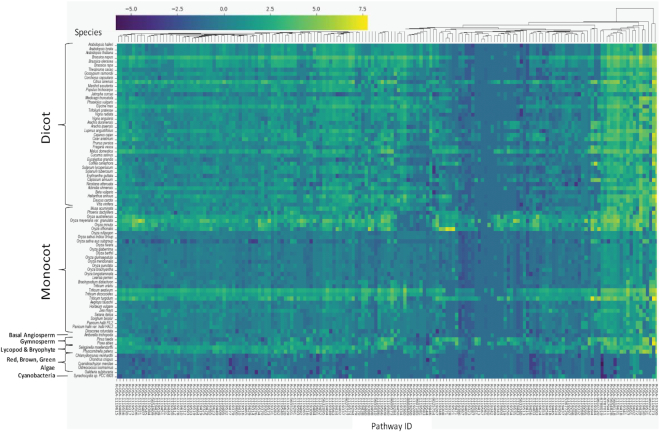
Gene orthology based pathway projections for the 82 plant species in the Plant Reactome. The pathways and associated reactions are clustered based on event hierarchy and species are ordered based on phylogeny. The shades of green to yellow are trending towards a higher number of ortholog count and the shades of blue trending towards lower counts of orthologs associated with individual pathways.
Figure 2.
Figure 2.
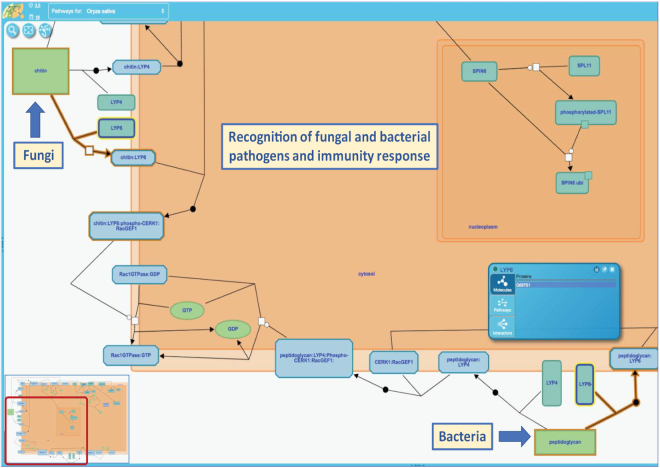
An example of a pathway depicting biotic stress response in rice. Current knowledge related to ‘Recognition of fungal and bacterial pathogens and immunity response’ has been summarized in this pathway. Depending on the type of pathogen, components of the microbial cell walls (e.g. fungal chitin, or bacterial peptidoglycan) serve as elicitors in plant innate immunity. The chitin elicitor binding protein (CEBiP) acts as the chitin receptor, whereas membrane-localized lysin motif-containing proteins 4 and 6 (LYP4 and LYP6) bind to peptidoglycan and chitin. Eventually, the binding of microbial cell wall components to plant cell membrane receptor(s) induces a downstream signaling cascade, which in turn triggers expression of regulatory factors, defense-related genes, and the components of programmed cell death leading to pathogen resistance. View pathway at https://plantreactome.gramene.org/PathwayBrowser/#/R-OSA-9611432
Figure 3.
Figure 3.
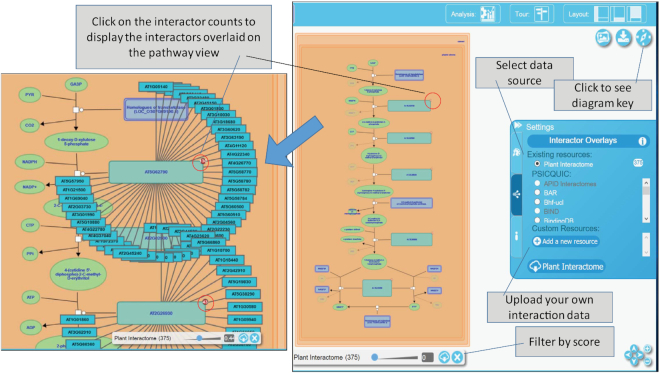
Gene-gene interaction overlay analysis for Arabidopsis thaliana genes encoding enzymes of methylerythritol phosphate (MEP) pathway. In the pathway diagram, the interactors associated with two enzymes (AT5G62790 and AT2G26930) are shown as a spoke-and-wheel overlay. A user has the option to display interactors of all enzymes of this pathway (total 375 from Plant Interactome and 6 from BAR) and download as a table (see Supplementary Table S3). View pathway at https://plantreactome.gramene.org/PathwayBrowser/#/R-ATH-1119464

References

    1. Tello-Ruiz M.K., Naithani S., Stein J.C., Gupta P., Campbell M., Olson A., Wei S., Preece J., Geniza M.J., Jiao Y. et al. .. Gramene 2018: unifying comparative genomics and pathway resources for plant research. Nucleic Acids Res. 2018; 46:D1181–D1189. - PMC - PubMed
    1. Naithani S., Preece J., D’Eustachio P., Gupta P., Amarasinghe V., Dharmawardhana P.D., Wu G., Fabregat A., Elser J.L., Weiser J. et al. .. Plant Reactome: a resource for plant pathways and comparative analysis. Nucleic Acids Res. 2017; 45:D1029–D1039. - PMC - PubMed
    1. Fabregat A., Jupe S., Matthews L., Sidiropoulos K., Gillespie M., Garapati P., Haw R., Jassal B., Korninger F., May B. et al. .. The reactome pathway knowledgebase. Nucleic Acids Res. 2018; 46:D649–D655. - PMC - PubMed
    1. Bolser D., Staines D.M., Pritchard E., Kersey P.. Ensembl plants: integrating tools for visualizing, mining, and analyzing plant genomics data. Methods Mol. Biol. 2016; 1374:115–140. - PubMed
    1. Papatheodorou I., Fonseca N.A., Keays M., Tang Y.A., Barrera E., Bazant W., Burke M., Fullgrabe A., Fuentes A.M., George N. et al. .. Expression Atlas: gene and protein expression across multiple studies and organisms. Nucleic Acids Res. 2018; 46:D246–D251. - PMC - PubMed

Publication types