Review
. 2019 Oct 18:7:230.
doi: 10.3389/fcell.2019.00230. eCollection 2019.

Importance of SLC26 Transmembrane Anion Exchangers in Sperm Post-testicular Maturation and Fertilization Potential

Affiliations
Review

Importance of SLC26 Transmembrane Anion Exchangers in Sperm Post-testicular Maturation and Fertilization Potential

Aminata Touré. Front Cell Dev Biol. .

Abstract

In mammals, sperm cells produced within the testis are structurally differentiated but remain immotile and are unable to fertilize the oocyte unless they undergo a series of maturation events during their transit in the male and female genital tracts. This post-testicular functional maturation is known to rely on the micro-environment of both male and female genital tracts, and is tightly controlled by the pH of their luminal milieus. In particular, within the epididymis, the establishment of a low bicarbonate (HCO3 -) concentration contributes to luminal acidification, which is necessary for sperm maturation and subsequent storage in a quiescent state. Following ejaculation, sperm is exposed to the basic pH of the female genital tract and bicarbonate (HCO3 -), calcium (Ca2+), and chloride (Cl-) influxes induce biochemical and electrophysiological changes to the sperm cells (cytoplasmic alkalinization, increased cAMP concentration, and protein phosphorylation cascades), which are indispensable for the acquisition of fertilization potential, a process called capacitation. Solute carrier 26 (SLC26) members are conserved membranous proteins that mediate the transport of various anions across the plasma membrane of epithelial cells and constitute important regulators of pH and HCO3 - concentration. Most SLC26 members were shown to physically interact and cooperate with the cystic fibrosis transmembrane conductance regulator channel (CFTR) in various epithelia, mainly by stimulating its Cl- channel activity. Among SLC26 members, the function of SLC26A3, A6, and A8 were particularly investigated in the male genital tract and the sperm cells. In this review, we will focus on SLC26s contributions to ionic- and pH-dependent processes during sperm post-testicular maturation. We will specify the current knowledge regarding their functions, based on data from the literature generated by means of in vitro and in vivo studies in knock-out mouse models together with genetic studies of infertile patients. We will also discuss the limits of those studies, the current research gaps and identify some key points for potential developments in this field.

Keywords: CFTR; SLC26; capacitation; epididymis; fertilization; motility; pH; sperm.


Figures

FIGURE 1
FIGURE 1
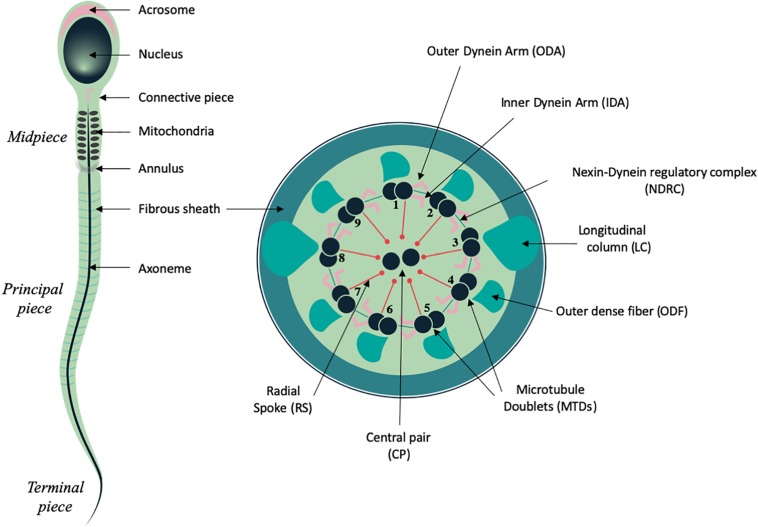
Schematic representation of mammalian spermatozoa and flagellum structure. Left panel, overall view of the spermatozoa showing the main head and flagellum structures and compartments. Right panel, cross section from the principal piece of the flagellum showing the organization of the axoneme: microtubule doublets (MTD), central pair (CP), radial spokes (RS), nexin dynein regulatory complex (NDRC), inner and outer dynein arms (IDA and ODA), together with some of the peri-axonemal structures: fibrous sheath (FS), outer dense fiber (ODF), and longitudinal columns (LC).
FIGURE 2
FIGURE 2
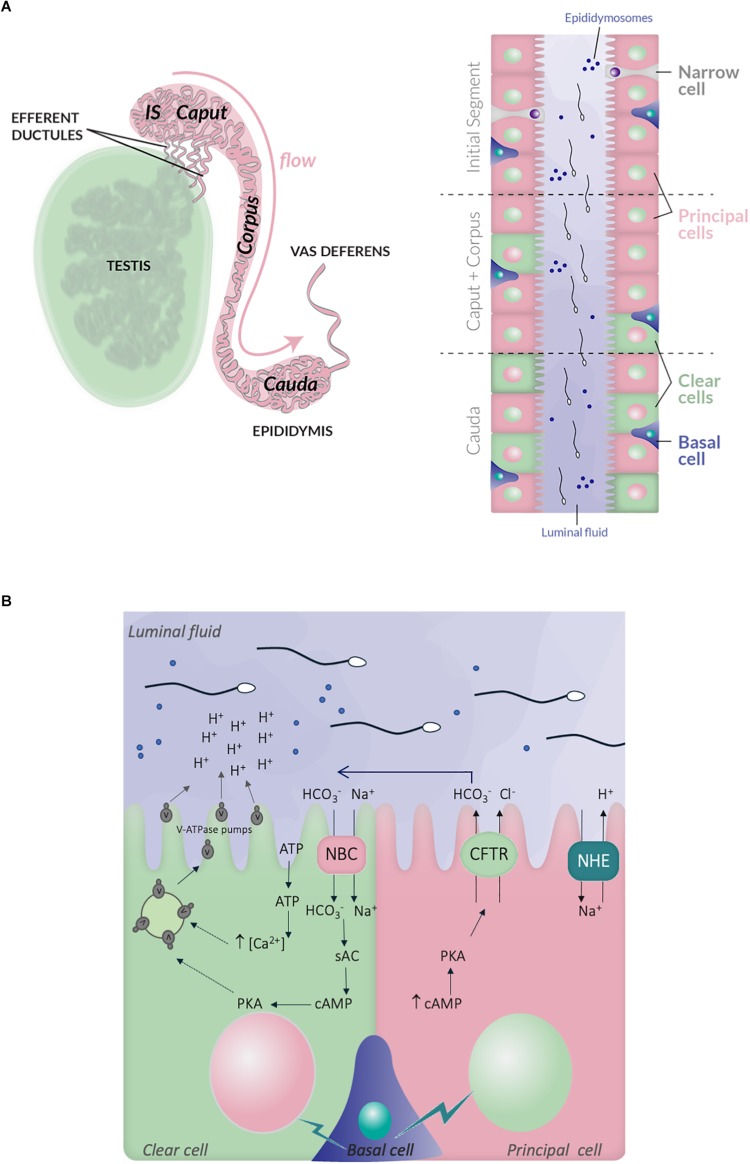
Schematic representation of the epididymis structure and ionic exchanges between epithelial cells, which control luminal acidification. (A) Left panel, the testis, efferent ductules and epididymis are schematized. The different regions within the epididymis, in mouse, are indicated: initial segment, caput, corpus and cauda, following the proximal-distal axis. Right panel, the distribution of the different epithelial cell-types within the epididymal tract is also illustrated: principal cells (PCs), clear cells (CCs), narrow cells (NCs), and basal cells; the luminal fluid shows epididymosomes, which are small vesicles transferring material from epithelia cells to the sperm cells. (B) Simplified representation of the main ionic fluxes and cross talks occuring between principal, clear, and basal cells. CCs expressed the V-ATPase pumps, which expression at the plasma membrane is induced by HCO3 and c-AMP dependent pathway. The HCO3 influx in CCs is mediated by the NBC sodium- HCO3 transporter. ATP also induces intracellular rise of Ca2+, which increase V-ATPase translocation at the plasma membrane and proton secretion. PCs express the NHE3 sodium-proton antiporter, which contributes to proton secretion and luminal acidification. They also secrete HCO3 through the CFTR channel. Lastly, basal cells transmit physiological cues, in particular during sexual arousal, which regulate the activity of principal and CCs.
FIGURE 3
FIGURE 3
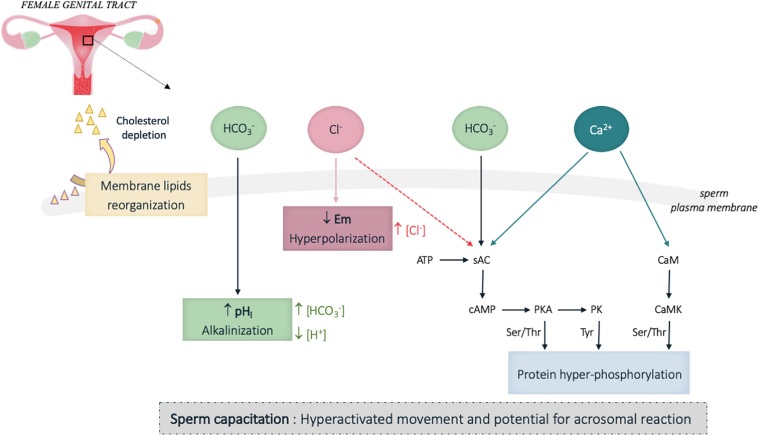
Schematic representation of the biochemical and electrophysiological changes during sperm capacitation in the female genital tract. Capacitation confers the sperm cells a hyperactivated motility characterized by an increased flagellar amplitude and beating frequency, and the ability to perform the acrosomal reaction and to specifically recognize and interact with oocyte. This functional activation is mainly induced by HCO3, Ca2+ and Cl influxes, which trigger biochemical and electrophysiological changes in the cytoplasm and the whole plasma membrane of the sperm cells. Among the principal changes, are observed an increase of the plasma membrane fluidity through cholesterol depletion, which favor the relocation of proteins located in the sperm head and involved in oocyte interaction, together with an alkalinization of the cytoplasm and plasma membrane hyperpolarization. Intense protein phosphorylation, which include some proteins involved in flagellar beating, is observed on the sperm flagellum. pHi, intracellular pH; Em, membrane potential; […], cytoplasmic ion concentrations; ↑, increase; ↓, decrease. Plain and broken arrows indicate a direct and indirect effect, respectively.
FIGURE 4
FIGURE 4
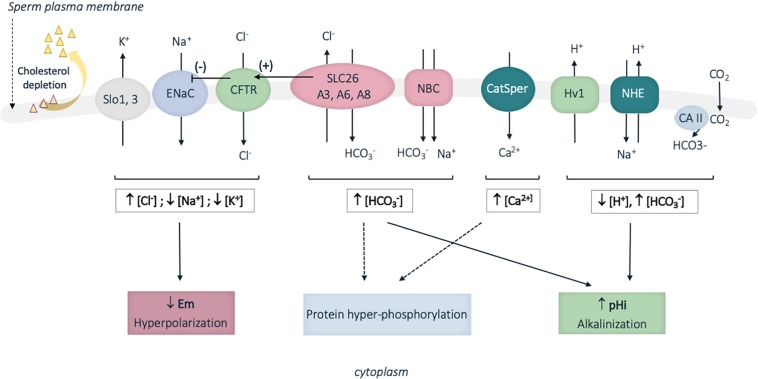
Schematic representation of some of the identified sperm membrane transporters involved in ion fluxes during human sperm capacitation. Cholesterol depletion occurring during capacitation also increases membrane fluidity. A panoply of ion transporters is involved in the complex ion fluxes, which induce membrane hyperpolarization, cytoplasm alkalinization and protein hyperphosphorylation. Slo13, sperm-specific K+ channel; ENaC, epithelial Na+ channel; CFTR, cystic fibrosis transmembrane conductance channel; SLC26, solute carrier 26; NBC, sodium HCO3 transporter; CatSPER, sperm specific Ca2+ channel; Hv1, proton channel; NHE, Na+/H+ exchanger; CA, carbonic anhydrases; pHi, intracellular pH; Em, membrane potential; […], cytoplasmic ion concentrations; ↑, increase; ↓, decrease. Plain and broken arrows indicate a direct and indirect effect, respectively. CFTR stimulation by SLC26 proteins is represented by an arrow with (+) and ENaC inhibition by CFTR is represented by an arrow with (–).
FIGURE 5
FIGURE 5
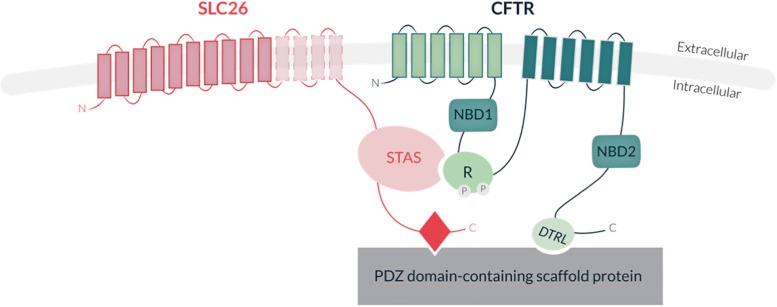
Schematic representation of SLC26 protein structure and interaction with the Cystic Fibrosis Transmembrane conductance Channel (CFTR). SLC26 proteins share a conserved transmembrane region of 10–14 hydrohobic spans, associated with their anion transport activity, and a cytoplasmic STAS domain (Sulfate Transporter and Anti-Sigma factor antagonist), involved in protein-protein interaction and regulation. Some members also contain a PDZ binding motif at their carboxy-terminal extremity. The CFTR protein consists of two transmembrane domains (TMD) (each containing six spans of alpha helices), two nucleotide-binding domains (NBD1 and NBD2) and a central regulatory domain (R-domain). CFTR activity is regulated by PKA-phosphorylation of the R-domain and ATP binding and hydrolysis at the two NBDs. Direct interaction of SLC26 with CFTR is mediated by the STAS domain and the regulatory (R) domain of CFTR. Indirect interaction of the proteins occurs through binding of both SLC26s and CFTR to common PDZ motif-containing scaffold proteins.

References

    1. Adamali H. I., Hermo L. (1996). Apical and narrow cells are distinct cell types differing in their structure, distribution, and functions in the adult rat epididymis. J. Androl. 17 208–222. - PubMed
    1. Alper S. L., Sharma A. K. (2013). The SLC26 gene family of anion transporters and channels. Mol. Aspects Med. 34 494–515. 10.1016/j.mam.2012.07.009 - DOI - PMC - PubMed
    1. Alvarez B. V., Kieller D. M., Quon A. L., Markovich D., Casey J. R. (2004). Slc26a6: a cardiac chloride-hydroxyl exchanger and predominant chloride-bicarbonate exchanger of the mouse heart. J. Physiol. 561 721–734. 10.1113/jphysiol.2004.077339 - DOI - PMC - PubMed
    1. Amlal H., Petrovic S., Xu J., Wang Z., Sun X., Barone S., et al. (2010). Deletion of the anion exchanger Slc26a4 (pendrin) decreases apical Cl/HCO3 exchanger activity and impairs bicarbonate secretion in kidney collecting duct. Am. J. Physiol. Cell Physiol. 299 C33–C41. 10.1152/ajpcell.00033.2010 - DOI - PMC - PubMed
    1. Anagnostopoulou P., Riederer B., Duerr J., Michel S., Binia A., Agrawal R., et al. (2012). SLC26A9-mediated chloride secretion prevents mucus obstruction in airway inflammation. J. Clin. Invest. 122 3629–3634. 10.1172/JCI60429 - DOI - PMC - PubMed