. 2019 Oct 23;5(10):eaaw6670.
doi: 10.1126/sciadv.aaw6670. eCollection 2019 Oct.

Range of motion in the avian wing is strongly associated with flight behavior and body mass

Affiliations

Range of motion in the avian wing is strongly associated with flight behavior and body mass

V B Baliga et al. Sci Adv. .

Abstract

Avian wing shape is highly variable across species but only coarsely associated with flight behavior, performance, and body mass. An underexplored but potentially explanatory feature is the ability of birds to actively change wing shape to meet aerodynamic and behavioral demands. Across 61 species, we found strong associations with flight behavior and mass for range of motion traits but not wing shape and strikingly different associations for different aspects of motion capability. Further, static morphology exhibits high phylogenetic signal, whereas range of motion shows greater evolutionary lability. These results suggest a new framework for understanding the evolution of avian flight: Rather than wing morphology, it is range of motion, an emergent property of morphology, that is predominantly reshaped as flight strategy and body size evolve.


Figures

Fig. 1
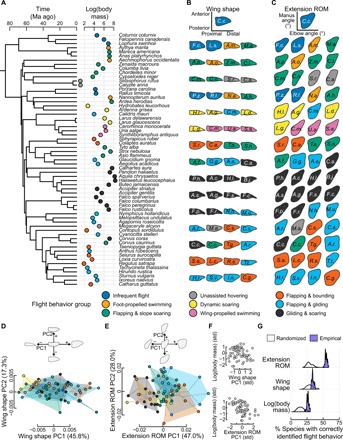
Fig. 1. Flight behavior and body mass influence the range of motion in wing extension and flexion but not wing shape.
(A) Time-calibrated phylogeny of 61 focal species, pruned from our 220-taxon maximum clade credibility tree. Circles to the right of the tree show natural log–transformed body mass (measured in grams) colored by flight behavior. Ma, million years. (B) Wing shape [two-dimensional (2D) outline shape at maximum extension] and (C) extension range of motion (ROM) of each species (outer boundary of possible elbow versus manus extension or flexion) after resizing shapes via Procrustes superimposition. Initials correspond to genus and species. (D) Phylogenetic principal components analysis (pPCA) of avian wing shape; birds of varying flight behavior show extensive overlap in morphospace. (E) pPCA of extension ROM shows higher differentiation among groups. Top diagrams each depict shape changes along major axes. (F) Mass varies little with wing shape (top) but more strongly with extension ROM shape (bottom). Each variable was standardized (z-transformed). Std, standardized. (G) Phylogenetic flexible discriminant analyses found that extension ROM had superior performance to predicting flight behavior group compared to wing shape or body mass. Purple kernel densities show jackknifed empirical prediction accuracies; gray kernel densities show prediction accuracies of 61 randomized permutations.
Fig. 2
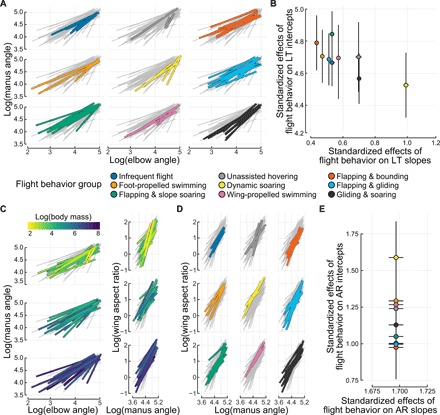
Fig. 2. Coupling of avian elbow and wrist motion is concordant with flight behavior but not body mass.
(A) Facet plots of each flight behavior group’s linkage trajectories against those of all other taxa (gray). Each line represents a motion path for one species; color corresponds to flight behavior. Elbow and manus angles are natural log–transformed for linearization. (B) Standardized effects (estimated marginal means) of flight behavior on linkage trajectory (LT) intercepts and slopes. Black lines indicate SEs of estimates. (C) Facet plots of linkage trajectory (left) and the correspondence between wing aspect ratio and linkage trajectory (right). Body mass (color bar) explains little variation. To enhance visual clarity, data are faceted by tercile. (D) Aspect ratio versus linkage trajectory, colored by flight behavior. Although this visualization suggests distinct patterns among groups, there is extensive overlap of estimated effects. (E) Estimated marginal means of flight behavior on the transfer function between linkage trajectory and wing aspect ratio (AR). Phylogenetic mixed models indicated that neither flight behavior nor body mass appears to affect these relationships; SEs of all estimates overlap extensively.
Fig. 3
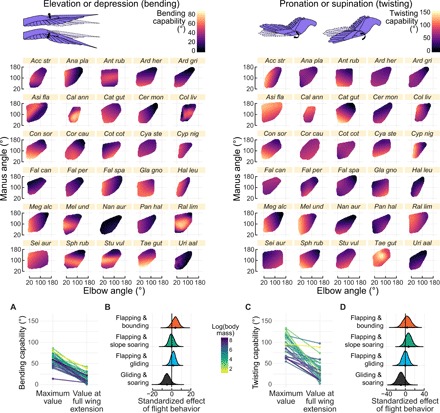
Fig. 3. The bending and twisting capacity of the wing is position dependent and is more strongly associated with body mass than with flight behavior.
Elevation/depression capability (left) and pronation/supination capability (right) at the manus joint were assessed over the extension ROM of each of 30 species. The combined capacity to elevate or depress at this joint was defined as bending capability; the combined capacity to pronate or supinate was defined as twisting capability. Species are labeled according to the first three letters of each of their genus and species names (as Gen spe); see Fig. 1 for full binomial nomenclature. In all 30 species, both (A) bending and (C) twisting capacity are reduced when the wing is at full extension. Heavier species (darker colored) tend to show greater overall restrictions to these types of motion. “Maximum value” indicates the highest capacity for a given motion irrespective of wing extension. Within each plot, lines connect data for each species. Estimated marginal means of flight behavior on the reduction in (B) bending and (D) twisting capacity after accounting for effects of natural log–transformed body mass. Given our data, flight behavior does not appear to substantially affect bending or twisting capacity.
Fig. 4
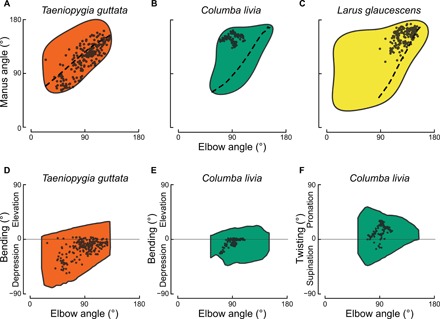
Fig. 4. In vivo wing kinematics reveal that natural motions fall within ROM limits.
Joint angles were tracked during in vivo flight in zebra finches (n = 4) and a pigeon (n = 1). Cadaveric extension ROM is shown as a colored shape for (A) the zebra finch and (B) the pigeon. Each point shows elbow extension against manus extension from a single frame of recorded flight; data from multiple individuals and flight behaviors are pooled. Dashed lines indicate linkage trajectories from cadavers. (C) Similar data from in vivo observations of gliding (points) in the glaucous-winged gull obtained from (5), shown against cadaveric extension ROM (colored shape) and linkage trajectory (dashed line) determined in this study. (D to F) Observations of in vivo bending or twisting (points) shown against ROM envelopes from cadavers (colored shapes).
Fig. 5
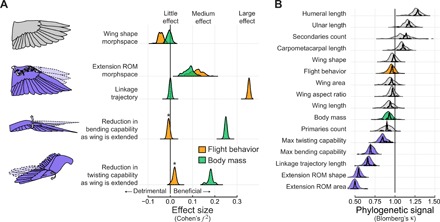
Fig. 5. Wing range of motion is more strongly associated with flight behavior and body mass and is more evolutionarily labile than wing shape.
(A) Effect sizes (Cohen’s f2) for each of the fixed effects considered. Increasingly positive effect sizes indicate that the addition of that variable substantially improved variance explained; increasingly negative indicates the opposite. Flight behavior or body mass did little to explain wing shape. Flight behavior has a pronounced effect in explaining extension/flexion patterns, whereas body mass substantively explains trends in bending and twisting capability of the hand-wing. Density plots show distributions of f2 as phylogeny is varied. Asterisks indicate that analyses were restricted to four well-represented flight behavior groups. (B) Range of motion traits (purple) have lower phylogenetic signal (Blomberg’s κ) than those related to static morphology or flight behavior. A κ value of 1 indicates strong phylogenetic signal that ostensibly follows Brownian motion. Traits with κ values increasingly greater than 1 are more phylogenetically conserved; κ values increasingly lower than 1 indicate greater lability. We performed two sensitivity analyses: one in which phylogeny was varied (dashed distributions) and one in which data were jackknifed (solid).

References

    1. J. M. V. Rayner, Form and Function in Avian Flight (Current Ornithology series, 1988), vol. 5, pp. 1–66.
    1. Kruyt J. W., van Heijst G. F., Altshuler D. L., Lentink D., Power reduction and the radial limit of stall delay in revolving wings of different aspect ratio. J. R. Soc. Interface 12, 20150051 (2015). - PMC - PubMed
    1. Wang X., Clarke J. A., The evolution of avian wing shape and previously unrecognized trends in covert feathering. Proc. Biol. Sci. 282, 20151935 (2015). - PMC - PubMed
    1. Lentink D., Müller U. K., Stamhuis E. J., de Kat R., van Gestel W., Veldhuis L. L., Henningsson P., Hedenström A., Videler J. J., van Leeuwen J. L., How swifts control their glide performance with morphing wings. Nature 446, 1082–1085 (2007). - PubMed
    1. Harvey C., Baliga V. B., Lavoie P., Altshuler D. L., Wing morphing allows gulls to modulate static pitch stability during gliding. J. R. Soc. Interface 16, 20180641 (2019). - PMC - PubMed

Publication types

LinkOut - more resources