


Review
doi: 10.3390/molecules24213951.
The Early Years of 2,2'-Bipyridine-A Ligand in Its Own Lifetime
Affiliations
- PMID: 31683694
- PMCID: PMC6864536
- DOI: 10.3390/molecules24213951
Item in Clipboard
Review
The Early Years of 2,2'-Bipyridine-A Ligand in Its Own Lifetime
Molecules.
.
Abstract
The first fifty years of the chemistry of 2,2'-bipyridine are reviewed from its first discovery in 1888 to the outbreak of the second global conflict in 1939. The coordination chemistry and analytical applications are described and placed in the context of the increasingly sophisticated methods of characterization which became available to the chemist in this time period. Many of the "simple" complexes of 2,2'-bipyridine reported in the early literature have been subsequently shown to have more complex structures.
Keywords: 2,2’-bipyridine; coordination chemistry; history; supramolecular chemistry; synthesis.
Conflict of interest statement
The authors declare that there are no conflicts of interest.
Figures

The structures of 2,2′-bipyridine (1) and some related compounds. The numbering scheme for the parent compound, 2,2′-bipyridine is shown. The coordination chemistry of 1,10-phenanthroline (2) is very similar to that of 1. The compounds 3, 4 and 5 are the isomers 4,4′-bipyridine, 3,4-bipyridine and 3,3’-bipyridine. Compound 6, 2,2′-bipiperidine, is one of the reduction products of 1. Also shown is the next higher oligopyridine 2,2′:6’,2”-terpyridine, 7, which Blau described in 1889.

Fritz Blau first prepared 2,2′-bipyridine by the dry distillation of copper(II) pyridine-2-carboxylate [16].

(a) The structures proposed by Fritz Blau for [Fe(phen)3]2+ and [Fe(phen)3]3+ [29]. The diagrams indicate that Blau had not fully understood Werner’s concepts of primary and secondary valence. The bonding to the iron(II) and iron(III) centres are based upon valency of two and three respectively (rather than an oxidation state). The bonding of the chloride to the nitrogen was relatively common in the depiction of ammonium and pyridinium salts at this period in time. (Reprinted from reference 29 by permission from Springer). (b) The bright red colour of the [Fe(bpy)3]2+ is familiar to all scientists who work with 2,2′-bipyridines.

(a) The solid-state crystal structure of 1 shows that the molecules of 2,2′-bipyridine are planar and possess a trans-conformation; (b) molecules of 1 exhibit face-to-face stacking in the crystal lattice. Graphics generated from data from reference [42].

What a difference a century makes! (a) The first reported absorption spectrum of 2,2′-bipyridine from 1913 (Reproduced from reference 46 by permission of The Royal Society of Chemistry); (b) a modern absorption spectrum of the same compound (courtesy of Ms. Dalila Rocco, University of Basel). Both spectra are recorded in ethanol as solvent.

The structures of bioactive materials related to the bipyridines, the herbicides paraquat (8) and diquat (9), the alkaloid nicotine (10) and neonicotine (11). The latter compound was responsible for the reported toxicity of crude bipyridine preparations [52].
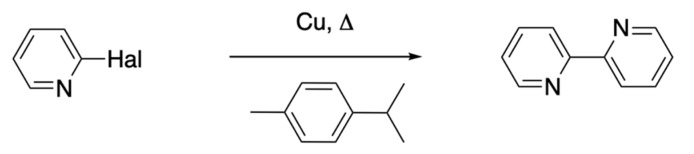
The preparation of 2,2′-bipyridine utilizing the Ullmann reaction was introduced by Wibaut in 1928 (Hal = Br or Cl) [72].

The structures of the earliest derivatives of 2,2′-bipyridine to be described; compound 12 was obtained from the pyrolysis of 2-methylpyridine [73].

The preparation of 2,2′-bipyridine by the reaction of pyridine with FeCl3 at elevated temperatures provided a convenient access to the ligand in 52% yield, although the work-up was sometimes challenging because of the large amounts of metal salts [77].

The Λ and Δ enantiomers of the [Fe(bpy)3]2+ cation resolved by Werner in 1912 [78].

The structures of some early derivatives of 2,2′-bipyridine.

The solid-state structure of [W(bpy)(CO)4] (structural data taken from reference [102].
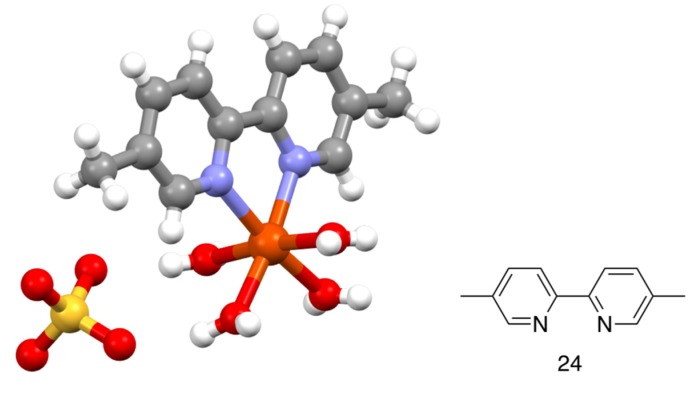
The solid-state structure of [Fe(24)(H2O)4](SO4) (structural data taken from reference 117) and the structure of 5,5′-dimethyl-2,2′-bipyridine, 24.

The solid-state structure of structure of {Fe(bpy)Cl3}, which was shown to be [Fe(bpy)2Cl2][FeCl4] (structural data taken from reference 129).

(a) mer-[Ru(bpy)Cl3(NO)] [134] (b) fac-[Ru(bpy)Cl3(NO)] [134] (c) the cis-[Ru(bpy)2Cl(NO)]2+ cation in [Ru(bpy)2Cl(NO)](ClO4)2 [135] (d) the trans-[Ru(bpy)2Cl(NO)]2+ cation in [Ru(bpy)2Cl(NO)](ClO4)2 [136].

(a) The structure of the [Ru(bpy)Cl4]– anion in K[Ru(bpy)Cl4] [138] and (b) the (H5O2)+ cation present in [(H5O2)Ru(25)Cl4].2H2O (25 = 2,2′-bipyridine-4,4′-dicarboxylic acid) [139].

(a) The neutral cobalt(II) coordination entity present in [Co(bpy)2Cl2].3H2O [141] (b) the [Co(bpy)2(H2O)2]2+ cation present in [Co(bpy)2(H2O)2][{N(CH2CO2)3}Cr(μ-OH)Cr{N(CH2CO2)3] [143].

(a) The one-dimensional coordination polymer present in {Ni(bpy)(H2O)2(SO4)}.nH2O [153] and (b) the dimer [(bpy)Cl(H2O)Ni(μ-Cl)2Ni(bpy)Cl(OH2)] [160].

The [Pt(bpy)2]2+ is distorted from the idealized square-planar geometry with the bpy ligands lying in the square-plane because of unfavourable steric interactions between H6 protons of the bpy ligands. The complexes are either distorted to (a) tetrahedral arrangement of the nitrogen donors about the platinum or (b) the ligands are riffled about a square-planar metal centre [179].

(a) The yellow polymorph [Pt(bpy)Cl2] contains zig-zag chains of Pt centres while (b) in the red polymorph the metal centres are closer and the propagation along the Pt...Pt...Pt vector is closer to linear.

The structure of the dimer [(bpy)(Cu(μ-I)2Cu(bpy)] (data taken from reference [207]).

The structure of the one-dimensional coordination polymer [{Cu(bpy)(H2O)2(μ-SO4)}n] (data taken from reference [211]).

Two polymorphs of {Cu(bpy)Cl2}. Although both are one-dimensional coordination polymers, the coordination number of the copper varies. (a) [{Cu(bpy)Cl(μ-Cl)}n] [217], (b) [{Cu(bpy)(μ-Cl)2}n] [218].

(a) The dimeric structure of [(AcO)(bpy)Cu(μ-OAc)2Cu(AcO)(bpy)].2H2O [240] and (b) the dimer present in anhydrous [Cu(bpy)(OAc)2] [241].

The solid-state structure of [Ag(bpy)2]2+ cation in [Ag(bipy)2](ClO4)2 [245].

(a) The compound initially formulated K[Au(bpy)(CN)2] was subsequently shown to have no bpy-Au bonding (data taken from reference 253. Colour code: K purple; Au, yellow. (b) The proposed structure of [Et2AuBr(μ-bpy)AuBrEt2] [255].

The one dimensional coordination polymers (a) [{Zn(bpy)(H2O)2(μ-SO4)}n] (data taken from reference [260]) and (b) [{Cd(bpy)(H2O)(O2NO)(μ-NO3)}n] [269].
References
-
- Summers L.A. The bipyridines. Adv. Heterocycl. Chem. 1984;35:281–374. doi: 10.1016/S0065-2725(08)60151-8. - DOI
-
- Summers L.A. The phenanthrolines. Adv. Heterocycl. Chem. 1978;24:1–69. doi: 10.1016/S0065-2725(08)60102-6. - DOI
-
- Constable E.C. Homoleptic complexes of 2,2′-bipyridine. Adv. Inorg. Chem. 1989;34:1–63. doi: 10.1016/S0898-8838(08)60014-8. - DOI
Publication types
MeSH terms
Substances
LinkOut - more resources
Full Text Sources
