


Humanely Ending the Life of Animals: Research Priorities to Identify Alternatives to Carbon Dioxide
- PMID: 31684044
- PMCID: PMC6912382
- DOI: 10.3390/ani9110911
Humanely Ending the Life of Animals: Research Priorities to Identify Alternatives to Carbon Dioxide
Abstract
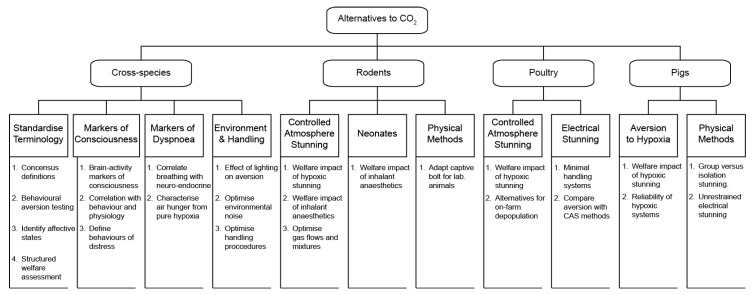
: The use of carbon dioxide (CO2) for stunning and killing animals is considered to compromise welfare due to air hunger, anxiety, fear, and pain. Despite decades of research, no alternatives have so far been found that provide a safe and reliable way to induce unconsciousness in groups of animals, and also cause less distress than CO2. Here, we revisit the current and historical literature to identify key research questions that may lead to the identification and implementation of more humane alternatives to induce unconsciousness in mice, rats, poultry, and pigs. In addition to the evaluation of novel methods and agents, we identify the need to standardise the terminology and behavioural assays within the field. We further reason that more accurate measurements of consciousness state are needed and serve as a central component in the assessment of suffering. Therefore, we propose a roadmap toward improving animal welfare during end-of-life procedures.
Keywords: Animal welfare, carbon dioxide, stunning, killing, euthanasia, rodents, poultry, pigs, aversion, air hunger..
Conflict of interest statement
The authors declare no conflict of interest.
Figures
References
-
- Abeyesinghe S.M., McKeegan D.E., McLeman M.A., Lowe J.C., Demmers T.G., White R.P., Kranen R.W., van Bemmel H., Lankhaar J.A., Wathes C.M. Controlled atmosphere stunning of broiler chickens. I. Effects on behaviour, physiology and meat quality in a pilot scale system at a processing plant. Br. Poult. Sci. 2007;48:406–423. doi: 10.1080/00071660701543089. - DOI - PubMed
-
- Parshall M.B., Schwartzstein R.M., Adams L., Banzett R.B., Manning H.L., Bourbeau J., Calverley P.M., Gift A.G., Harver A., Lareau S.C. An official American Thoracic Society statement: update on the mechanisms, assessment, and management of dyspnea. Am. J. Respir. Crit. Care Med. 2012;185:435–452. doi: 10.1164/rccm.201111-2042ST. - DOI - PMC - PubMed
Grants and funding
LinkOut - more resources
Full Text Sources
