


Adherence to a healthy lifestyle and all-cause and cause-specific mortality in Chinese adults: a 10-year prospective study of 0.5 million people
- PMID: 31685026
- PMCID: PMC6827204
- DOI: 10.1186/s12966-019-0860-z
Adherence to a healthy lifestyle and all-cause and cause-specific mortality in Chinese adults: a 10-year prospective study of 0.5 million people
Abstract
Background: Adherence to a healthy lifestyle is associated with substantially lower risks of mortality from all causes, cardiovascular diseases, and cancer in white populations. However, little is known about the health benefits among non-white populations. Also, no previous studies have focused on respiratory disease mortality in both white and non-white populations. We assessed the relationships between a combination of healthy lifestyle factors and multiple death outcomes in Chinese adults.
Methods: This study included 487,198 adults aged 30-79 years from the China Kadoorie Biobank without heart disease, stroke, and cancer at study enrolment. We defined five healthy lifestyle factors as never smoking or smoking cessation not due to illness; non-daily drinking or moderate alcohol drinking; median or higher level of physical activity; a diet rich in vegetables, fruits, legumes and fish, and limited in red meat; a body mass index of 18.5 to 27.9 kg/m2 and a waist circumference < 90 cm (men)/85 cm (women). Cox regression was used to produce adjusted hazard ratios (HRs) relating these healthy lifestyle factors to all-cause and cause-specific mortality.
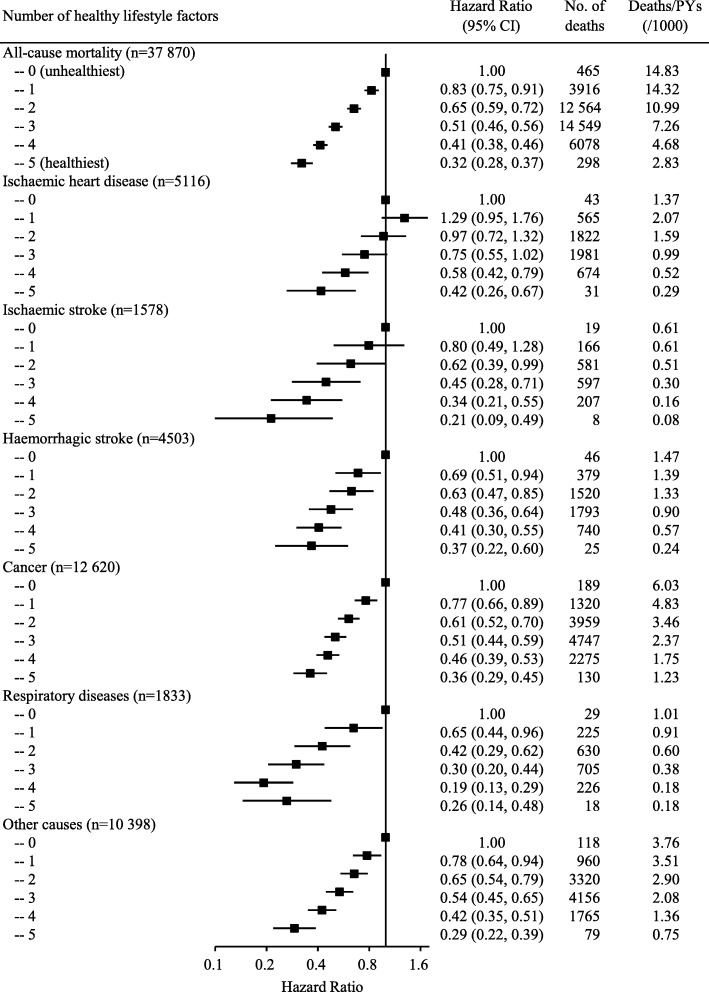
Results: During a median follow-up of 10.2 years (IQR 9.2-11.1), we documented 37,845 deaths. After multivariable adjustment, the number of healthy lifestyle factors exhibited almost inverse linear relationships with the risks of all-cause and cause-specific mortality. Compared with participants without any healthy factors, the hazard ratio of participants with five healthy factors was 0.32 [95% confidence interval (CI): 0.28, 0.37] for all-cause mortality. The corresponding HRs in specific cause of death were 0.42 (95% CI: 0.26, 0.67) for ischaemic heart disease, 0.21 (95% CI: 0.09, 0.49) for ischaemic stroke, 0.37 (95% CI: 0.22, 0.60) for haemorrhage stroke, 0.36 (95% CI: 0.29, 0.45) for cancer, 0.26 (95% CI: 0.14, 0.48) for respiratory diseases, and 0.29 (95% CI: 0.22, 0.39) for other causes. Theoretically, 38.5% (95% CI: 33.0, 43.8%) of all-cause mortality was attributable to nonadherence to a healthy lifestyle, and the proportions of preventable deaths through lifestyle modification ranged from 26.9 to 47.9% for cause-specific mortality.
Conclusions: Adherence to a healthy lifestyle was associated with substantially lower risks of all-cause, cardiovascular, respiratory, and cancer mortality in Chinese adults. Promotion of a healthy lifestyle may considerably reduce the burden of non-communicable diseases in China.
Keywords: Chinese; Cohort study; Healthy lifestyle; Mortality; Non-communicable diseases.
Conflict of interest statement
The authors declare that they have no competing interests.
Figures
References
-
- World Health Organization . Noncommunicable diseases country profiles 2018. Geneva: World Health Organization; 2018.
-
- Bloom DE, Cafiero ET, Jané-Llopis E, Abrahams-Gessel S, Bloom LR, Fathima S, et al. The global economic burden of noncommunicable diseases. Geneva: World Economic Forum; 2011.
-
- Carlsson AC, Wandell PE, Gigante B, Leander K, Hellenius ML, de Faire U. Seven modifiable lifestyle factors predict reduced risk for ischemic cardiovascular disease and all-cause mortality regardless of body mass index: a cohort study. Int J Cardiol. 2013;168(2):946–952. doi: 10.1016/j.ijcard.2012.10.045. - DOI - PubMed
Publication types
MeSH terms
Grants and funding
LinkOut - more resources
Full Text Sources
Medical
