. 2020 Jan;38(1):90-96.
doi: 10.1038/s41587-019-0297-6. Epub 2019 Nov 4.

Large-scale analysis of acquired chromosomal alterations in non-tumor samples from patients with cancer

Affiliations

Large-scale analysis of acquired chromosomal alterations in non-tumor samples from patients with cancer

Y A Jakubek et al. Nat Biotechnol. 2020 Jan.

Abstract

Mosaicism, the presence of subpopulations of cells bearing somatic mutations, is associated with disease and aging and has been detected in diverse tissues, including apparently normal cells adjacent to tumors. To analyze mosaicism on a large scale, we surveyed haplotype-specific somatic copy number alterations (sCNAs) in 1,708 normal-appearing adjacent-to-tumor (NAT) tissue samples from 27 cancer sites and in 7,149 blood samples from The Cancer Genome Atlas. We find substantial variation across tissues in the rate, burden and types of sCNAs, including those spanning entire chromosome arms. We document matching sCNAs in the NAT tissue and the adjacent tumor, suggesting a shared clonal origin, as well as instances in which both NAT tissue and tumor tissue harbor a gain of the same oncogene arising in parallel from distinct parental haplotypes. These results shed light on pan-tissue mutations characteristic of field cancerization, the presence of oncogenic processes adjacent to cancer cells.


Figures
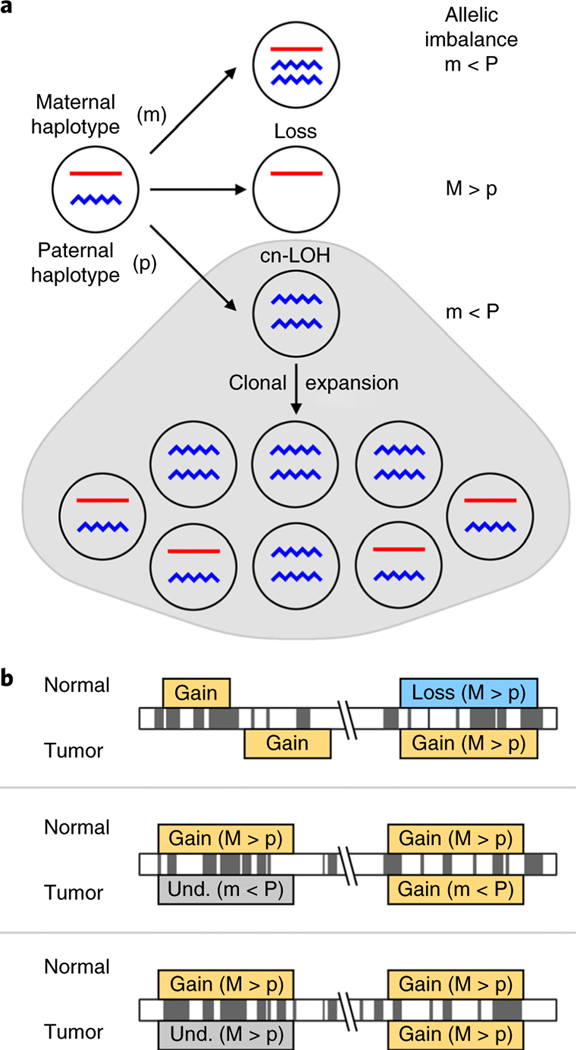
Fig. 1 |
Fig. 1 |. Chromosomal alterations, allelic imbalance and mosaicism.
a, sCnAs lead to deviations from a 1:1 ratio of the maternal to paternal chromosomal segment (haplotype); therefore, the within-sample allele frequencies at heterozygous sites can be used to infer genomic regions with deviations from the 1:1 ratio, which is referred to as allelic imbalance. b, sCnA profiles from non-tumor samples were compared to those from cancers within the same individual. The criteria used for comparison and inference of clonal origin include: event overlap, event type and allelic imbalance direction. The top two panels show examples of events that do not overlap, or that have conflicting event type. The term ‘mirrored allelic imbalance’ has been used to describe instances when samples from the same individual exhibit opposite haplotypes in imbalance, which is shown in the middle panel. As shown in the middle panel, this analysis can help identify conflicting events that are of the same type, or those that are too subtle for classification, which are hereafter referred to as undetermined (und.).
Fig. 2 |
Fig. 2 |. Summary of results.
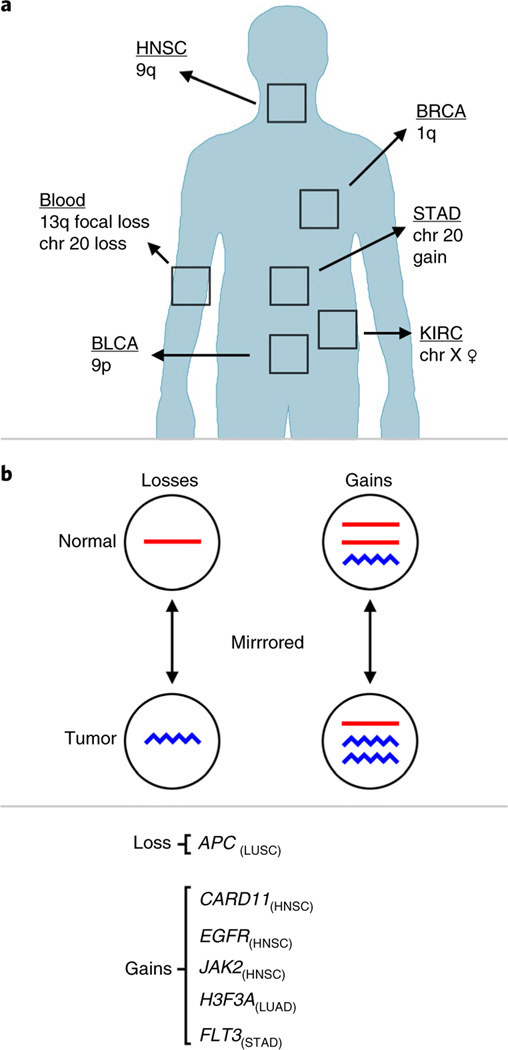
a, A summary of sCnAs with tissue-specific patterns of enrichment. b, Genes that were gained or lost in nAT tissues and that were also gained or lost in the matched tumor, but show mirrored allelic imbalance and are inferred to have arisen independently in separate clonal lineages.
Fig. 3 |
Fig. 3 |. Landscape of sCNAs.
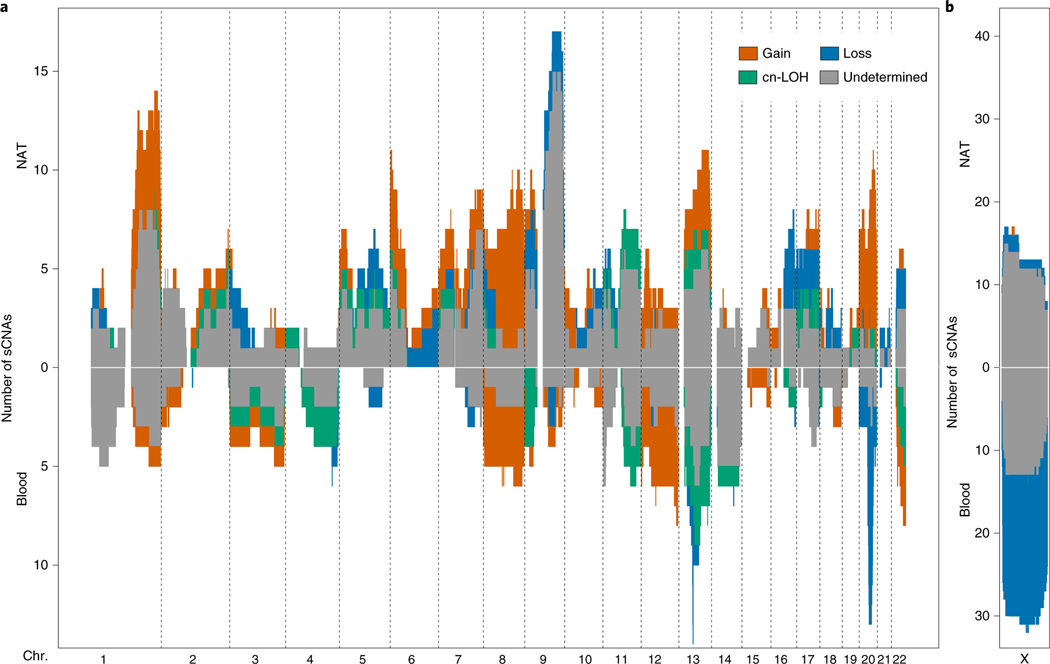
a, The landscape of autosomal sCNAs across blood and NAT tissues. Chromosomes are ordered along the x axis and sCNAs were binned in 1-Mb genomic segments on the basis of their overlap with that region. The number of sCNAs (y axis) is plotted using a different color for each event type. b, The landscape of chromosome X sCNAs in female blood and NAT tissues.
Fig. 4 |
Fig. 4 |. Arm-level sCNAs in NAT tissues.
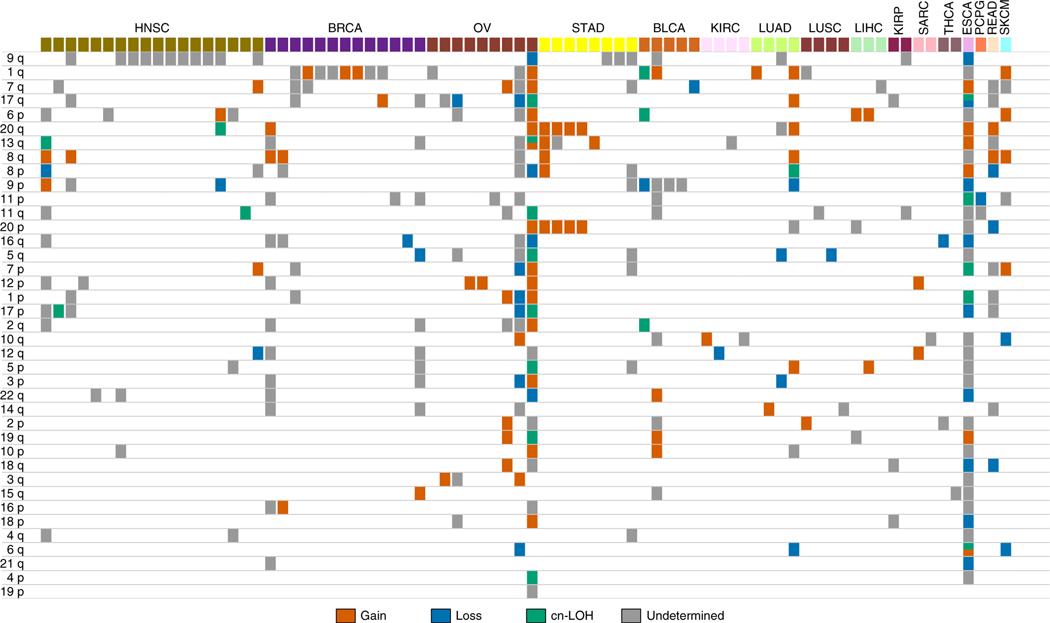
Arm-level sCNA summary for each mosaic NAT tissue, arranged by cancer site. Each column represents one NAT sample with detectable sCNAs. Chromosome arms are ordered by sCNA frequency.

References

    1. Freed D, Stevens EL & Pevsner J. Somatic mosaicism in the human genome. Genes (Basel) 5, 1064–1094 (2014). - PMC - PubMed
    1. Forsberg LA, Gisselsson D. & Dumanski JP Mosaicism in health and disease—clones picking up speed. Nat. Rev. Genet 18, 128–142 (2017). - PubMed
    1. Machiela MJ & Chanock SJ The ageing genome, clonal mosaicism and chronic disease. Curr. Opin. Genet. Dev 42, 8–13 (2017). - PMC - PubMed
    1. Martincorena I. & Campbell PJ Somatic mutation in cancer and normal cells. Science 349, 1483–1489 (2015). - PubMed
    1. Beroukhim R. et al. The landscape of somatic copy-number alteration across human cancers. Nature 463, 899–905 (2010). - PMC - PubMed

Publication types