


Ethnic differences in inflammatory bowel disease: Results from the United Kingdom inception cohort epidemiology study
- PMID: 31686769
- PMCID: PMC6824277
- DOI: 10.3748/wjg.v25.i40.6145
Ethnic differences in inflammatory bowel disease: Results from the United Kingdom inception cohort epidemiology study
Abstract
Background: The current epidemiology of inflammatory bowel disease (IBD) in the multi-ethnic United Kingdom is unknown. The last incidence study in the United Kingdom was carried out over 20 years ago.
Aim: To describe the incidence and phenotype of IBD and distribution within ethnic groups.
Methods: Adult patients (> 16 years) with newly diagnosed IBD (fulfilling Copenhagen diagnostic criteria) were prospectively recruited over one year in 5 urban catchment areas with high South Asian population. Patient demographics, ethnic codes, disease phenotype (Montreal classification), disease activity and treatment within 3 months of diagnosis were recorded onto the Epicom database.
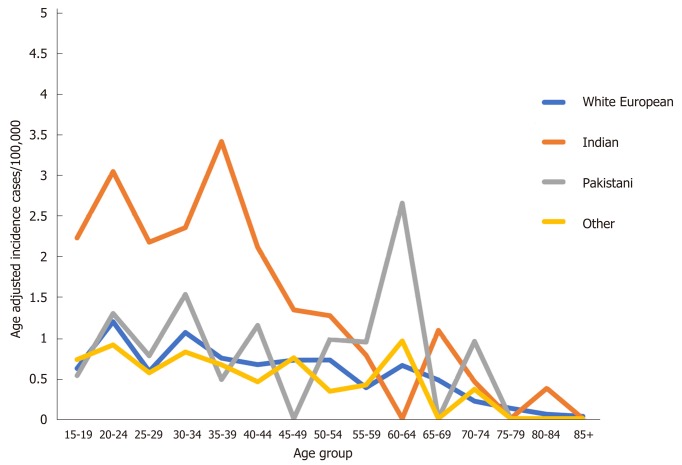
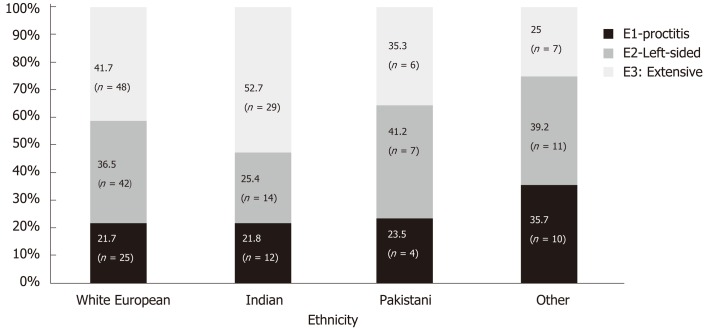
Results: Across a population of 2271406 adults, 339 adult patients were diagnosed with IBD over one year: 218 with ulcerative colitis (UC, 64.3%), 115 with Crohn's disease (CD, 33.9%) and 6 with IBD unclassified (1.8%). The crude incidence of IBD, UC and CD was 17.0/100000, 11.3/100000 and 5.3/100000 respectively. The age adjusted incidence of IBD and UC were significantly higher in the Indian group (25.2/100000 and 20.5/100000) compared to White European (14.9/100000, P = 0.009 and 8.2/100000, P < 0.001) and Pakistani groups (14.9/100000, P = 0.001 and 11.2/100000, P = 0.007). The Indian group were significantly more likely to have extensive disease than White Europeans (52.7% vs 41.7%, P = 0.031). There was no significant difference in time to diagnosis, disease activity and treatment.
Conclusion: This is the only prospective study to report the incidence of IBD in an ethnically diverse United Kingdom population. The Indian ethnic group showed the highest age-adjusted incidence of UC (20.5/100000). Further studies on dietary, microbial and metabolic factors that might explain these findings in UC are underway.
Keywords: Epidemiology; Ethnicity; Incidence; Inflammatory bowel disease; Phenotype.
©The Author(s) 2019. Published by Baishideng Publishing Group Inc. All rights reserved.
Conflict of interest statement
Conflict-of-interest statement: There are no conflicts of interest.
Figures

References
-
- Ng SC, Shi HY, Hamidi N, Underwood FE, Tang W, Benchimol EI, Panaccione R, Ghosh S, Wu JCY, Chan FKL, Sung JJY, Kaplan GG. Worldwide incidence and prevalence of inflammatory bowel disease in the 21st century: a systematic review of population-based studies. Lancet. 2018;390:2769–2778. - PubMed
-
- Burisch J, Pedersen N, Čuković-Čavka S, Brinar M, Kaimakliotis I, Duricova D, Shonová O, Vind I, Avnstrøm S, Thorsgaard N, Andersen V, Krabbe S, Dahlerup JF, Salupere R, Nielsen KR, Olsen J, Manninen P, Collin P, Tsianos EV, Katsanos KH, Ladefoged K, Lakatos L, Björnsson E, Ragnarsson G, Bailey Y, Odes S, Schwartz D, Martinato M, Lupinacci G, Milla M, De Padova A, D'Incà R, Beltrami M, Kupcinskas L, Kiudelis G, Turcan S, Tighineanu O, Mihu I, Magro F, Barros LF, Goldis A, Lazar D, Belousova E, Nikulina I, Hernandez V, Martinez-Ares D, Almer S, Zhulina Y, Halfvarson J, Arebi N, Sebastian S, Lakatos PL, Langholz E, Munkholm P EpiCom-group. East-West gradient in the incidence of inflammatory bowel disease in Europe: the ECCO-EpiCom inception cohort. Gut. 2014;63:588–597. - PubMed
-
- Ng SC, Tang W, Ching JY, Wong M, Chow CM, Hui AJ, Wong TC, Leung VK, Tsang SW, Yu HH, Li MF, Ng KK, Kamm MA, Studd C, Bell S, Leong R, de Silva HJ, Kasturiratne A, Mufeena MNF, Ling KL, Ooi CJ, Tan PS, Ong D, Goh KL, Hilmi I, Pisespongsa P, Manatsathit S, Rerknimitr R, Aniwan S, Wang YF, Ouyang Q, Zeng Z, Zhu Z, Chen MH, Hu PJ, Wu K, Wang X, Simadibrata M, Abdullah M, Wu JC, Sung JJY, Chan FKL Asia–Pacific Crohn's and Colitis Epidemiologic Study (ACCESS) Study Group. Incidence and phenotype of inflammatory bowel disease based on results from the Asia-pacific Crohn's and colitis epidemiology study. Gastroenterology. 2013;145:158–165.e2. - PubMed
-
- Rubin GP, Hungin AP, Kelly PJ, Ling J. Inflammatory bowel disease: epidemiology and management in an English general practice population. Aliment Pharmacol Ther. 2000;14:1553–1559. - PubMed
-
- Office for National Statistics. Census 2011. Available from: https://www.nomisweb.co.uk/census/2011/lc2109ewls.
Publication types
MeSH terms
Grants and funding
LinkOut - more resources
Full Text Sources
Medical
