


A new record of the invasive seaweed Caulerpa cylindracea Sonder in the South Adriatic Sea
- PMID: 31687554
- PMCID: PMC6819781
- DOI: 10.1016/j.heliyon.2019.e02449
A new record of the invasive seaweed Caulerpa cylindracea Sonder in the South Adriatic Sea
Erratum in
-
Erratum to "A new record of the invasive seaweed Caulerpa cylindracea Sonder in the South Adriatic Sea" [Heliyon 5 (9), (September 2019), e02449].Heliyon. 2019 Nov 1;5(10):e02628. doi: 10.1016/j.heliyon.2019.e02628. eCollection 2019 Oct. Heliyon. 2019. PMID: 31720451 Free PMC article.
Abstract
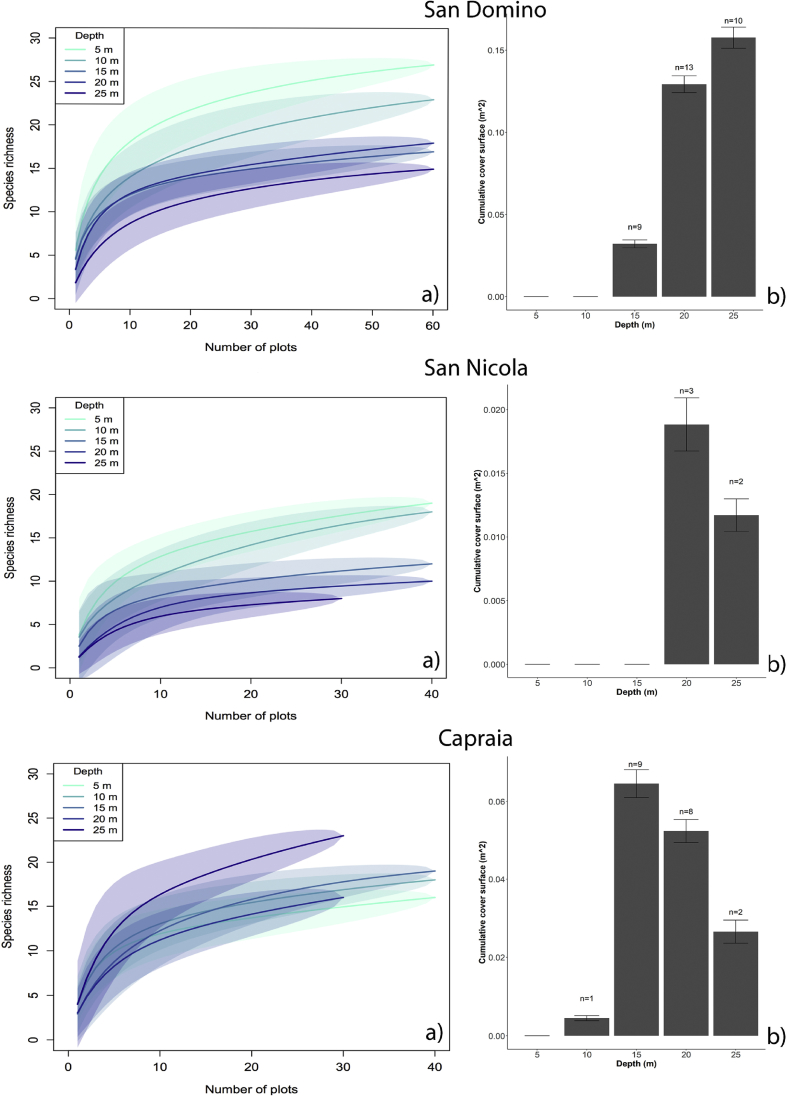
The green alga Caulerpa cylindracea Sonder is one of the most infamous and threatening invasive species in the Mediterranean Sea. Since 1985, it started rapidly spreading to all Mediterranean regions causing many ecological changes on natural communities. In the present study, we present an example of this proliferation with the first record in the Marine Protected Area of Tremiti Island (MPATI) in the South Adriatic Sea. Fifteen sites along the coast and 5 different depths have been investigated. Our results provide eveidence of a wide invasion of this pest in three islands, San Domino, San Nicola and Capraia. This study fills a particular data gap in the ongoing biomonitoring of invasive seaweeds in the Mediterranean Sea representing a base line of this invasive species for the MPATI.
Keywords: Aquatic ecology; Bioinvasion; Biological pollutants; Caulerpa cylindracea; Ecology; Ecosystem change; Environmental science; Flora; Invasive macrophytes; Mediterranean sea; Tropicalisation.
© 2019 The Author(s).
Figures


References
-
- Alongi G., Cormaci M., Furnari G., Giaccone G. Prima segnalazione di Caulerpa racemosa (Chlorophyceae, Caulerpales) per le coste italiane. Bollettino dell’Accademia Gioenia di Scienze Naturali Catania. 1993;26(342):9–53.
-
- Altamirano M., Andreakis N., Souza-Egipsy V., Zanolla M., De la Rosa J. Vol. 71. 2014. First record of Caulerpa cylindracea (caulerpaceae, chlorophyta) in andalusia (southern Spain) pp. 2–007. (Anales del Jardín Botánico de Madrid).
-
- Anderson L.W. Control of invasive seaweeds. Bot. Mar. 2007;50:418–437.
-
- Arenas F., Sanchez I., Hawkins S., Jenkins S.R. The invasibility of marine algal assemblages: role of functional diversity and identity. Ecology. 2006;87:2851–2861. - PubMed
-
- Argyrou M., Demetropoulos A., Hadjichristophorou M. Expansion of the macroalga Caulerpa racemosa and changes in softbottom macrofaunal assemblages in Moni Bay, Cyprus. Oceanol. Acta. 1999;22:517–528.
LinkOut - more resources
Full Text Sources
Miscellaneous
