. 2019 Nov 5;10(6):e01879-19.
doi: 10.1128/mBio.01879-19.

Paternal Grandmother Age Affects the Strength of Wolbachia-Induced Cytoplasmic Incompatibility in Drosophila melanogaster

Affiliations

Paternal Grandmother Age Affects the Strength of Wolbachia-Induced Cytoplasmic Incompatibility in Drosophila melanogaster

Emily M Layton et al. mBio. .

Abstract

Wolbachia are obligate intracellular bacteria that are globally distributed in half of all arthropod species. As the most abundant maternally inherited microbe in animals, Wolbachia manipulate host reproduction via reproductive parasitism strategies, including cytoplasmic incompatibility (CI). CI manifests as embryonic death when Wolbachia-modified sperm fertilize uninfected eggs but not maternally infected eggs. Thus, CI can provide a relative fitness advantage to Wolbachia-infected females and drive the infection through a population. In the genetic model Drosophila melanogaster, the Wolbachia strain wMel induces variable CI, making mechanistic studies in D. melanogaster cumbersome. Here, we demonstrate that sons of older paternal D. melanogaster grandmothers induce stronger CI than sons of younger paternal grandmothers, and we term this relationship the "paternal grandmother age effect" (PGAE). Moreover, the embryos and adult sons of older D. melanogaster grandmothers have higher Wolbachia densities, correlating with their ability to induce stronger CI. In addition, we report that Wolbachia density positively correlates with female age and decreases after mating, suggesting that females transmit Wolbachia loads that are proportional to their own titers. These findings reveal a transgenerational impact of age on wMel-induced CI, elucidate Wolbachia density dynamics in D. melanogaster, and provide a methodological advance to studies aimed at understanding wMel-induced CI in the D. melanogaster model.IMPORTANCE Unidirectional cytoplasmic incompatibility (CI) results in a postfertilization incompatibility between Wolbachia-infected males and uninfected females. CI contributes to reproductive isolation between closely related species and is used in worldwide vector control programs to drastically lower arboviral vector population sizes or to replace populations that transmit arboviruses with those resistant to transmission. Despite decades of research on the factors that influence CI, penetrance is often variable under controlled laboratory conditions in various arthropods, suggesting that additional variables influence CI strength. Here, we demonstrate that paternal D. melanogaster grandmother age influences the strength of CI induced by their sons. Older D. melanogaster females have higher Wolbachia densities and produce offspring with higher Wolbachia densities that associate with stronger CI. This work reveals a multigenerational impact of age on CI and expands our understanding of host-Wolbachia interactions and the biology of CI induced by the Wolbachia strain infecting the most widely used arthropod model, D. melanogaster.

Keywords: Drosophila melanogaster; Wolbachia; cytoplasmic incompatibility; maternal transmission.


Figures

FIG 1
FIG 1
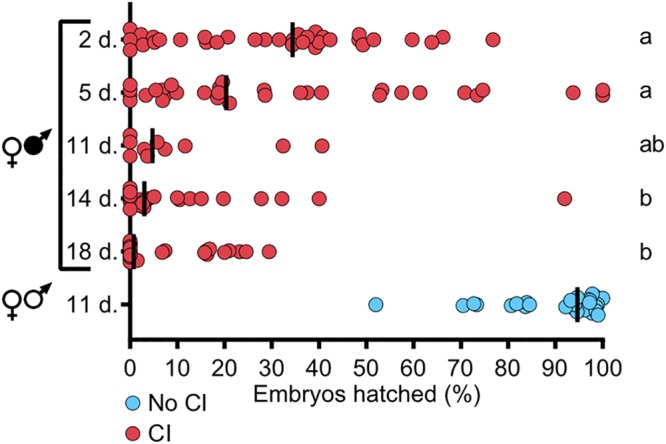
Paternal grandmother age effect impacts CI strength. Hatch rate assays were conducted with either uninfected y1w* males derived from uninfected females aged 11 days (d.) before mating or infected y1w* males derived from infected females aged 2, 5, 11, 14, or 18 days. Wolbachia infections are represented by filled sex symbols, and the age of the paternal grandmother is shown immediately to the left of the y axis. Each dot represents a replicate of offspring from single-pair matings. Vertical bars represent medians, and letters to the right indicate significant differences based on α = 0.05 calculated by a Kruskal-Wallis test followed by a Dunn’s multiple-comparison test performed between all CI crosses. All statistical values are presented in Table S1 in the supplemental material.
FIG 2
FIG 2
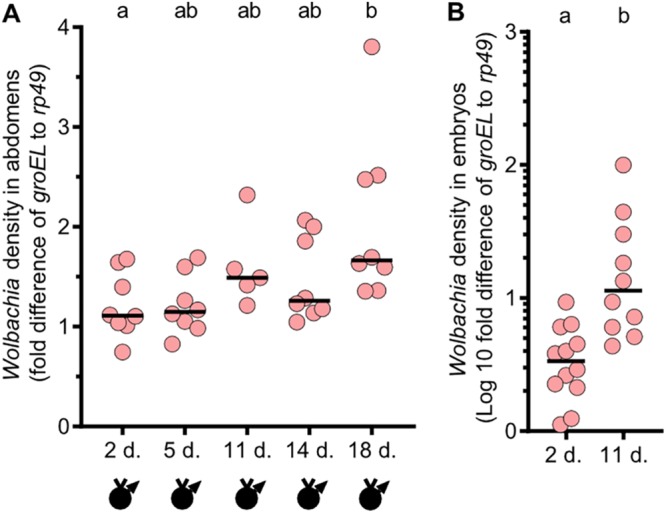
Wolbachia densities are highest in sons and embryos of older D. melanogaster grandmothers. (A) Wolbachia density assays were conducted with virgin females (indicated by a “v” above a sex symbol) and with infected y1w* males derived from grandmothers aged 2, 5, 11, 14, or 18 days (d.). Wolbachia infections are represented by filled sex symbols, and the age of the grandmother is shown immediately below the x axis. The samples analyzed were from abdomens of siblings of fathers corresponding to the hatch rate data in Fig. 1. (B) Wolbachia density assays were conducted with pools of 50 1-to-2-h-old embryos collected from 2-and-11-day-old grandmothers. The sex of the embryos was unknown since it cannot be determined visually. Wolbachia titers were lower in adults, requiring a standard linear scale (A), but higher in embryos, requiring a common logarithmic scale (B). Each dot represents the average of results from triplicate technical replicates for panel A and duplicates for panel B. Horizontal bars indicate medians, and the letters above the bars indicate significant differences based on α = 0.05 calculated by Kruskal-Wallis test followed by a Dunn’s multiple-comparison test performed between all groups (A) or by a Mann Whitney U test (B). All statistical values are presented in Table S1. Fold differences in Wolbachia densities (groEL) relative to D. melanogaster reference gene rp49 were determined with 2−ΔΔCT.
FIG 3
FIG 3
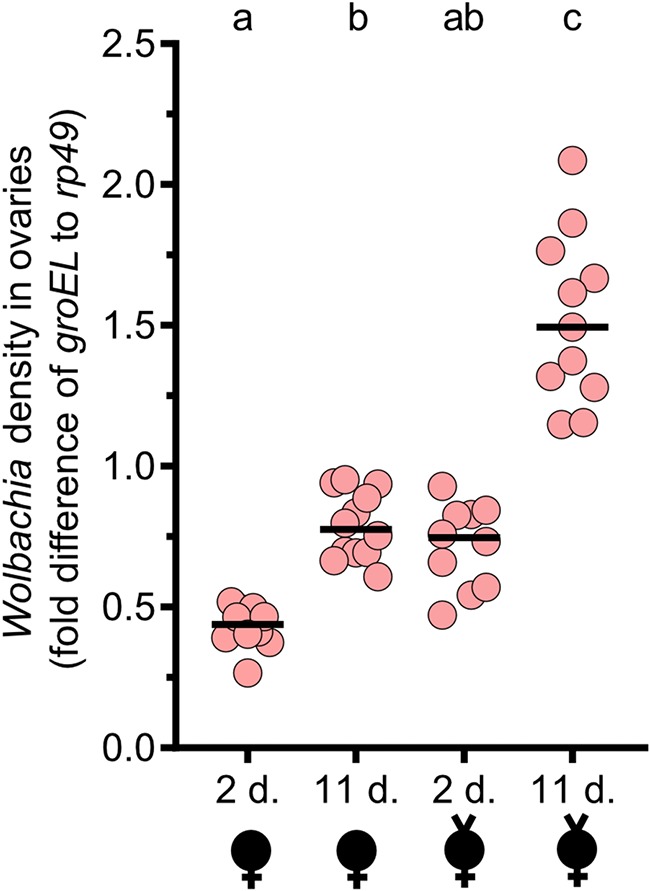
Wolbachia densities increase with female age in ovaries and decrease after mating. Wolbachia density assays were conducted with pools of 4 ovaries from virgin females (indicated by a “v” above a sex symbol) and nonvirgin females aged 2 or 11 days (d.). Wolbachia infections are represented by filled sex symbols, and the age of the sample is shown immediately below the x axis. Virgin and nonvirgin females were siblings. The nonvirgin females produced the embryos whose results are shown in Fig. 2B. Nonvirgin females were allowed to mate and lay for 48 h before ovary dissections. Nonvirgin and virgin females were incubated for that same period of time and dissected in parallel. Each dot represents the average of duplicate values. Horizontal bars indicate medians, and the letters above the bars indicate significant differences based on α = 0.05 calculated by a Kruskal-Wallis test followed by a Dunn’s multiple-comparison test performed between all groups. All statistical values are presented in Table S1. Fold differences in Wolbachia density (groEL) relative to D. melanogaster reference gene rp49 were determined with 2−ΔΔCT.

References

    1. Hilgenboecker K, Hammerstein P, Schlattmann P, Telschow A, Werren JH. 2008. How many species are infected with Wolbachia? – a statistical analysis of current data: Wolbachia infection rates. FEMS Microbiol Lett 281:215–220. doi:10.1111/j.1574-6968.2008.01110.x. - DOI - PMC - PubMed
    1. Weinert LA, Araujo-Jnr EV, Ahmed MZ, Welch JJ. 2015. The incidence of bacterial endosymbionts in terrestrial arthropods. Proc Biol Sci 282:20150249. doi:10.1098/rspb.2015.0249. - DOI - PMC - PubMed
    1. Zug R, Hammerstein P. 2012. Still a host of hosts for Wolbachia: analysis of recent data suggests that 40% of terrestrial arthropod species are infected. PLoS One 7:e38544. doi:10.1371/journal.pone.0038544. - DOI - PMC - PubMed
    1. Ferri E, Bain O, Barbuto M, Martin C, Lo N, Uni S, Landmann F, Baccei SG, Guerrero R, de Souza Lima S, Bandi C, Wanji S, Diagne M, Casiraghi M. 2011. New insights into the evolution of Wolbachia infections in filarial nematodes inferred from a large range of screened species. PLoS One 6:e20843. doi:10.1371/journal.pone.0020843. - DOI - PMC - PubMed
    1. Serbus LR, Casper-Lindley C, Landmann F, Sullivan W. 2008. The genetics and cell biology of Wolbachia-host interactions. Annu Rev Genet 42:683–707. doi:10.1146/annurev.genet.41.110306.130354. - DOI - PubMed

Publication types

LinkOut - more resources