. 2020 Mar;51(1):409-416.
doi: 10.1007/s42770-019-00178-z. Epub 2019 Nov 5.

Isolation and characterization of phage AHP-1 and its combined effect with chloramphenicol to control Aeromonas hydrophila

Affiliations

Isolation and characterization of phage AHP-1 and its combined effect with chloramphenicol to control Aeromonas hydrophila

H P S U Chandrarathna et al. Braz J Microbiol. 2020 Mar.

Abstract

To develop an alternative bio-control measure for multi-drug resistant pathogenic Aeromonas hydrophila, which causes motile Aeromonas septicemia in fish, novel virulent phage (AHP-1) was isolated from carp tissues. Morphological analysis by transmission electron microscopy revealed that AHP-1 belongs to Myoviridae family. AHP-1 displayed 81% of moderate adsorption by 25 min, and latent period of 40 min with burst size of 97 PFU mL-1 at an optimal multiplicity of infection (MOI) 0.1. AHP-1 was stable over a broad range of pH (4-11), temperature (4-50 °C), and salinity (0.1-3.5%). Both time and MOI dependent in vitro A. hydrophila growth inhibition was observed with AHP-1. AHP-1 (10 MOI) showed higher growth inhibition against A. hydrophila than chloramphenicol (5 μg mL-1), and combined treatment was more promising than individuals. Immune gene expression analysis of zebrafish upon continuous bath exposure to AHP-1 resulted significantly higher (il-6 and sod-1) or slight induction (tnf-α, il1-β, il-10, and cxcl-8a) than controls at beginning of the phage exposure, but those lowered to basal level by day 12 post-phage exposure. It suggests no adverse immune responses have occurred for the AHP-1 dose that used, and have potential for the phage therapy. Further detailed in vivo studies are needed to confirm the protective efficacy of newly isolated AHP-1 against A. hydrophila infection.

Keywords: A. hydrophila; Chloramphenicol; Fish pathogen; Immune responses; Multi-drug resistance; Phage AHP-1.


Conflict of interest statement

The authors declare that they have no conflict of interest.

Figures
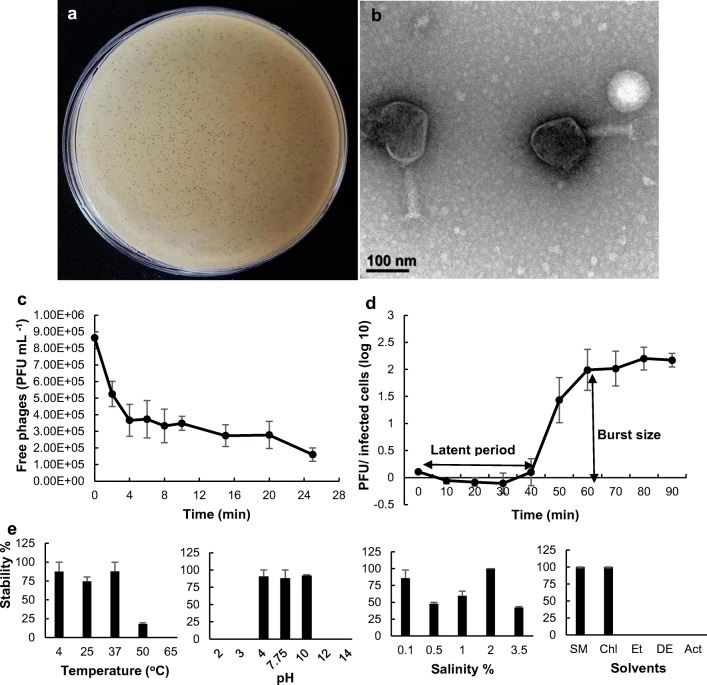
Fig. 1
Fig. 1
Characterization of AHP-1: a plaque morphology, b TEM image showing icosahedral head and sheathed tail tube with tail fiber of AHP-1. Bar = 100 nm, c adsorption curve, d one-step growth profile of AHP-1 indicating burst size and latent period. All the experiments were conducted at MOI = 0.1 as independent duplicate experiments, e stability of AHP-1 in a range of temperatures (4–65 °C), pH (2–14), salinity (0.1–3.5%), and different organic solvents (chloroform, ethanol; EtOH, diethyl ether, acetone). Phage stability percentages of temperature, pH, salinity, and organic solvents were calculated based on 4 °C, 10, 2%, and SM buffer, respectively. Error bars represent mean ± SE
Fig. 2
Fig. 2
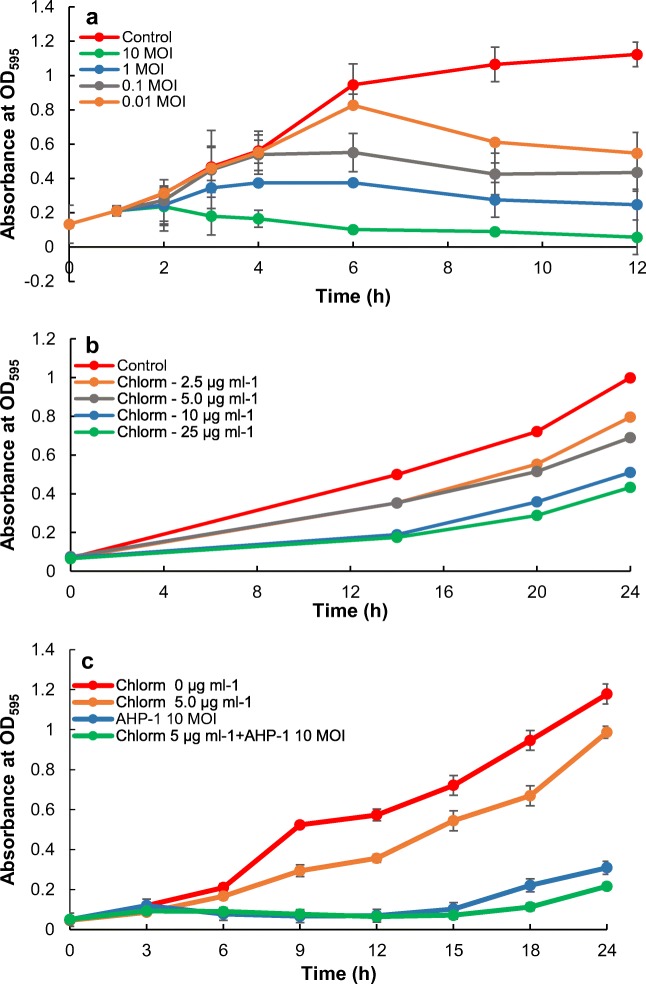
Comparison of individual and combined in vitro effect on A. hydrophila growth inhibition over the time with AHP-1 and chloramphenicol: a growth inhibition by AHP-1 at different MOI (10, 1, 0.1, and 0.01), b growth inhibition by chloramphenicol at different doses (2.5, 5, 15, and 25 μg mL−1), c combined effect on growth inhibition by AHP-1 and chloramphenicol. Error bars represent mean ± SE; chloramphenicol = Chlorm
Fig. 3
Fig. 3
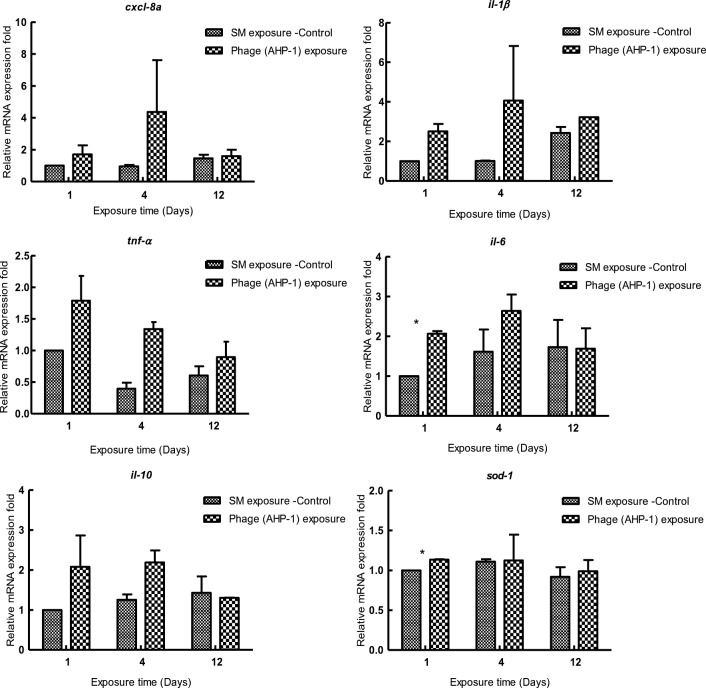
Transcriptional analysis of immune related genes (cxcl-8a, il1-β, tnf-α, il-6, il-10, and sod-1) in adult zebrafish upon bath exposure of AHP-1 for 12 days. Experiments were conducted as independent duplicate experiments for control and phage exposure. Tissues were pooled (n = 3) at each time point for each replicate group. Relative mRNA expression fold change for a particular candidate gene of SM buffer exposed fish at day 1 = 1. Asterisk represents significantly different (P < .05) values with controls. Error bars represent mean ± SE

References

    1. Zaman SB, Hussain MA, Nye R, Mehta V, Mamun KT, Hossain N. A review on antibiotic resistance: alarm bells are ringing. Cureus. 2017;9:e1403. doi: 10.7759/cureus.1403. - DOI - PMC - PubMed
    1. Aslam B, Wang W, Arshad MI, Khurshid M, Muzammil S, Rasool MH, Nisar MA, Alvi RF, Aslam MA, Qamar MU, Salamat MKF, Baloch Z. Antibiotic resistance: a rundown of a global crisis. Infect Drug Resist. 2018;11:1645–1658. doi: 10.2147/IDR.S173867. - DOI - PMC - PubMed
    1. Miranda CD, Godoy FA, Lee MR. Current status of the use of antibiotics and the antimicrobial resistance in the Chilean salmon farms. Front Microbiol. 2018;9:1–14. doi: 10.3389/fmicb.2018.01284. - DOI - PMC - PubMed
    1. Salmond GPC, Fineran PC. A century of the phage: past, present and future. Nat Rev Microbiol. 2015;13:777–786. doi: 10.1038/nrmicro3564. - DOI - PubMed
    1. Rose T, Verbeken G, De Vos D, Merabishvili M, Vaneechoutte M, Lavigne R, Jennes S, Zizi M, et al. Experimental phage therapy of burn wound infection: difficult first steps. Int J Burns Trauma. 2014;4:66–73. - PMC - PubMed

MeSH terms