. 2020 Jan;34(1):103-114.
doi: 10.1177/0269881119885262. Epub 2019 Nov 6.

Pro-cognitive effect of upregulating cyclic guanosine monophosphate signalling during memory acquisition or early consolidation is mediated by increased AMPA receptor trafficking

Affiliations

Pro-cognitive effect of upregulating cyclic guanosine monophosphate signalling during memory acquisition or early consolidation is mediated by increased AMPA receptor trafficking

Elentina K Argyrousi et al. J Psychopharmacol. 2020 Jan.

Abstract

Background: Episodic memory consists of different mnemonic phases, including acquisition and early and late consolidation. Each of these phases is characterised by distinct molecular processes. Although both cyclic adenosine monophosphate (cAMP) and cyclic guanosine monophosphate (cGMP) are implicated in the acquisition phase, early consolidation only depends on cGMP, whereas late consolidation is mediated by cAMP. Accordingly, the cGMP-selective phosphodiesterase 5 (PDE5) inhibitor vardenafil or the cAMP-selective PDE4 inhibitor rolipram can improve memory acquisition or consolidation when applied during their respective time windows.

Aims: Considering the important role of glutamatergic α-amino-3-hydroxy-5-methyl-4-isoxazolepropionic acid receptors (AMPAR) during normal memory function, we aimed to investigate whether the differential actions of these PDE inhibitors are mediated through AMPAR dynamics.

Methods: For biochemical analysis, mice were treated with either vardenafil or rolipram and sacrificed shortly after injection. For the behavioural studies, mice received either of the inhibitors during the different mnemonic phases, while their spatial memory was tested using the object location task, and they were sacrificed 24 hours later.

Results: Administration of either vardenafil or rolipram causes rapid changes in AMPARs. Moreover, treatment with vardenafil during the acquisition or early consolidation of spatial memory resulted in increased surface levels of AMPARs which were still augmented 24 hours after learning. Membrane levels of AMPARs were not affected anymore 24 hours after learning when rolipram was administrated at either the acquisition or late consolidation phase.

Conclusions: These results suggest that dissociative molecular mechanisms could mediate the pro-cognitive function of different classes of PDE inhibitors, and in the case of vardenafil, this phenomenon could be explained by changes in AMPAR dynamics.

Keywords: AMPA receptors; Phosphodiesterase inhibitors; cAMP; cGMP; cyclic nucleotide pathways; rolipram; vardenafil.


Conflict of interest statement

Declaration of conflicting interests: The author(s) declared no potential conflicts of interest with respect to the research, authorship, and/or publication of this article.

Figures

Figure 1.
Figure 1.
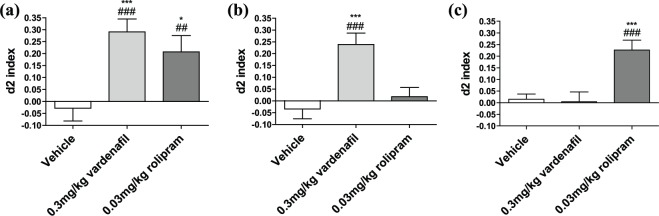
The effect of vardenafil and rolipram treatment given intraperitoneally in the object location task (OLT) at different memory stages. (a) OLT performance after treatment with vardenafil or rolipram 30 minutes before T1 (acquisition phase) and with a 24-hour retention interval showed that both treated groups are able to discriminate between the old and the new location of the object compared to zero (chance level). Additionally, treated animals exhibit improved d2 index in comparison to that of the vehicle. N=18 for all three groups. (b) OLT performance when the treatment was given 20 minutes after T1 (early consolidation phase), and the animals tested after a 24-hour inter-trial interval showed that only treatment with vardenafil was able to improve the animals’ performance in comparison to the chance level, as well as the d2 index in comparison to that of the vehicle. N=18 for all the groups. (c) OLT performance when treatment was administered three hours after T1 (late consolidation phase) showed that only treatment with rolipram improved the animals’ performance in comparison to the chance level. Additionally, the d2 index differs significantly from that of the vehicle-treated group. Vehicle group: N=17; vardenafil group: N=19; rolipram group: N=20. Data are shown as the mean±standard error of the mean (SEM). A significant difference from zero is depicted with hashes (one sample t-tests, ##p<0.01; ###p<0.001). A significant difference from the vehicle condition is depicted with asterisks (one-way analysis of variance (ANOVA) followed by post hoc Dunnett’s test, *p<0.05; ***p<0.001).
Figure 2.
Figure 2.
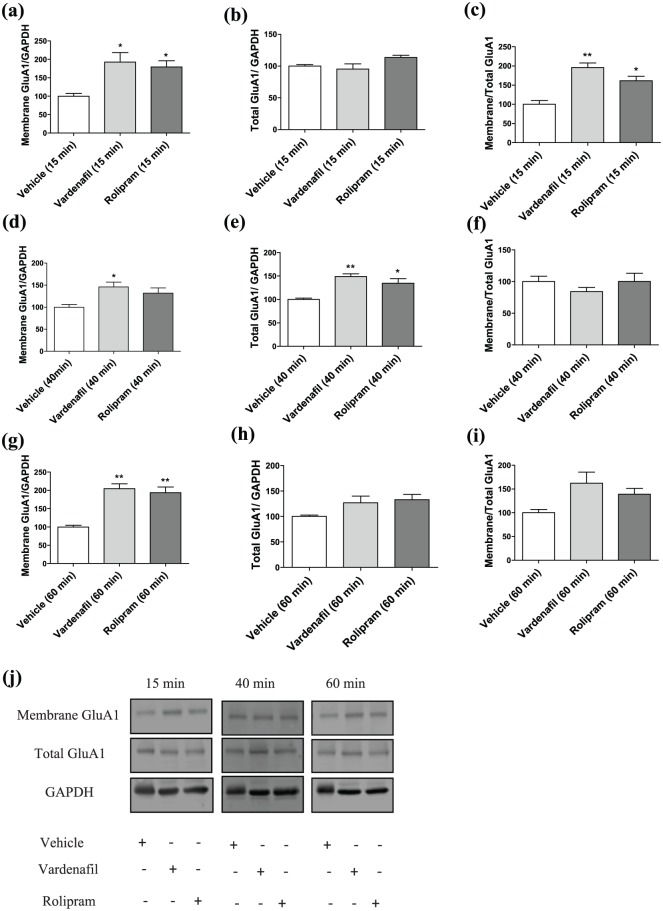
Effects of vardenafil or rolipram treatment on GluA1-AMPAR dynamics at different time points. (a)–(c) Administration of either vardenafil or rolipram resulted in an increased GluA1-AMPAR membrane/total ratio in the hippocampus of mice sacrificed 15 minutes after treatment, while total levels of GluA1-AMPARs remain unaffected. Additionally, increased surface expression of GluA1-AMPARs was observed for the vardenafil-treated animals in comparison to the vehicle. (a) N=4, 6, 6 for vehicle, vardenafil and rolipram, respectively; (b) N=3, 6, 5 for vehicle, vardenafil and rolipram, respectively; (c) N=3, 4, 6 for vehicle vardenafil and rolipram, respectively. (d)–(f) When the brains were harvested 40 minutes after drug administration, both treatments resulted in increased total levels of GluA1-AMPARs and a concomitant upregulation of the surface fraction of the receptors only for the vardenafil-treated animals. At this time point, there was no difference in the membrane/total ratio of GluA1-AMPARs between the groups. (d) and (e) N=4, 6, 6 for vehicle, vardenafil and rolipram, respectively; (f) N=4, 5, 6 for vehicle, vardenafil and rolipram, respectively. (g)–(i) Waiting 60 minutes before harvesting the brains resulted in upregulation of membrane levels of GluA1-AMPARs for both treatments, while the total levels and the membrane/total ratio did not differ from the vehicle. (g) and (h) N=3, 6, 6 for vehicle, vardenafil and rolipram, respectively; (i) N=4, 6, 6 for vehicle, vardenafil and rolipram, respectively. (j) Representative blots for each time point. Data are shown as the mean±SEM. A significant difference from the vehicle condition is depicted with asterisks (one-way ANOVA followed by post hoc Dunnett’s test, *p<0.05; **p<0.01).
Figure 3.
Figure 3.
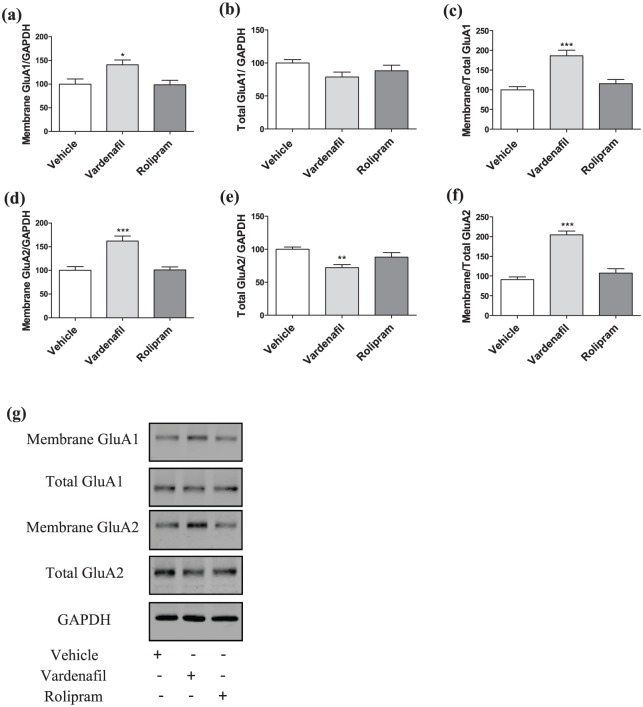
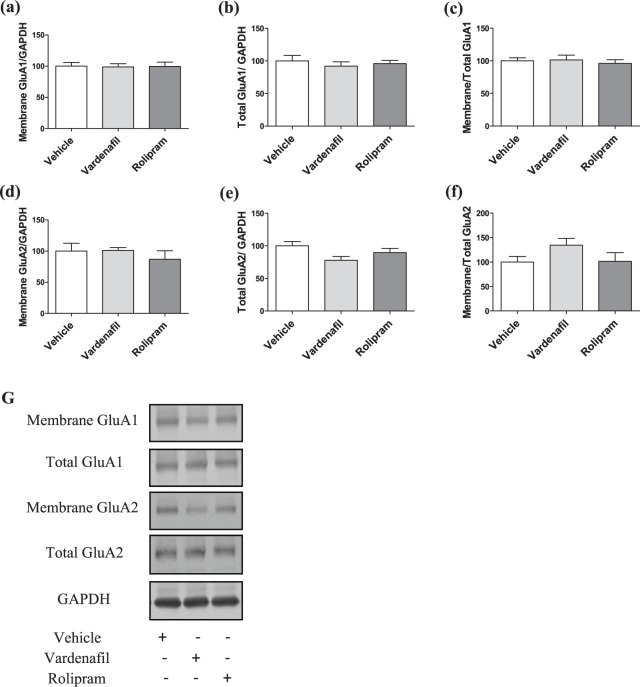
Effects of vardenafil or rolipram treatment on GluA1 and GluA2 AMPAR subunits 24 hours after T1, while the treatment was given 30 minutes before T1. (a)–(c) Administration of vardenafil before T1 resulted in increased surface expression of GluA1-AMPARs that was accompanied by upregulated membrane/total ratio, while the total levels of GluA1-AMPARs did not differ from the vehicle-treated animals. Administration of rolipram did not affect any of these values. (d)–(f) Treatment with vardenafil at the same time point as before increased the surface/GAPDH and membrane/total ratio of GluA2-AMPARs, while the total levels were decreased. Treatment with rolipram had no effect to these values. N=7 for all the conditions. (g) Representative blots for the acquisition treatments. Data are shown as the mean±SEM. A significant difference from the vehicle condition is depicted with asterisks (one-way ANOVA followed by post hoc Dunnett’s test, *p<0.05; **p<0.01; ***p<0.001).
Figure 4.
Figure 4.
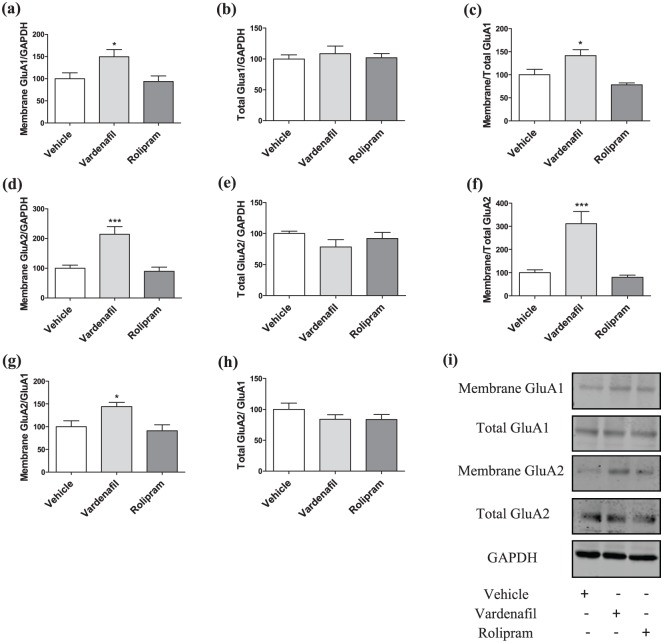
Effects of vardenafil or rolipram treatment on GluA1 and GluA2 AMPAR subunits 24 hours after T1, while the treatment was given 20 minutes after T1. (a)–(c) Administration of vardenafil 20 minutes after T1 resulted in increased membrane/GAPDH and membrane/total ratio of GluA1-AMPARs, while the total levels of GluA1-AMPARs remained unaffected. Administration of rolipram did not affect any of these values. (a) and (b) N=8 for all the groups; (c) N=8, 8, 7 for vehicle, vardenafil and rolipram, respectively. (d)–(f) Similar to GluA1-AMPARs, treatment with vardenafil at the same time point upregulated both the membrane/GAPDH and membrane/total ratio of GluA2-AMPARs without changing the total levels. Treatment with rolipram did not affect these values. (d) and (e) N=8 for all the groups; (f) N=8, 8, 7 for vehicle, vardenafil and rolipram, respectively. (g) and (h) Vardenafil-treated animals exhibited increase in membrane GluA2/GluA1 ratio, whereas no changes are observed in the total GluA2/GluA1 ratio. (g) N=8 for all the groups; (h) N=8, 7, 8 for vehicle, vardenafil and rolipram, respectively. (i) Representative blots for the early consolidation treatments. Data are shown as the mean±SEM. A significant difference from the vehicle condition is depicted with asterisks (one-way ANOVA followed by post hoc Dunnett’s test, *p<0.05; ***p<0.001).
Figure 5.
Figure 5.
Effects of vardenafil or rolipram treatment on GluA1 and GluA2 AMPAR subunits 24 hours after T1, while the treatment was given three hours after T1. (a)–(c) Administration of vardenafil or rolipram three hours after T1 did not affect the surface levels, total levels and the membrane/total ratio of GluA1-AMPARs. (a) N=7, 8, 8 for vehicle, vardenafil and rolipram, respectively. (b) and (c) N=8 for all the groups. (d)–(f) Treatment with vardenafil or rolipram at the same time point did not change GluA2-AMPARs dynamics. N=8 for all the groups. (g) Representative blots for the late consolidation treatments. Data are shown as the mean±SEM.

References

    1. Akkerman S, Blokland A, Prickaerts J. (2016) Possible overlapping time frames of acquisition and consolidation phases in object memory processes: a pharmacological approach. Learn Memory 23: 29–37. - PMC - PubMed
    1. Akkerman S, Blokland A, Reneerkens O, et al. (2012) Object recognition testing: methodological considerations on exploration and discrimination measures. Behav Brain Res 232: 335–347. - PubMed
    1. Arancio O, Kandel E, Hawkins R. (1995) Activity-dependent long-term enhancement of transmitter release by presynaptic 3′,5′-cyclic GMP in cultured hippocampal neurons. Nature 376: 74. - PubMed
    1. Bach ME, Barad M, Son H, et al. (1999) Age-related defects in spatial memory are correlated with defects in the late phase of hippocampal long-term potentiation in vitro and are attenuated by drugs that enhance the cAMP signaling pathway. Proc Natl Acad Sci U S A 96: 5280–5285. - PMC - PubMed
    1. Banke T, Bowie D, Lee H-K, et al. (2000) Control of GluR1 AMPA receptor function by cAMP-dependent protein kinase. J Neurosci 20: 89–102. - PMC - PubMed

Publication types