


Clinical outcomes and toxicity of proton beam radiation therapy for re-irradiation of locally recurrent breast cancer
- PMID: 31692702
- PMCID: PMC6806378
- DOI: 10.1016/j.ctro.2019.09.005
Clinical outcomes and toxicity of proton beam radiation therapy for re-irradiation of locally recurrent breast cancer
Abstract
Purpose: Repeat radiation therapy (RT) using photons/X-rays for locally recurrent breast cancer results in increased short and long-term toxicity. Proton beam RT (PBRT) can minimize dose to surrounding organs, thereby potentially reducing toxicity. Here, we report the toxicity and clinical outcomes for women who underwent re-irradiation to the chest wall for locally recurrent breast cancer using PBRT.
Materials and methods: This was a retrospective study analyzing 16 consecutive patients between 2013 and 2018 with locally recurrent breast cancer who underwent re-irradiation to the chest wall with PBRT. For the recurrent disease, patients underwent maximal safe resection, including salvage mastectomy, wide local excision, or biopsy only per surgeons recommendations. Systemic therapy was used per the recommendation of the medical oncologist. Patients were treated with median dose of 50.4 Cobalt Gray Equivalent (CGyE) in 28 fractions at the time of re-irradiation. Follow-up was calculated from the start of second RT course. Acute toxicities were defined as those occurring during treatment or up to 8 weeks after treatment. Late toxicities were defined as those occurring more than 8 weeks after the completion of therapy. Toxicities were based on CTCAE 4.0.
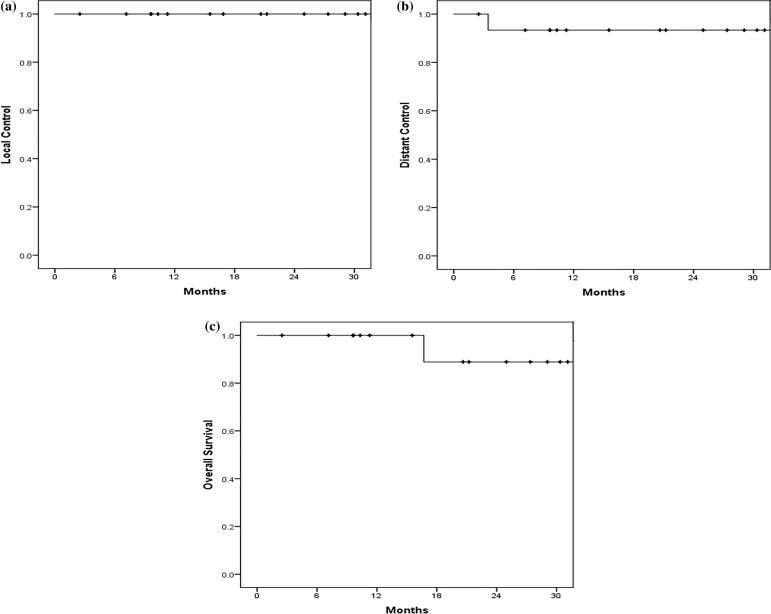
Results: The median age at original diagnosis and at recurrence was 49.8 years and 60.2 years, respectively. The median time between the two RT courses was 10.2 (0.7-20.2) years. The median follow-up time was 18.7 (2.5-35.2) months. No local failures were observed after re-irradiation. One patient developed distant metastasis and ultimately died. Grade 3-4 acute skin toxicity was observed in 5 (31.2%) patients. Four (25%) patients developed chest wall infections during or shortly (2 weeks) after re-irradiation. Late grade 3-4 fibrosis was observed in only 3 (18.8%) patients. Grade 5 toxicities were not observed. Hyperpigmentation was seen in 12 (75%) patients. Pneumonitis, telangiectasia, rib fracture, and lymphedema occurred in 2 (12.5%), 4 (25%), 1 (6.3%), and 1 (6.3%) patients, respectively.
Conclusions: Re-irradiation with PBRT for recurrent breast cancer has acceptable toxicities. There was a high incidence of acute grade 3-4 skin toxicity and infections, which resolved, however, with skin care and antibiotics. Longer follow-up is needed to determine long-term clinical outcomes.
© 2019 The Authors.
Conflict of interest statement
The authors declare that they have no known competing financial interests or personal relationships that could have appeared to influence the work reported in this paper.
Figures
References
-
- Noone A.M., Howlader N., Krapcho M., Miller D., Brest A., Yu M., Ruhl J., Tatalovich Z., Mariotto A., Lewis D.R., Chen H.S., Feuer E.J., Cronin K.A., editors. SEER Cancer Statistics Review, 1975–2015. National Cancer Institute; Bethesda, MD: 2018. https://seercancergov/csr/1975_2015/
-
- Clarke M., Collins R., Darby S., Davies C., Elphinstone P., Evans V. Effects of radiotherapy and of differences in the extent of surgery for early breast cancer on local recurrence and 15-year survival: an overview of the randomised trials. Lancet. 2005;366:2087–2106. - PubMed
-
- Darby S., McGale P., Correa C., Taylor C., Arriagada R., Clarke M. Effect of radiotherapy after breast-conserving surgery on 10-year recurrence and 15-year breast cancer death: meta-analysis of individual patient data for 10,801 women in 17 randomised trials. Lancet. 2011;378:1707–1716. - PMC - PubMed
-
- McGale P., Taylor C., Correa C., Cutter D., Duane F., Ewertz M. Effect of radiotherapy after mastectomy and axillary surgery on 10-year recurrence and 20-year breast cancer mortality: meta-analysis of individual patient data for 8135 women in 22 randomised trials. Lancet. 2014;383:2127–2135. - PMC - PubMed
LinkOut - more resources
Full Text Sources
