


doi: 10.1080/23723556.2019.1677140.
eCollection 2019.
p16: cycling off the beaten path
Affiliations
- PMID: 31692916
- PMCID: PMC6816386
- DOI: 10.1080/23723556.2019.1677140
Item in Clipboard
p16: cycling off the beaten path
Mol Cell Oncol.
.
Abstract
p16INK4A (hereafter called p16) is a faithful cellular ally in the fight against tumorigenesis. Although its canonical pathway through retinoblastoma (RB) is well delineated, RB-independent functions for p16 are beginning to emerge. Here we summarize non-canonical roles of p16, including our recent finding on its role in nucleotide metabolism.
Keywords: AP-1; JNK1/3; NF-κB; Retinoblastoma; SP1; cell cycle; mTORC1; nucleotide metabolism; reactive oxygen species; senescence.
© 2019 The Author(s). Published by Taylor & Francis.
Figures
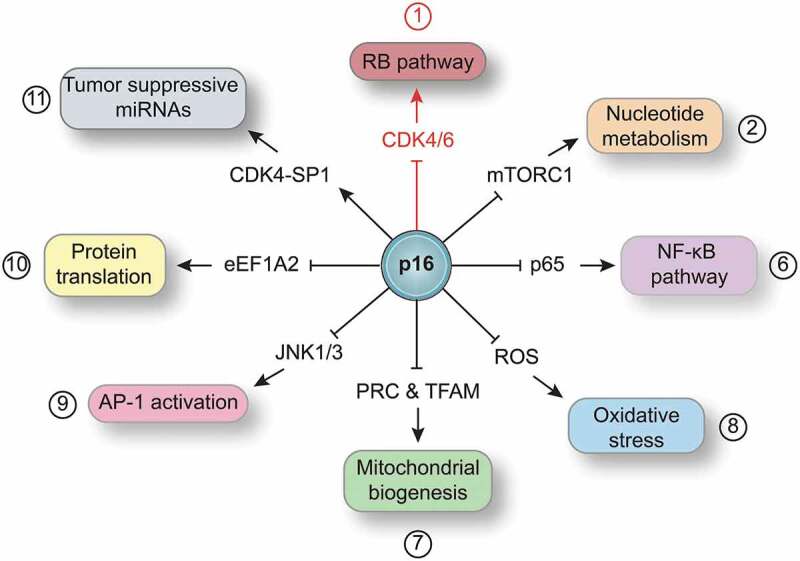
Canonical and non-canonical p16 signaling. Schematic showing the p16 canonical (red) and non-canonical (black) pathways, including: p16–Retinoblastoma (RB) pathway; p16 regulation of nucleotide metabolism through the mammalian target of rapamycin complex 1 (mTORC1); p16 directly binds to p65 and inhibits the nuclear factor kappa light chain enhancer of activated B cells (NF-κB) complex; p16 regulation of intracellular oxidative stress; p16 regulation of mitochondrial biogenesis (PRC: PGC-1-related coactivator; TFAM: Transcription Factor A, Mitochondrial); p16 directly binds to mitogen-activated protein kinases (JNK1/3) and regulates the activating protein-1 (AP1) transcription factor activity; p16 directly binds the eukaryotic translation elongation factor 1 alpha 2 (eEF1A2) and inhibits protein translation; and p16 forms a complex with the cyclin-dependent kinase 4 (CDK4) and SP1 transcription factor that promotes the transcription of tumor-suppressive miRNAs.
References
-
- Aird KM, Freyermuth F, Tabet R, Tran T, He F, Ruffenach F, Alunni V, Moine H, Thibault C, Page A, et al. Suppression of nucleotide metabolism underlies the establishment and maintenance of oncogene-induced senescence. Cell Reports. 2013;3(1252–1265). doi:10.1016/j.celrep.2013.03.004. - DOI - PMC - PubMed
Grants and funding
LinkOut - more resources
Full Text Sources
Research Materials
Miscellaneous
