


Factors influencing bird-building collisions in the downtown area of a major North American city
- PMID: 31693699
- PMCID: PMC6834121
- DOI: 10.1371/journal.pone.0224164
Factors influencing bird-building collisions in the downtown area of a major North American city
Abstract
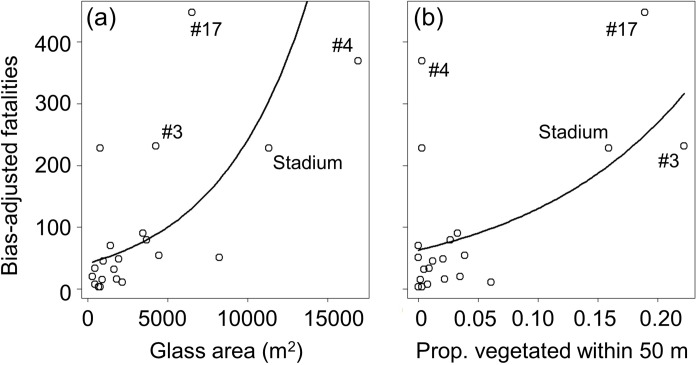
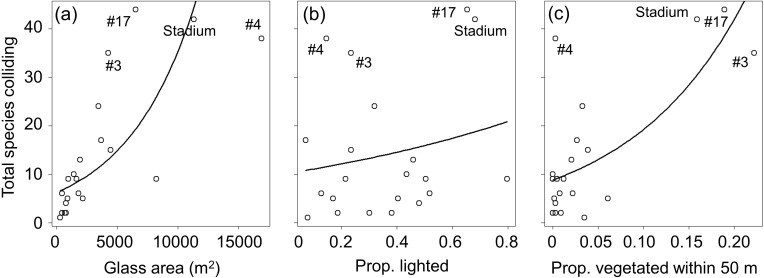
Bird-building collisions are the largest source of avian collision mortality in North America. Despite a growing literature on bird-building collisions, little research has been conducted in downtown areas of major cities, and no studies have included stadiums, which can be extremely large, often have extensive glass surfaces and lighting, and therefore may cause many bird collisions. Further, few studies have assessed the role of nighttime lighting in increasing collisions, despite the often-cited importance of this factor, or considered collision correlates for different seasons and bird species. We conducted bird collision monitoring over four migration seasons at 21 buildings, including a large multi-use stadium, in downtown Minneapolis, Minnesota, USA. We used a rigorous survey methodology to quantify among-building variation in collisions and assess how building features (e.g., glass area, lighting, vegetation) influence total collision fatalities, fatalities for separate seasons and species, and numbers of species colliding. Four buildings, including the stadium, caused a high proportion of all collisions and drove positive effects of glass area and amount of surrounding vegetation on most collision variables. Excluding these buildings from analyses resulted in slightly different collision predictors, suggesting that factors leading some buildings to cause high numbers of collisions are not the exact same factors causing variation among more typical buildings. We also found variation in collision correlates between spring and fall migration and among bird species, that factors influencing collision fatalities also influence numbers of species colliding, and that the proportion, and potentially area, of glass lighted at night are associated with collisions. Thus, reducing bird collisions at large buildings, including stadiums, should be achievable by reducing glass area (or treating existing glass), reducing light emission at night, and prioritizing mitigation efforts for glass surfaces near vegetated areas and/or avoiding use of vegetation near glass.
Conflict of interest statement
We received research funding from commercial sources (Minnesota Sports Facilities Authority and Minnesota Vikings Football, LLC). This does not alter our adherence to PLOS ONE policies on sharing data and materials. The funders had no role in study design, data collection and analysis, the decision to publish, or preparation of the manuscript.
Figures
References
-
- Calvert A, Bishop C, Elliot R, Krebs E, Kydd T, Machtans C, et al. A synthesis of human-related avian mortality in Canada. Avian Conserv Ecol. 2013;8: 11.
-
- Loss SR, Will T, Marra PP. Direct mortality of birds from anthropogenic causes. Annu Rev Ecol Evol Syst. 2015;46: 99–125.
-
- Loss SR, Will T, Loss SS, Marra PP. Bird-building collisions in the United States: Estimates of annual mortality and species vulnerability. Condor 2014;116: 8–23.
-
- Machtans C, Wedeles C, Bayne E. A first estimate for Canada of the number of birds killed by colliding with building windows. Avian Conserv Ecol. 2013;8: 6.
Publication types
MeSH terms
LinkOut - more resources
Full Text Sources
