


Promoter Activation in Δhfq Mutants as an Efficient Tool for Specialized Metabolite Production Enabling Direct Bioactivity Testing
- PMID: 31693786
- PMCID: PMC6972681
- DOI: 10.1002/anie.201910563
Promoter Activation in Δhfq Mutants as an Efficient Tool for Specialized Metabolite Production Enabling Direct Bioactivity Testing
Abstract
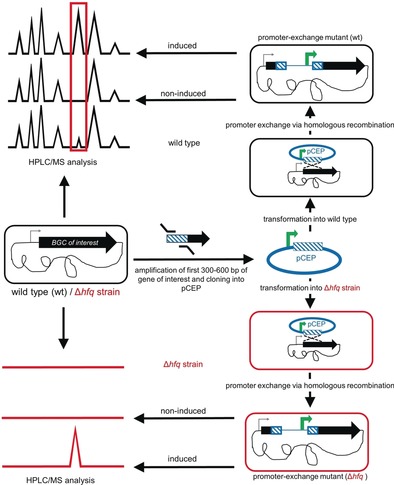
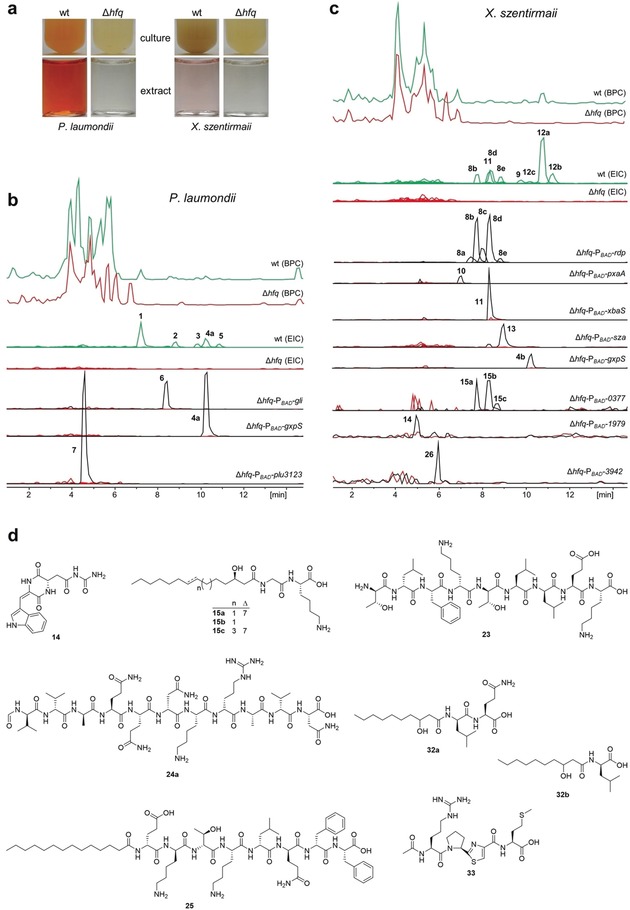
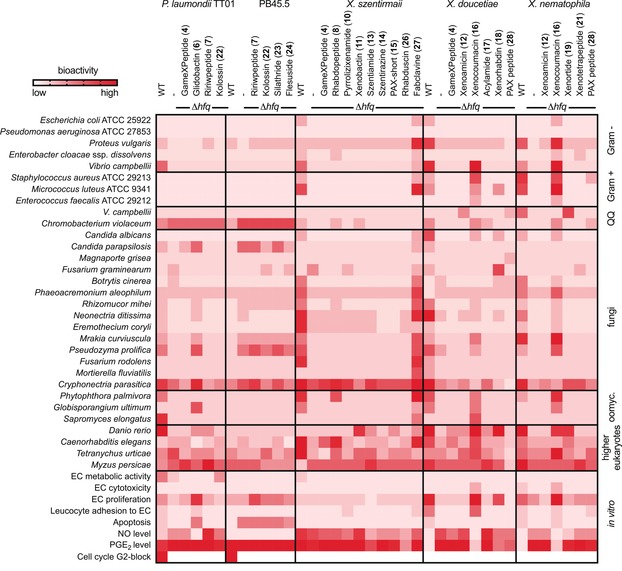
Natural products (NPs) from microorganisms have been important sources for discovering new therapeutic and chemical entities. While their corresponding biosynthetic gene clusters (BGCs) can be easily identified by gene-sequence-similarity-based bioinformatics strategies, the actual access to these NPs for structure elucidation and bioactivity testing remains difficult. Deletion of the gene encoding the RNA chaperone, Hfq, results in strains losing the production of most NPs. By exchanging the native promoter of a desired BGC against an inducible promoter in Δhfq mutants, almost exclusive production of the corresponding NP from the targeted BGC in Photorhabdus, Xenorhabdus and Pseudomonas was observed including the production of several new NPs derived from previously uncharacterized non-ribosomal peptide synthetases (NRPS). This easyPACId approach (easy Promoter Activated Compound Identification) facilitates NP identification due to low interference from other NPs. Moreover, it allows direct bioactivity testing of supernatants containing secreted NPs, without laborious purification.
Keywords: bioactivity testing; easyPACId; natural products; proteobacteria; simplified production.
© 2019 The Authors. Published by Wiley-VCH Verlag GmbH & Co. KGaA.
Conflict of interest statement
The authors declare no conflict of interest.
Figures
References
Publication types
MeSH terms
Substances
Grants and funding
- LOEWE TBG/LOEWE-Centre Translational Biodiversity Genomics/International
- TOVAG-117O172/Scientific and Technological Research Council of Turkey (TUBITAK)/International
- LOEWE TMP/LOEWE-Centre Translational Medicine and Pharmacology/International
- LOEWE Insect biotechnology/LOEWE-Centre Insect Biotechnology and Bioressources/International
- LOEWE MegaSyn/LOEWE research cluster MegaSyn/International
LinkOut - more resources
Full Text Sources
Other Literature Sources
Miscellaneous
