


Multiplex proteomics identifies novel CSF and plasma biomarkers of early Alzheimer's disease
- PMID: 31694701
- PMCID: PMC6836495
- DOI: 10.1186/s40478-019-0795-2
Multiplex proteomics identifies novel CSF and plasma biomarkers of early Alzheimer's disease
Abstract
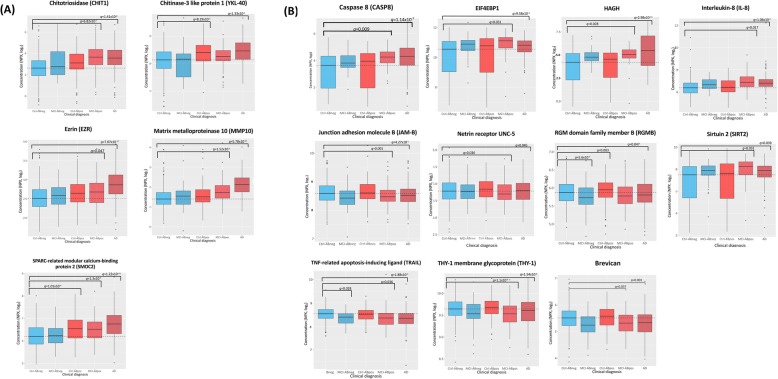
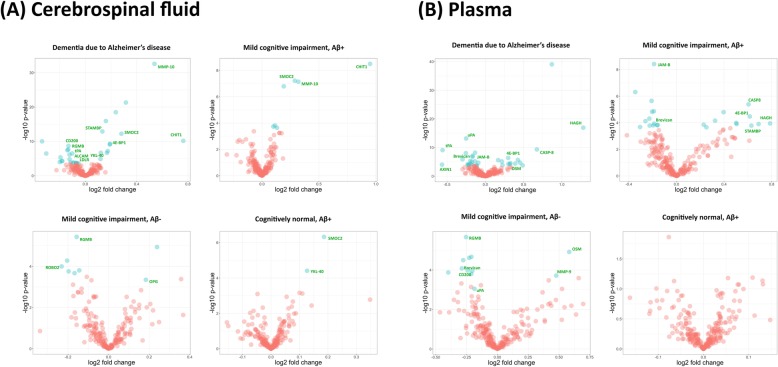
To date, the development of disease-modifying therapies for Alzheimer's disease (AD) has largely focused on the removal of amyloid beta Aβ fragments from the CNS. Proteomic profiling of patient fluids may help identify novel therapeutic targets and biomarkers associated with AD pathology. Here, we applied the Olink™ ProSeek immunoassay to measure 270 CSF and plasma proteins across 415 Aβ- negative cognitively normal individuals (Aβ- CN), 142 Aβ-positive CN (Aβ+ CN), 50 Aβ- mild cognitive impairment (MCI) patients, 75 Aβ+ MCI patients, and 161 Aβ+ AD patients from the Swedish BioFINDER study. A validation cohort included 59 Aβ- CN, 23 Aβ- + CN, 44 Aβ- MCI and 53 Aβ+ MCI. To compare protein concentrations in patients versus controls, we applied multiple linear regressions adjusting for age, gender, medications, smoking and mean subject-level protein concentration, and corrected findings for false discovery rate (FDR, q < 0.05). We identified, and replicated, altered levels of ten CSF proteins in Aβ+ individuals, including CHIT1, SMOC2, MMP-10, LDLR, CD200, EIF4EBP1, ALCAM, RGMB, tPA and STAMBP (- 0.14 < d < 1.16; q < 0.05). We also identified and replicated alterations of six plasma proteins in Aβ+ individuals OSM, MMP-9, HAGH, CD200, AXIN1, and uPA (- 0.77 < d < 1.28; q < 0.05). Multiple analytes associated with cognitive performance and cortical thickness (q < 0.05). Plasma biomarkers could distinguish AD dementia (AUC = 0.94, 95% CI = 0.87-0.98) and prodromal AD (AUC = 0.78, 95% CI = 0.68-0.87) from CN. These findings reemphasize the contributions of immune markers, phospholipids, angiogenic proteins and other biomarkers downstream of, and potentially orthogonal to, Aβ- and tau in AD, and identify candidate biomarkers for earlier detection of neurodegeneration.
Keywords: Alzheimer’s disease; Angiogenesis; Apoptosis; Biomarker; Inflammation; Mild cognitive impairment; Proteomics.
Conflict of interest statement
CDW and GR are employees of Biogen Inc. MN, CH, JL, LF, and AM are employees of Pfizer Worldwide Research & Development. TS is an employee of Sanofi. CDW, GR, TS, and RM were employed at Pfizer Worldwide Research & Development during the conduct of this study. OH has acquired research support (for the institution) from Roche, GE Healthcare, Biogen, AVID Radiopharmaceuticals, Fujirebio, and Euroimmun. In the past 2 years, he has received consultancy/speaker fees (paid to the institution) from Biogen, Roche, and Fujirebio.
Figures
References
-
- Alcolea D, Vilaplana E, Pegueroles J, Montal V, Sánchez-Juan P, González-Suárez A, et al. Relationship between cortical thickness and cerebrospinal fluid YKL-40 in predementia stages of Alzheimer's disease. Neurobiol Aging. 2015;36:2018–2023. doi: 10.1016/j.neurobiolaging.2015.03.001. - DOI - PubMed
-
- Alzheimer's Association, 2017. 2017 Alzheimer's disease facts and figures. Alzheimer’s & Dementia. Elsevier; 2017; 13(4): 325-373
Publication types
MeSH terms
Substances
Grants and funding
LinkOut - more resources
Full Text Sources
Other Literature Sources
Medical
Research Materials
Miscellaneous
