


Cost-effectiveness of point-of-care viscoelastic haemostatic assays in the management of bleeding during cardiac surgery: protocol for a prospective multicentre pragmatic study with stepped-wedge cluster randomised controlled design and 1-year follow-up (the IMOTEC study)
- PMID: 31694845
- PMCID: PMC6858223
- DOI: 10.1136/bmjopen-2019-029751
Cost-effectiveness of point-of-care viscoelastic haemostatic assays in the management of bleeding during cardiac surgery: protocol for a prospective multicentre pragmatic study with stepped-wedge cluster randomised controlled design and 1-year follow-up (the IMOTEC study)
Abstract
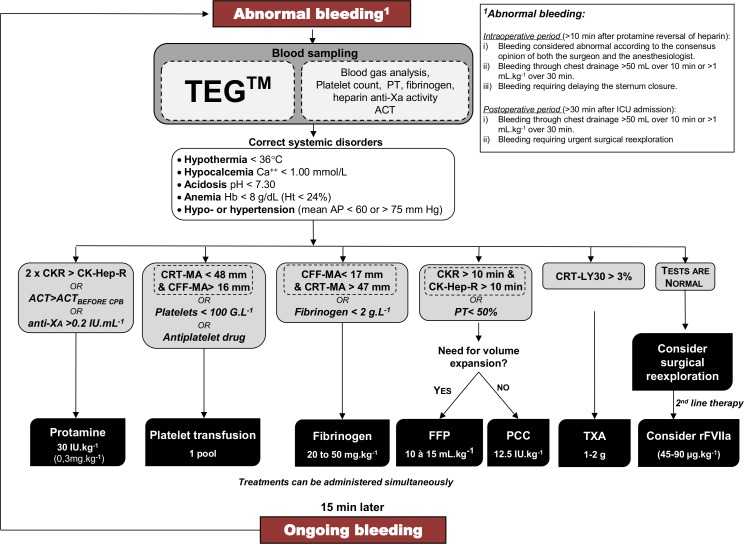
Introduction: During cardiac surgery-associated bleeding, the early detection of coagulopathy is crucial. However, owing to time constraints or lack of suitable laboratory tests, transfusion of haemostatic products is often inappropriately triggered, either too late (exposing to prolonged bleeding and thus to avoidable administration of blood products) or blindly to the coagulation status (exposing to unnecessary haemostatic products administration in patients with no coagulopathy). Undue exposition to transfusion risks and additional healthcare costs may arise. With the perspective of secondary care-related costs, the IMOTEC study (Intérêt MédicO-économique de la Thrombo-Elastographie, dans le management transfusionnel des hémorragies péri-opératoires de chirurgies Cardiaques sous circulation extracorporelle) aims at assessing the cost-effectiveness of a point-of-care viscoelastic haemostatic assay (VHA: RoTem or TEG)-guided management of bleeding. Among several outcome measures, particular emphasis will be put on quality of life with a 1-year follow-up.
Methods and analysis: This is a multicentre, prospective, pragmatic study with stepped-wedge cluster randomised controlled design. Over a 36-month period (24 months of enrolment and 12 months of follow-up), 1000 adult patients undergoing cardiac surgery with cardiopulmonary bypass will be included if a periprocedural significant bleeding occurs. The primary outcome is the cost-effectiveness of a VHA-guided algorithm over a 1-year follow-up, including patients' quality of life. Secondary outcomes are the cost-effectiveness of the VHA-guided algorithm with regard to the rate of surgical reexploration and 1-year mortality, its cost per-patient, its effectiveness with regard to haemorrhagic, infectious, renal, neurological, cardiac, circulatory, thrombotic, embolic complications, transfusion requirements, mechanical ventilation free-days, duration of intensive care unit and in-hospital stay and mortality.
Ethics and dissemination: The study was registered at Clinicaltrials.gov and was approved by the Committee for the Protection of Persons of Nantes University Hospital, The French Advisory Board on Medical Research Data Processing and the French Personal Data Protection Authority. A publication of the results in a peer-reviewed journal is planned.
Trial registration number: NCT02972684; Pre-results.
Keywords: blood transfusion; cardiac surgery; haemorrhage; health economics; perioperative care; point-of-care systems.
© Author(s) (or their employer(s)) 2019. Re-use permitted under CC BY-NC. No commercial re-use. See rights and permissions. Published by BMJ.
Conflict of interest statement
Competing interests: J-CR received during the past 3 years, lecture and consulting fees from VIFOR PHARMA, congress registration fees from FRESENIUS, travel fees from WERFEN and EDWARDS. EB received, during the past 3 years, congress registration and/or travel fees from Aspen, Werfen Instrumentation Laboratory, Swedish Orphan Biovitrum, Bayer Healthcare SAS, LFB Biomédicaments. KL has no conflict of interest in connection with the work submitted. In addition, KL received, during the past 3 years, lecture fees from MEDTRONIC (once, in 2017), congress registration fees from SANOFI AVENTIS (once in 2018), travel fees from MSD France (once, in 2017), NOVEX PHARMA (once, in 2016), GILEAD SCIENCES (twice, 2016 and 2017), PFIZER (once, in 2019). V-PR has no conflict of interest in connection with the work submitted. ID-Z has no conflict of interest in connection with the work submitted. In addition, during the past 5 years ID-Z participated to advisory boards for Abbvie, BMS, MSD, Pfizer, Sanofi. BR has no conflict of interest in connection with the work submitted. In addition, BR received, during the past 5 years, lecture fees from Fisher&Paykel, Baxter, LFB, Aspen, research grants from Baxter and consulting fees from LFB, Astra Zeneca.
Figures


References
-
- Direction de la Recherche des Etudes, de l’Evaluation et des Statistiques Statistiques annuelles des établissements de santé - rapport 2017; 2017.
-
- National Institute for Care and Health Excellence Detecting, managing and monitoring haemostasis: viscoelastometric point-of-care testing (ROTEM, TEG and Sonoclot systems), 2014. Available: https://www.nice.org.uk/guidance/dg13
Publication types
MeSH terms
Associated data
LinkOut - more resources
Full Text Sources
Medical
