Evaluation of WASPLab Software To Automatically Read chromID CPS Elite Agar for Reporting of Urine Cultures
- PMID: 31694967
- PMCID: PMC6935927
- DOI: 10.1128/JCM.00540-19
Evaluation of WASPLab Software To Automatically Read chromID CPS Elite Agar for Reporting of Urine Cultures
Abstract
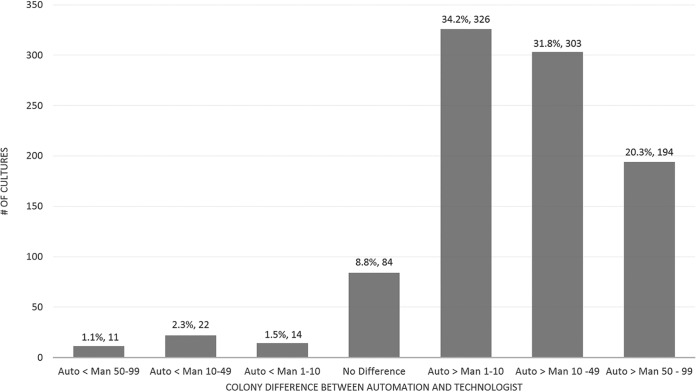
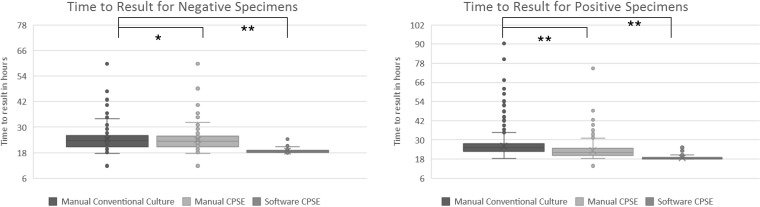
Urine cultures are among the most common specimens received by clinical laboratories and generate a major share of the laboratory workload. Chromogenic agar can expedite culture results, but technologist review is still needed. In this study, we evaluated the ability of the WASPLab software to interpret urine specimens plated onto chromID CPS Elite (CPSE) agar. Urine specimens submitted for bacterial culture were plated onto CPSE agar with a 1-μl loop using the WASP. Each plate was imaged after 0 and 18 h of incubation, and colonies were enumerated by color using the WASPLab software and a technologist's reading from a high-definition (HD) monitor. The results were reported as negative if <10 colonies/plate were detected. Laboratory information system (LIS) time stamps were used to measure the time to result. A total of 1,581 urine cultures were tested. The sensitivity and specificity of the software were 99.8% and 68.5%, respectively, which included 2 manual-positive/automation-negative (MP/AN) results and 170 manual-negative/automation-positive (MN/AP) results. Of the 170 MN/AP specimens, 116 were caused by microcolonies missed by the technologist. The remaining MN/AP results were caused by either count differences near the 10-colony threshold (n = 43) or count differences of >50 CFU (n = 11). The use of both CPSE agar and the WASPLab software improved the time to result for urine culture, reducing the average time to result by 4 h 42 min for negative specimens and 3 h 28 min for positive specimens compared to that with standard-of-care testing. These data demonstrate that the use of CPSE agar and automated plate reading has the potential to improve turnaround time while maintaining high sensitivity and reducing urine culture workload.
Keywords: automation; chromogenic media; urinary tract infection.
Copyright © 2019 Faron et al.
Figures
References
-
- Schappert SM, Rechtsteiner EA. 2011. Ambulatory medical care utilization estimates for 2007. Vital Health Stat 13 169:1–38. - PubMed
MeSH terms
Substances
LinkOut - more resources
Full Text Sources
Medical