. 2019 Nov 6;9(1):16089.
doi: 10.1038/s41598-019-52682-9.

The intrinsic circadian clock in podocytes controls glomerular filtration rate

Affiliations

The intrinsic circadian clock in podocytes controls glomerular filtration rate

Camille Ansermet et al. Sci Rep. .

Abstract

Glomerular filtration rate (GFR), or the rate of primary urine formation, is the key indicator of renal function. Studies have demonstrated that GFR exhibits significant circadian rhythmicity and, that these rhythms are disrupted in a number of pathologies. Here, we tested a hypothesis that the circadian rhythm of GFR is driven by intrinsic glomerular circadian clocks. We used mice lacking the circadian clock protein BMAL1 specifically in podocytes, highly specialized glomerular cells critically involved in the process of glomerular filtration (Bmal1lox/lox/Nphs2-rtTA/LC1 or, cKO mice). Circadian transcriptome profiling performed on isolated glomeruli from control and cKO mice revealed that the circadian clock controls expression of multiple genes encoding proteins essential for normal podocyte function. Direct assessment of glomerular filtration by inulin clearance demonstrated that circadian rhythmicity in GFR was lost in cKO mice that displayed an ultradian rhythm of GFR with 12-h periodicity. The disruption of circadian rhythmicity in GFR was paralleled by significant changes in circadian patterns of urinary creatinine, sodium, potassium and water excretion and by alteration in the diurnal pattern of plasma aldosterone levels. Collectively, these results indicate that the intrinsic circadian clock in podocytes participate in circadian rhythmicity of GFR.


Conflict of interest statement

The authors declare no competing interests.

Figures
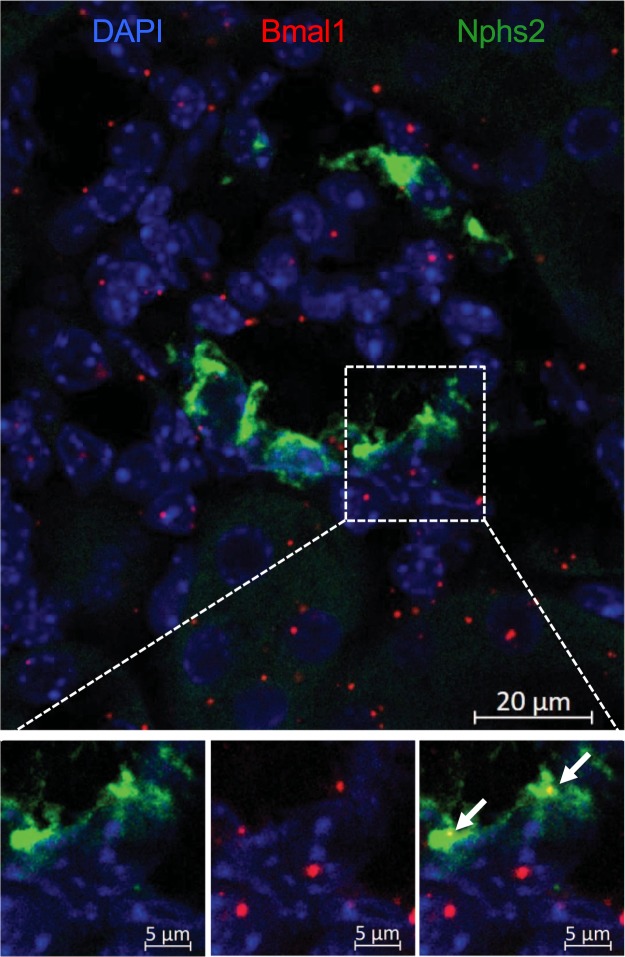
Figure 1
Figure 1
Bmal1 expression in podocytes. Representative RNAscope staining of Bmal1 (red) and Nphs2 (green) RNAs in a kidney section of Control mice. Area in the white rectangle is shown enlarged in the lower panel. White arrows indicate Bmal1 RNA molecules co-localized with Nphs2 staining.
Figure 2
Figure 2
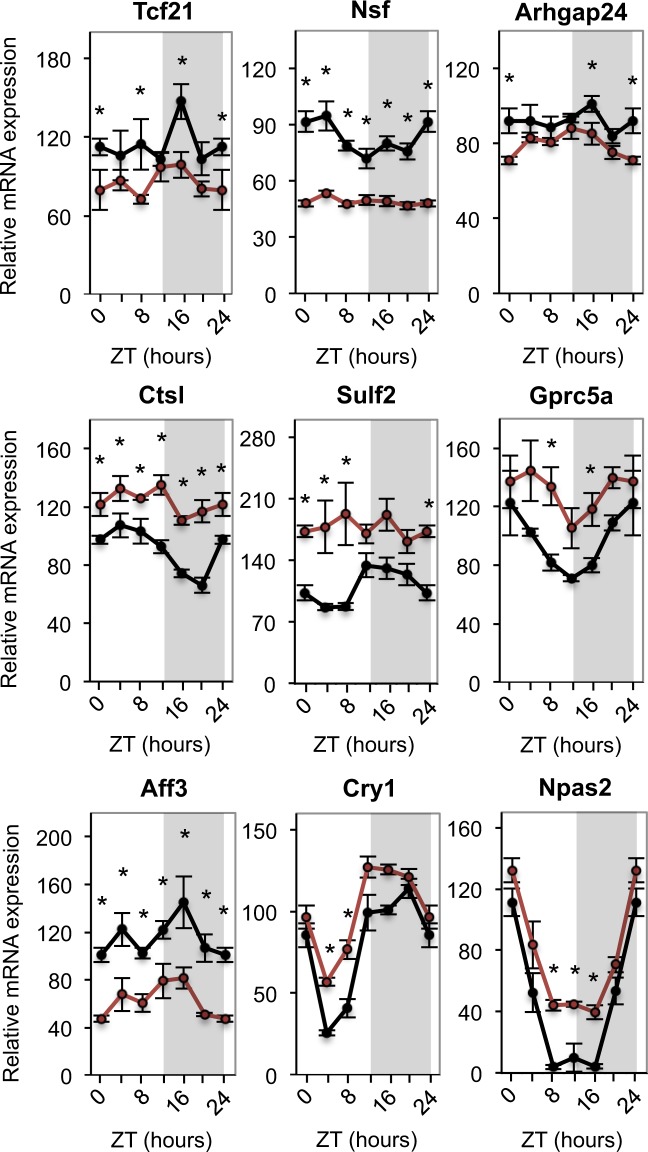
Analysis of glomeruli transcriptome revealed altered expression of genes involved in diverse podocyte-specific processes or being part of the circadian clock core. mRNA expression profiles of Tcf21, Nsf, Arhgap24, Ctsl, Sulf2, Gprc5a, Aff3, Cry1 and Npas2 in Control (black) and cKO (red) glomeruli. Values are means ± SEM. Statistical analyses were performed with the R package limma. Contrasts between cKO and Control at each time point were combined into one F-test. *Time point with difference after post-hoc classification of significant genes (false discovery rate <5%). n = 6 mice/time-point/genotype.
Figure 3
Figure 3
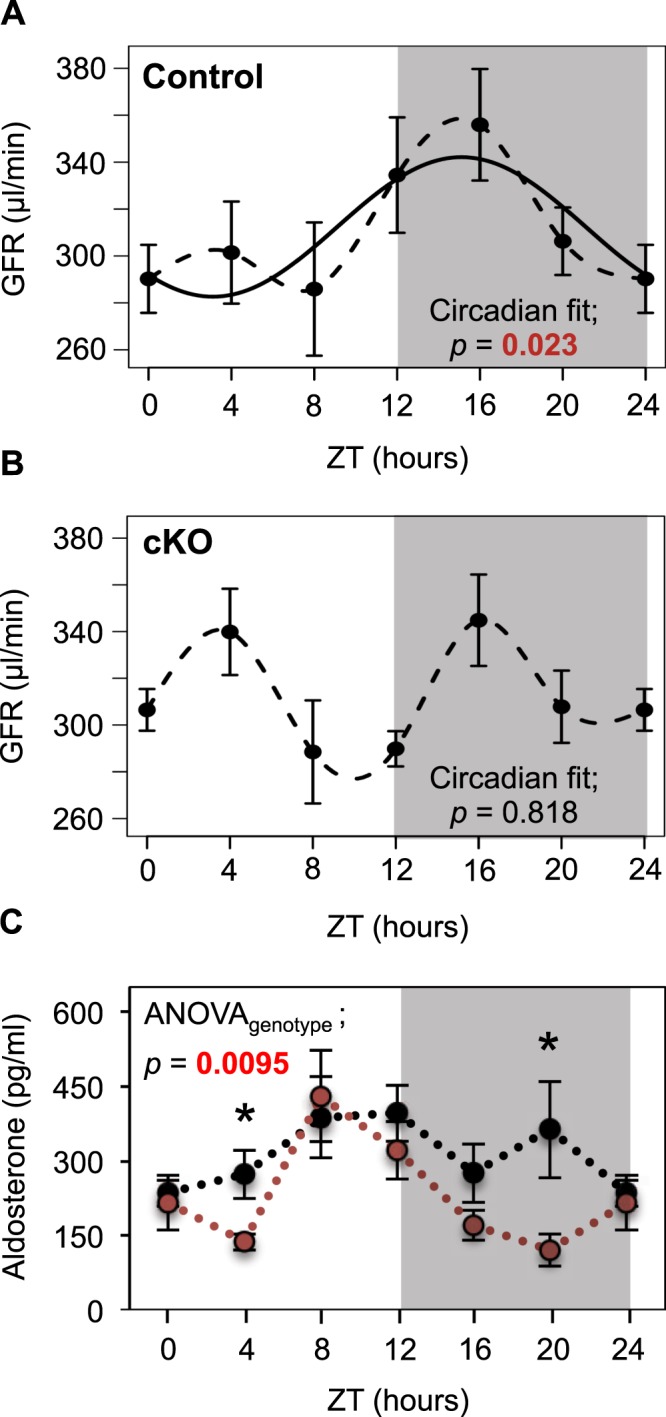
Circadian pattern of GFR is disrupted in cKO mice. Temporal profiles of GFR in (A) Control and (B) cKO mice. (C) Temporal profile of plasma aldosterone levels in Control (black) and cKO (red) mice. Values are means ± SEM. *p < 0.05 (unpaired t test). Circadian fit were analyzed with a linear model of a pair of cosine curves with a period of 24 hours. (A,B) Sin and Cos coefficients were combined into one contrast with the ‘glht’ (generalized linear hypothesis test) function of the R package ‘multcomp’. Effect on aldosterone levels was tested with two-way Anova with genotypes and time points as factors. n = 6 mice/time-point/genotype, except n = 5 for cKO mice at ZT16.
Figure 4
Figure 4
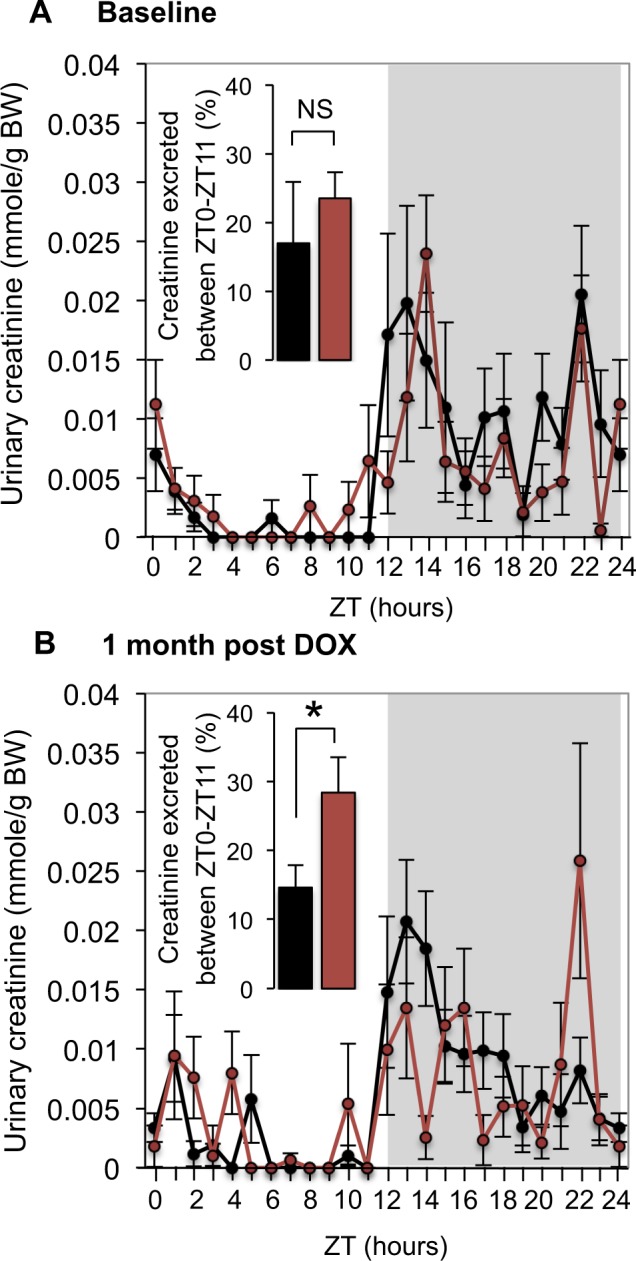
Urinary creatinine excretion during the inactive (light) phase (ZT0-ZT11) is higher in cKO mice. Profiles of every-hour urinary creatinine excretion in Control (black) and cKO (red) mice in (A) baseline (before DOX treatment) and (B) one month after the end of the DOX treatment. Bar plots represent the percentage of 24-hour urinary creatinine excretion excreted during the inactive (light) phase (ZT0-ZT11). *p < 0.05 (unpaired t test). n = 10 for cKO mice after DOX treatment, n = 11 in all other groups.

References

    1. Firsov, D. & Bonny, O. Circadian rhythms and the kidney. Nature reviews. Nephrology (2018). - PubMed
    1. Solocinski K, Gumz ML. The Circadian Clock in the Regulation of Renal Rhythms. Journal of biological rhythms. 2015;30:470–486. doi: 10.1177/0748730415610879. - DOI - PMC - PubMed
    1. Reinke, H. & Asher, G. Crosstalk between metabolism and circadian clocks. Nature reviews. Molecular cell biology (2019). - PubMed
    1. Zuber AM, et al. Molecular clock is involved in predictive circadian adjustment of renal function. Proc Natl Acad Sci USA. 2009;106:16523–16528. doi: 10.1073/pnas.0904890106. - DOI - PMC - PubMed
    1. Nikolaeva S, et al. Nephron-Specific Deletion of Circadian Clock Gene Bmal1 Alters the Plasma and Renal Metabolome and Impairs Drug Disposition. J Am Soc Nephrol. 2016;27:2997–3004. doi: 10.1681/ASN.2015091055. - DOI - PMC - PubMed

Publication types