Review
. 2019 Oct 22:13:3635-3646.
doi: 10.2147/DDDT.S192475. eCollection 2019.

Lanadelumab Injection Treatment For The Prevention Of Hereditary Angioedema (HAE): Design, Development And Place In Therapy

Affiliations
Review

Lanadelumab Injection Treatment For The Prevention Of Hereditary Angioedema (HAE): Design, Development And Place In Therapy

Maria Bova et al. Drug Des Devel Ther. .

Abstract

Despite the efficacy of the on-demand treatment for the control of acute attacks of Hereditary Angioedema due to C1-Inhibitor Deficiency (C1-INH-HAE), the number and severity of attacks and the impairment in the quality of life of the affected patients have led to the development of a new monoclonal antibody, lanadelumab, directly addressed to the blockage of bradykinin, the principal mediator of vasodilation during angioedema attacks. It is indicated for the prophylactic treatment, it is easy to administer, highly effective and with known limited side effects. The current review summarizes the development of the drug, its clinical background and its perspectives.

Keywords: C1-inhibitor hereditary angioedema; lanadelumab; long-term prophylaxis; monoclonal antibody; rare disease.


Conflict of interest statement

Dr Maria Bova reports personal fees and travel grants from Shire - ora Takeda, personal fees and travel grants from CSL behring, outside the submitted work; Dr Anna Valerieva reports grants from Bulgarian Ministry of Science under the National Program for Research, personal fees from Shire/Takeda, personal fees from Pharming Group N.V., personal fees from CSL Behring, outside the submitted work; Dr Riccardo Senter reports travel grants received by Shire-Takeda, CSL Behring, Biocryst and Novartis. The authors report no other conflicts of interests in this work.

Figures
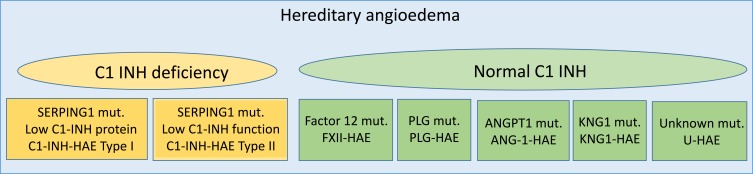
Figure 1
Figure 1
Classification of hereditary angioedema. Abbreviations: C1-INH, C1 inhibitor; HAE, hereditary angioedema; FXII, factor XII; PLG, plasminogen; ANG1, angiopoietin1; KNG1, kininogen1; U, unknown.
Figure 2
Figure 2
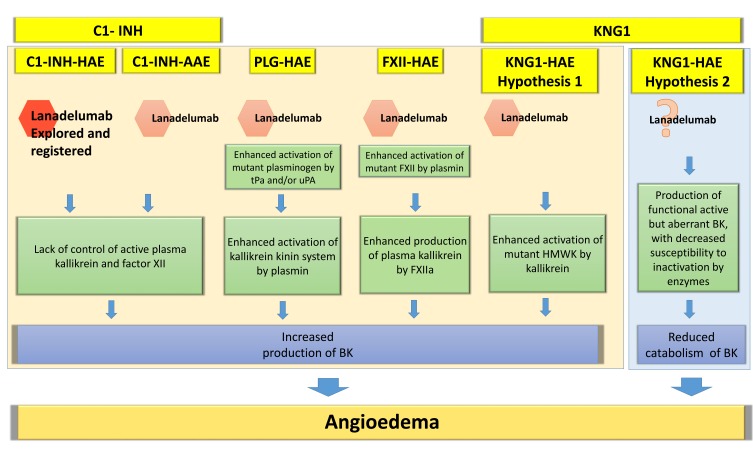
Hypothesis for a potential role of lanadelumab in hereditary angioedema with normal C1 inhibitor and acquired angioedema with C1 inhibitor deficiency. Notes: Pathogenesis of hereditary angioedema with normal C1 inhibitor is partially known. This figure is based on speculation about the possible mechanisms hypothesized for these diseases. In KNG1-HAE, we report the two pathogenetic hypothesis described by Bork et al Allergy 2019. In hypothesis 1, we imagine a possible role of lanadelumab, while in the hypothesis 2, based on a reduced catabolism of BK, we put a question mark. We did not include ANGPT1-HAE because the few data considered about its pathogenesis suggest a different mechanism not including the kallikrein-kinin system. In spite of this, we keep open new possibilities, based on the described efficacy of tranexamic acid in this group of patients. *Lanadelumab is only explored and registered for prophylactic treatment of C1-INH-HAE patients. Abbreviations: BK, bradykinin; HMWK, high molecular weight kininogen; tPa, tissue PLG activator; uPA, urokinase PLG activator; PLG-HAE, hereditary angioedema with mutation in plasminogen (PLG) gene; KNG1-HAE, hereditary angioedema with mutation in kininogen 1 gene; FXII-HAE, hereditary angioedema with mutation in FXII gene (F12); C1-INH-AAE, angioedema with acquired C1-inhibitor deficiency.

References

    1. Cicardi M, Aberer W, Banerji A, et al. Classification, diagnosis and approach to treatment for angioedema: consensus report from the Hereditary Angioedema International Working Group. Allergy. 2014;69:602–616. doi: 10.1111/all.12380 - DOI - PubMed
    1. Banerji A, Busse P, Christiansen SC, et al. Current state of hereditary angioedema management: a patient survey. Allergy Asthma Proc. 2015;36(3):213–217. doi: 10.2500/aap.2015.36.3824 - DOI - PMC - PubMed
    1. Aygören-Pürsün E, Bygum A, Beusterien K, et al. Socioeconomic burden of hereditary angioedema: results from the hereditary angioedema burden of illness study in Europe. Orphanet J Rare Dis. 2014;4(9):99. doi: 10.1186/1750-1172-9-99 - DOI - PMC - PubMed
    1. Bova M, De Feo G, Parente R, et al. Hereditary and acquired angioedema: heterogeneity of pathogenesis and clinical phenotypes. Int Arch Allergy Immunol. 2018;175(3):126–135. doi: 10.1159/000486312 - DOI - PubMed
    1. Valerieva A, Perego F, Porebski G, et al. Hereditary angioedema: treatment options and availability. Balance between patients’ needs and stakeholders’ plans. Alergia Astma Immunologia. 2018;23(4).

MeSH terms