


Medication Regimen Complexity In 8 Australian Residential Aged Care Facilities: Impact Of Age, Length Of Stay, Comorbidity, Frailty, And Dependence In Activities Of Daily Living
- PMID: 31695348
- PMCID: PMC6815218
- DOI: 10.2147/CIA.S216705
Medication Regimen Complexity In 8 Australian Residential Aged Care Facilities: Impact Of Age, Length Of Stay, Comorbidity, Frailty, And Dependence In Activities Of Daily Living
Abstract
Objective: To explore variation in medication regimen complexity in residential aged care facilities (RACFs) according to resident age, length of stay, comorbidity, dementia severity, frailty, and dependence in activities of daily living (ADLs), and compare number of daily administration times and Medication Regimen Complexity Index (MRCI) as measures of regimen complexity.
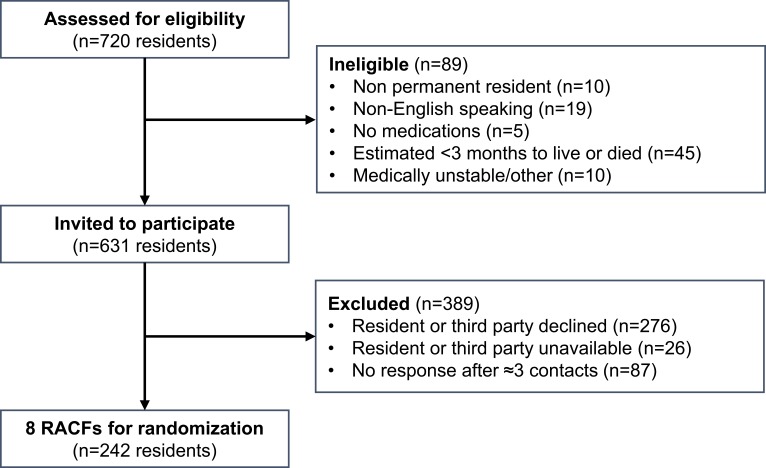
Methods: This study was a cross-sectional analysis of baseline data from the SImplification of Medications Prescribed to Long-tErm care Residents (SIMPLER) cluster-randomized controlled trial. The SIMPLER study recruited 242 residents with at least one medication charted for regular administration from 8 RACFs in South Australia. Comorbidity was assessed using the Charlson Comorbidity Index (CCI). Dementia severity was assessed using the Dementia Severity Rating Scale. Frailty was assessed using the FRAIL-NH scale. Dependence in ADLs was assessed using the Katz ADL scale.
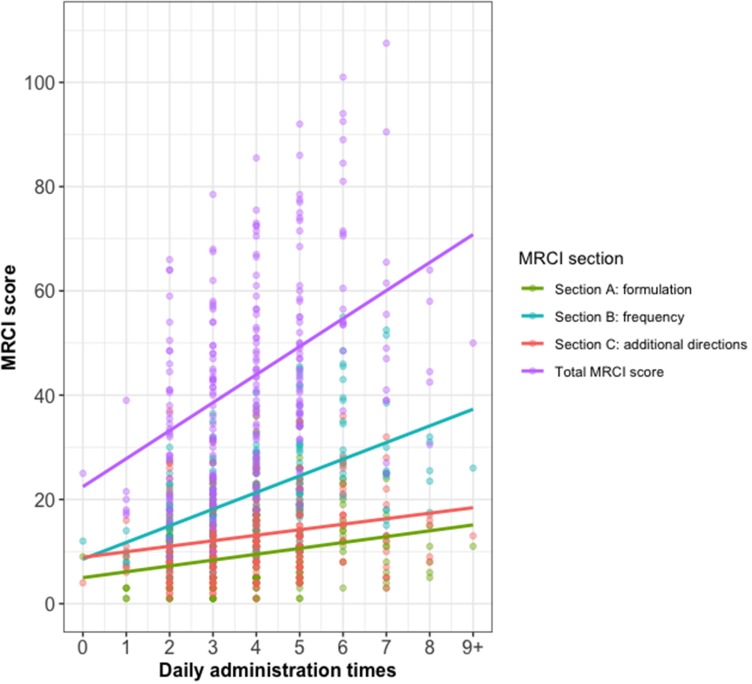
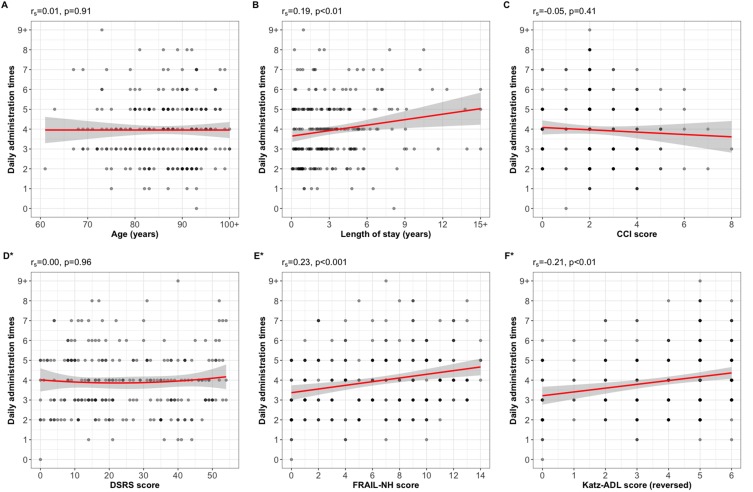
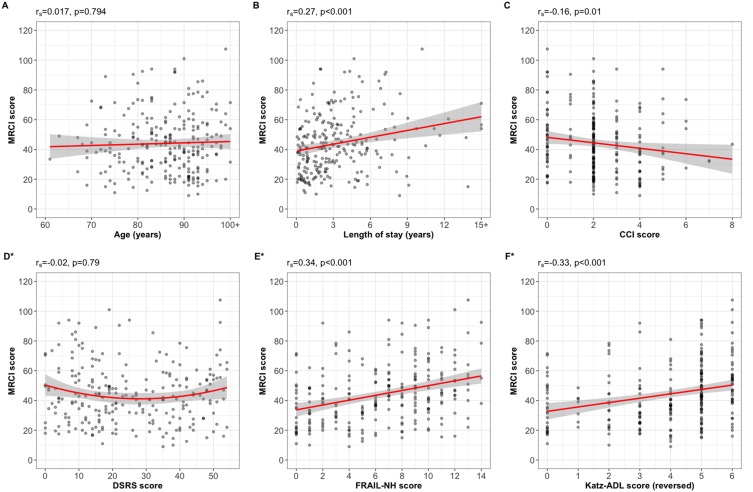
Results: The median age of participants was 87 years (interquartile range 81-92). Over one-third of participants (n=86, 36%) had 5 or more daily medication administration times. The number of daily administration times and MRCI scores were positively correlated with resident length of stay (rs=0.19; 0.27), FRAIL-NH score (rs=0.23; 0.34) and dependence in ADLs (rs=-0.21; -0.33) (all p<0.01). MRCI was weakly negatively correlated with CCI score (rs=-0.16; p=0.013). Neither number of daily administration times nor MRCI score were correlated with age or dementia severity. In multivariate analysis, frailty was associated with number of daily administration times (OR: 1.13, 95% CI: 1.03-1.24) and MRCI score (OR: 1.26, 95% CI: 1.13-1.41). Dementia severity was inversely associated with both multiple medication administration times (OR: 0.97, 95% CI: 0.94-0.99) and high MRCI score (OR: 0.95, 95% CI: 0.92-0.98).
Conclusion: Residents with longer lengths of stay, more dependent in ADLs and most frail had the most complex medication regimens and, therefore, may benefit from targeted strategies to reduce medication regimen complexity.
Keywords: Aged; activities of daily living; frailty index; long-term care facilities; medication regimen complexity; multimorbidity; nursing homes.
© 2019 Chen et al.
Conflict of interest statement
This work was supported by the NHMRC Cognitive Decline Partnership Centre (grant number GNT9100000). The Cognitive Decline Partnership Centre receives support from the NHMRC and funding partners including Helping Hand Aged Care, HammondCare, Brightwater and Dementia Australia. The contents of the published materials are solely the responsibility of the individual authors identified, and do not reflect the views of the NHMRC and any other funding bodies or the funding partners. EYHC was supported by a postgraduate research scholarship funded by the Cognitive Decline Partnership Centre and the Monash University Faculty of Pharmacy and Pharmaceutical Sciences. JSB was supported by an NHMRC Dementia Research Leadership Fellowship. MC, MH and JvE are employed by Helping Hand Aged Care. JKS and JI were supported by NHMRC Early Career Fellowships. The authors report no other conflicts of interest in this work.
Figures
References
-
- Vogelsmeier A, Scott-Cawiezell J, Zellmer D. Barriers to safe medication administration in the nursing home – exploring staff perceptions and concerns about the medication use process. J Gerontol Nurs. 2007;33(4):5–12. - PubMed
MeSH terms
Substances
LinkOut - more resources
Full Text Sources
Medical
