


Clinical Utility Of Elagolix As An Oral Treatment For Women With Uterine Fibroids: A Short Report On The Emerging Efficacy Data
- PMID: 31695514
- PMCID: PMC6815212
- DOI: 10.2147/IJWH.S185023
Clinical Utility Of Elagolix As An Oral Treatment For Women With Uterine Fibroids: A Short Report On The Emerging Efficacy Data
Abstract
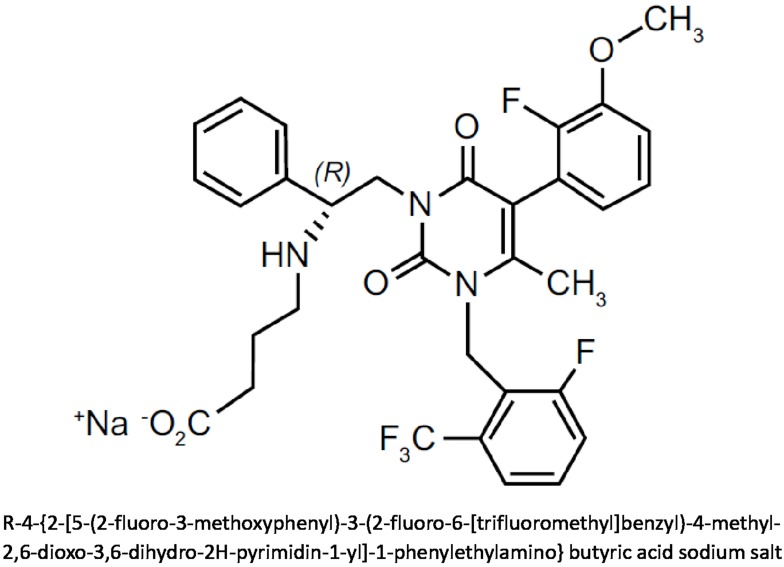
Uterine fibroids (UFs) are the most common gynaecological benign disease. Even though often asymptomatic, UFs can worsen women's health and their quality of life, causing heavy bleeding and anaemia, pelvic discomfort and reduced fertility. Surgical treatment of UFs could be limited by its invasiveness and the desire to preserve fertility. Thus, effective medical therapies for the management of this condition are needed. Common drugs used to control bleeding, such us hormonal contraceptive or levonorgestrel-releasing intrauterine system, have no effect on fibroids volume. Among other more efficient treatments, the gonadotropin-releasing hormone (GnRH) agonist or the selective progesterone-receptor modulators have a non-neutral safety profile; thus, they are used for limited periods or for cyclic treatments. Elagolix is a potent, orally bioavailable, non-peptide GnRH antagonist that acts by a competitive block of the GnRH receptor. The biological effect is a dose-dependent inhibition of gonadal axis, without a total suppression of estradiol concentrations. For this reason, even though comparative studies between elagolix and GnRH agonists have not been performed, elagolix has been associated with a better profile of adverse events. Recently, elagolix received US FDA approval for the treatment of moderate to severe pain caused by endometriosis. Several clinical trials assessed the efficacy of elagolix for the treatment of heavy bleeding caused by UFs and the definitive results of Phase III studies are expected. Available data on elagolix and UFs showed that the drug, with or without low-dose hormone add-back therapy, is able to significantly reduce menstrual blood loss, lead to amenorrhea and improve haemoglobin concentrations in the majority of participants in comparison with placebo. The safety and tolerability profile appeared generally acceptable. The concomitant use of add-back therapy can prevent bone loss due to the hypoestrogenic effect and can improve safety during elagolix treatment.
Keywords: elagolix; heavy menstrual bleeding; leiomyomas; non-peptide GnRH antagonist; uterine fibroids.
© 2019 Neri et al.
Conflict of interest statement
The authors report no conflicts of interest in this work.
Figures
References
Publication types
LinkOut - more resources
Full Text Sources
Research Materials
