Review
. 2019 Oct 22:10:2388.
doi: 10.3389/fimmu.2019.02388. eCollection 2019.

The Role of TLRs in Anti-cancer Immunity and Tumor Rejection

Affiliations
Review

The Role of TLRs in Anti-cancer Immunity and Tumor Rejection

Zuzanna Urban-Wojciuk et al. Front Immunol. .

Abstract

In recent years, a lot of scientific interest has focused on cancer immunotherapy. Although chronic inflammation has been described as one of the hallmarks of cancer, acute inflammation can actually trigger the immune system to fight diseases, including cancer. Toll-like receptor (TLR) ligands have long been used as adjuvants for traditional vaccines and it seems they may also play a role enhancing efficiency of tumor immunotherapy. The aim of this perspective is to discuss the effects of TLR stimulation in cancer, expression of various TLRs in different types of tumors, and finally the role of TLRs in anti-cancer immunity and tumor rejection.

Keywords: anti-cancer immunity; immuno-oncology; immunotherapy; toll-like receptors; tumor rejection.


Figures

Figure 1
Figure 1
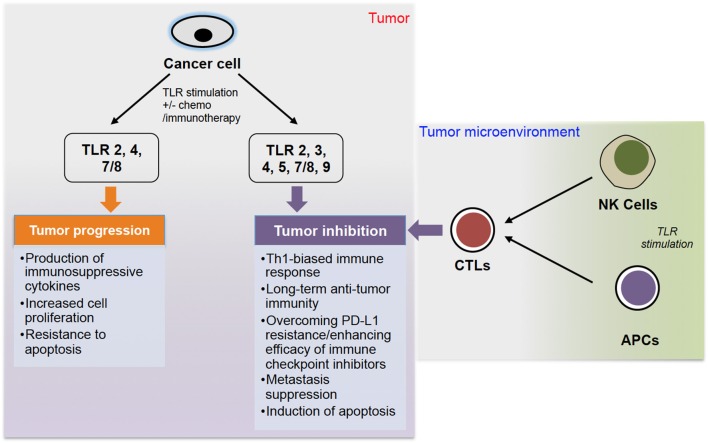
The role of TLR stimulation in cancer progression. TLR stimulation of cancer cells can lead to either tumor progression or inhibition. Stimulation of TLR 2, 4, and 7/8 can lead to tumor progression via production of immunosuppressive cytokines, increased cell proliferation and resistance to apoptosis. On the other hand, stimulation of TLR 2, 3, 4, 5, 7/8, and 9, often combined with chemo- or immunotherapy, can lead to tumor inhibition via different pathways. Additionally, stimulation of TLRs on NK cells and APCs (DCs and macrophages) can induce CTLs to further inhibit tumor growth.

References

    1. Chan JK, Roth J, Oppenheim JJ, Tracey KJ, Vogl T, Feldmann M, et al. . Alarmins: awaiting a clinical response. J Clin Invest. (2012) 122:2711–9. 10.1172/JCI62423 - DOI - PMC - PubMed
    1. Zhao S, Zhang Y, Zhang Q, Wang F, Zhang D. Toll-like receptors and prostate cancer. Front Immunol. (2014) 5:352. 10.3389/fimmu.2014.00352 - DOI - PMC - PubMed
    1. Ellerman JE, Brown CK, de Vera M, Zeh HJ, Billiar T, Rubartelli A, et al. . Masquerader: high mobility group box-1 and cancer. Clin Cancer Res. (2007) 13:2836–48. 10.1158/1078-0432.CCR-06-1953 - DOI - PubMed
    1. Hernandez C, Huebener P, Schwabe RF. Damage-associated molecular patterns in cancer: a double-edged sword. Oncogene. (2016) 35:5931–41. 10.1038/onc.2016.104 - DOI - PMC - PubMed
    1. Yang, Han Z, Oppenheim JJ. Alarmins and immunity. Immunol Rev. (2017) 280:41–56. 10.1111/imr.12577 - DOI - PMC - PubMed

Publication types

LinkOut - more resources