Review
. 2019 Oct 22:7:241.
doi: 10.3389/fcell.2019.00241. eCollection 2019.

Escape From X-Chromosome Inactivation: An Evolutionary Perspective

Affiliations
Review

Escape From X-Chromosome Inactivation: An Evolutionary Perspective

Bronwyn J Posynick et al. Front Cell Dev Biol. .

Abstract

Sex chromosomes originate as a pair of homologus autosomes that then follow a general pattern of divergence. This is evident in mammalian sex chromosomes, which have undergone stepwise recombination suppression events that left footprints of evolutionary strata on the X chromosome. The loss of genes on the Y chromosome led to Ohno's hypothesis of dosage equivalence between XY males and XX females, which is achieved through X-chromosome inactivation (XCI). This process transcriptionally silences all but one X chromosome in each female cell, although 15-30% of human X-linked genes still escape inactivation. There are multiple evolutionary pathways that may lead to a gene escaping XCI, including remaining Y chromosome homology, or female advantage to escape. The conservation of some escape genes across multiple species and the ability of the mouse inactive X to recapitulate human escape status both suggest that escape from XCI is controlled by conserved processes. Evolutionary pressures to minimize dosage imbalances have led to the accumulation of genetic elements that favor either silencing or escape; lack of dosage sensitivity might also allow for the escape of flanking genes near another escapee, if a boundary element is not present between them. Delineation of the elements involved in escape is progressing, but mechanistic understanding of how they interact to allow escape from XCI is still lacking. Although increasingly well-studied in humans and mice, non-trivial challenges to studying escape have impeded progress in other species. Mouse models that can dissect the role of the sex chromosomes distinct from sex of the organism reveal an important contribution for escape genes to multiple diseases. In humans, with their elevated number of escape genes, the phenotypic consequences of sex chromosome aneuplodies and sexual dimorphism in disease both highlight the importance of escape genes.

Keywords: X-chromosome inactivation; dosage compensation; escape from X-chromosome inactivation; gametologues; mammalian evolution; sex chromosomes.


Figures

FIGURE 1
FIGURE 1
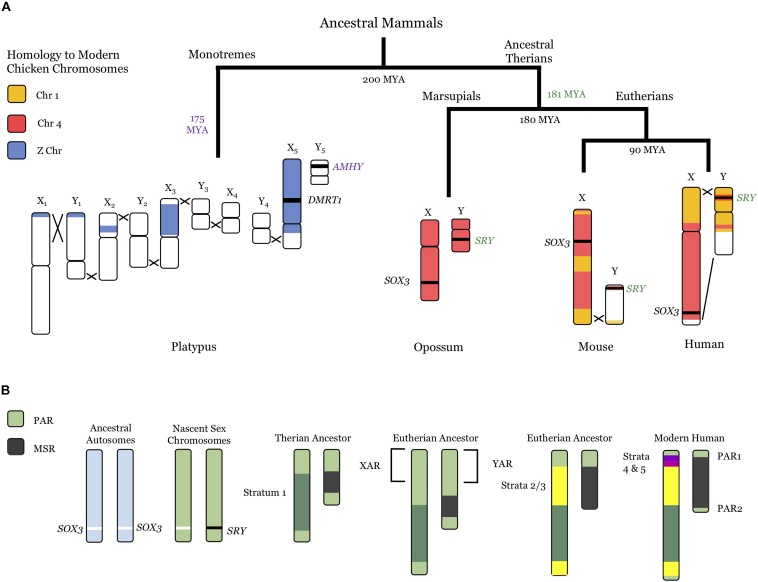
Evolution of mammalian sex chromosomes. (A) Current sex chromosomes of the platypus, opossum, mouse, and human, including recombination locations (black Xs) and homology to current chicken chromosomes (Z chromosome, blue; Chromosome 4, red; Chromosome 1, orange). Divergence times between lineages (black) and approximate dates of sex-determining mutations (monotremes, AMHY, purple text; marsupials and eutherians, SRY, green text) are also noted. There is variation in dates in the literature: those shown are from Cortez et al. (2014). See text for further references. (B) Evolutionary progression from autosomes (light blue, left) to modern human sex chromosomes (right). PARs, light green; Stratum 1, dark green; Strata 2/3, yellow; Stratum 4, fuchsia; Stratum 5, purple. The XAR/YAR regions from the ancestral chromosome 4 (A) are also noted. MYA, million years ago; PAR, pseudoautosomal region; MSR, male-specific region; XAR/YAR, X/Y added region.
FIGURE 2
FIGURE 2
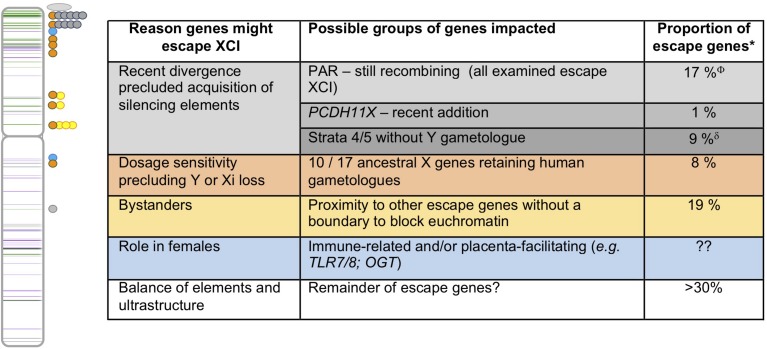
Human escape genes and possible underlying evolutionary reasons for their ongoing expression from the Xi. On the left is an ideogram of the X chromosome showing the genes that escape XCI (green) or variably escape XCI (purple) with lines appearing darker when multiple genes are nearby (data from Balaton et al., 2015). Circles to the right of the chromosome reflect locations of escape genes with features highlighted in the table to the right. The color of the dots matches the table, with PAR1 genes shown as an oval, given their abundance. As tabulated in Balaton et al. (2015); ΦIncludes three ancestral X genes; δIncludes four ancestral X genes.

References

    1. Aitken R. J., Graves J. A. M. (2002). Human spermatozoa: the future of sex. Nature 415 963–963. 10.1038/415963a - DOI - PubMed
    1. Al Nadaf S., Deakin J. E., Gilbert C., Robinson T. J., Graves J. A. M., Waters P. D. (2011). A cross-species comparison of escape from X inactivation in Eutheria: implications for evolution of X chromosome inactivation. Chromosoma 121 71–78. 10.1007/s00412-011-0343-8 - DOI - PMC - PubMed
    1. Bachtrog D., Kirkpatrick M., Mank J. E., McDaniel S. F., Pires J. C., Rice W., et al. (2011). Are all sex chromosomes created equal? Trends Genet. 27 350–357. 10.1016/j.tig.2011.05.005 - DOI - PubMed
    1. Bachtrog D., Mank J. E., Peichel C. L., Kirkpatrick M., Otto S. P., Ashman T.-L., et al. (2014). Sex determination: why so many ways of doing it? PLoS Biol. 12:e1001899. 10.1371/journal.pbio.1001899 - DOI - PMC - PubMed
    1. Bailey J. A., Carrel L., Chakravarti A., Eichler E. E. (2000). Molecular evidence for a relationship between LINE-1 elements and X chromosome inactivation: the Lyon repeat hypothesis. Proc. Natl. Acad. Sci. U.S.A. 97 6634–6639. 10.1073/pnas.97.12.6634 - DOI - PMC - PubMed

LinkOut - more resources