


Reversibility of delirium in Ill-hospitalized cancer patients: Does underlying etiology matter?
- PMID: 31696671
- PMCID: PMC6943139
- DOI: 10.1002/cam4.2669
Reversibility of delirium in Ill-hospitalized cancer patients: Does underlying etiology matter?
Abstract
Background: The objective of this study was to explore the underlying etiologies associated with the resolution and improvement of delirium in ill-hospitalized cancer patients.
Methods: We conducted a secondary analysis of a multicenter, prospective, observational study to estimate the effectiveness of pharmacotherapy for delirium. Participants were cancer patients with delirium. We assessed the Delirium Rating Scale, Revised-98 (DRS-R98) severity scale score at baseline and three days after pharmacotherapy initiation. Delirium resolution was defined as a DRS-R98 severity scale score ≤9, and improvement was defined as ≥50% reduction at Day 3.
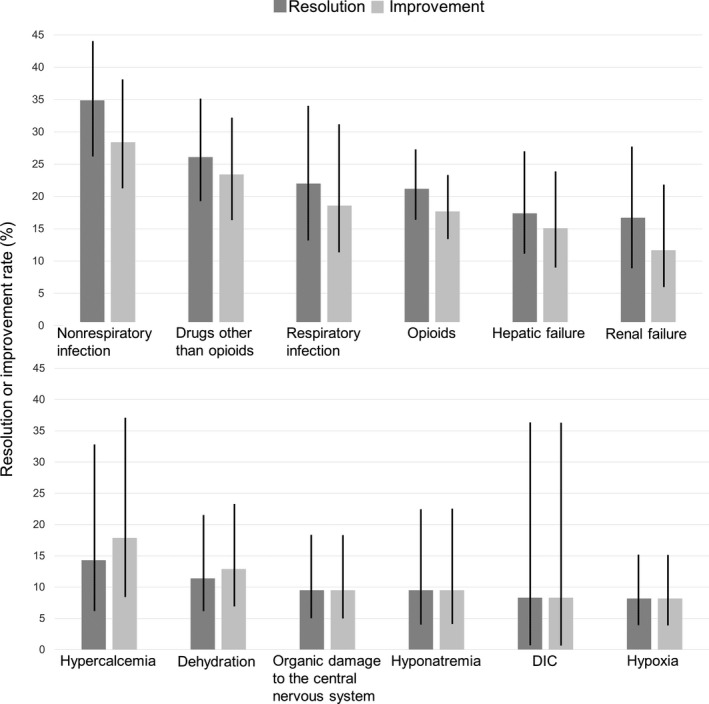
Results: We enrolled 566 patients (491 patients had performance status of 3 or 4). The resolution and improvement rates in all patients were 22.6% and 19.3%, respectively. Univariate analysis determined that nonrespiratory infection (OR 2.18, 95% CI 1.38-3.45) was significantly associated with greater resolution, while dehydration (0.40, 0.19-0.87), organic damage to the central nervous system (CNS) (0.32, 0.43-0.72), hypoxia (0.25, 0.12-0.52), and hyponatremia (0.34, 0.12-0.97) were significantly associated with no resolution. Potential causes associated with delirium improvement were nonrespiratory infection (1.93, 1.19-3.13), organic damage to the CNS (0.40, 0.18-1.90), and hypoxia (0.32, 0.16-0.65). After multivariate analysis, dehydration (0.34, 0.15-0.76), organic damage to the CNS (0.25, 0.10-0.60), and hypoxia (0.29, 0.14-0.61) were significantly associated with no resolution.
Conclusions: Delirium caused by nonrespiratory infection may be reversible, while delirium associated with dehydration, organic damage to the CNS, hypoxia, or hyponatremia seems to be irreversible in ill-hospitalized cancer patients.
Keywords: cancer; cause; delirium; palliative care; reversibility.
© 2019 The Authors. Cancer Medicine published by John Wiley & Sons Ltd.
Conflict of interest statement
All authors declare no conflicts of interest.
Figures
References
-
- Lawlor PG, Gagnon B, Mancini IL, et al. Occurrence, causes, and outcome of delirium in patients with advanced cancer: a prospective study. Arch Intern Med. 2000;160:786‐794. - PubMed
-
- Bruera E, Miller L, McCallion J, Macmillan K, Krefting L, Hanson J. Cognitive failure in patients with terminal cancer: a prospective study. J Pain Symptom Manage. 1992;7:192‐195. - PubMed
-
- Minagawa H, Uchitomi Y, Yamawaki S, Ishitani K. Psychiatric morbidity in terminally ill cancer patients. A prospective study. Cancer. 1996;78:1131‐1137. - PubMed
-
- Bush SH, Lawlor PG, Ryan K, et al. Delirium in adult cancer patients: ESMO Clinical Practice Guidelines. Ann Oncol. 2018;29:iv143‐iv165. - PubMed
-
- Breitbart W, Gibson C, Tremblay A. The delirium experience: delirium recall and delirium‐related distress in hospitalized patients with cancer, their spouses/caregivers, and their nurses. Psychosomatics. 2002;43:183‐194. - PubMed
Publication types
MeSH terms
Substances
LinkOut - more resources
Full Text Sources
Medical
