


Simultaneous revascularization of the occluded internal carotid artery using the Solitaire as a workhorse wire during acute ischemic stroke intervention
- PMID: 31696768
- PMCID: PMC7507217
- DOI: 10.1177/1591019919885253
Simultaneous revascularization of the occluded internal carotid artery using the Solitaire as a workhorse wire during acute ischemic stroke intervention
Abstract
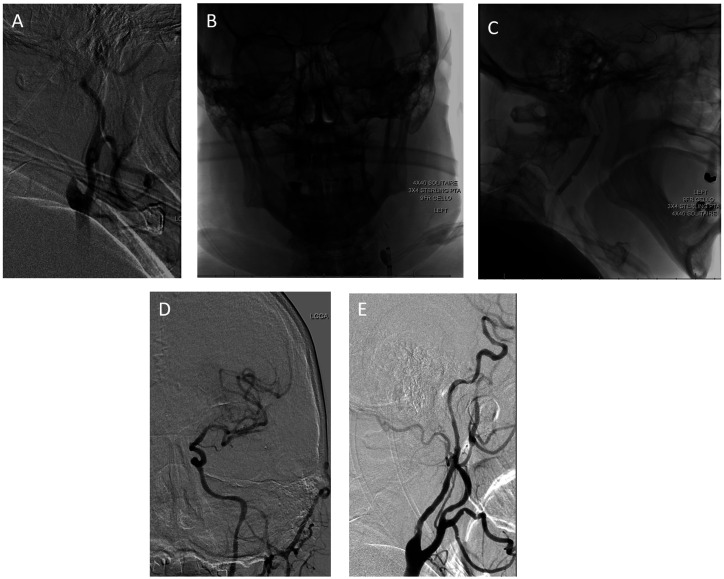
Introduction: Tandem lesions involving a large vessel occlusion intracranially with concomitant cervical carotid critical stenosis or occlusion are a common presentation of acute ischemic stroke. These lesions are both challenging and time-consuming but can be extremely beneficial for patients when successful. We present a technique utilizing the pusher wire of the stent retriever used for intracranial thrombectomy as the workhorse wire for carotid intervention using a monorail system to perform cervical carotid angioplasty.
Methods: We reviewed four successive patients who presented with a tandem occlusion and underwent thrombectomy and simultaneous carotid artery intervention using this technique.
Results: All four patients had radiographically successful intracranial thrombectomy and cervical carotid revascularization. Time from groin puncture to intracranial stent retriever deployment was 63 min on average. Then, using the pusher wire as a monorail workhorse, time from stent retriever deployment to carotid angioplasty was on average 6 min.
Discussion: This technique allows for cervical carotid revascularization to begin during the recommended 5-min wait time after stent retriever deployment, allowing for rapid near-simultaneous revascularization across both lesions. This technique has been reported briefly in the past for management of a cervical dissection. There is continued debate regarding the management of tandem occlusions, as to which lesion should be managed first.
Conclusion: As the management paradigms of tandem occlusions continue to evolve, this technique may improve outcomes by expediting endovascular intervention. Using the stent retriever wire provides a method of expediting the management of the proximal lesion after addressing the more distal intracranial occlusion first.
Keywords: Acute ischemic stroke; Solitaire; neuroendovascular; occlusion; stent retriever; tandem lesions; thrombectomy.
Figures
References
-
- Goyal M, Demchuk AM, Menon BK, et al. Randomized assessment of rapid endovascular treatment of ischemic stroke. N Engl J Med 2015; 372: 1019–1030. - PubMed
-
- del Zoppo GJ, Poeck K, Pessin MS, et al. Recombinant tissue plasminogen activator in acute thrombotic and embolic stroke. Ann Neurol 1992; 32: 78–86. - PubMed
-
- Fahed R, Redjem H, Blanc R, et al. Endovascular management of acute ischemic strokes with tandem occlusions. Cerebrovasc Dis 2016; 41: 298–305. - PubMed
MeSH terms
LinkOut - more resources
Full Text Sources
Medical
Research Materials
Miscellaneous
