


The association between dietary fibre deficiency and high-income lifestyle-associated diseases: Burkitt's hypothesis revisited
- PMID: 31696832
- PMCID: PMC6944853
- DOI: 10.1016/S2468-1253(19)30257-2
The association between dietary fibre deficiency and high-income lifestyle-associated diseases: Burkitt's hypothesis revisited
Abstract
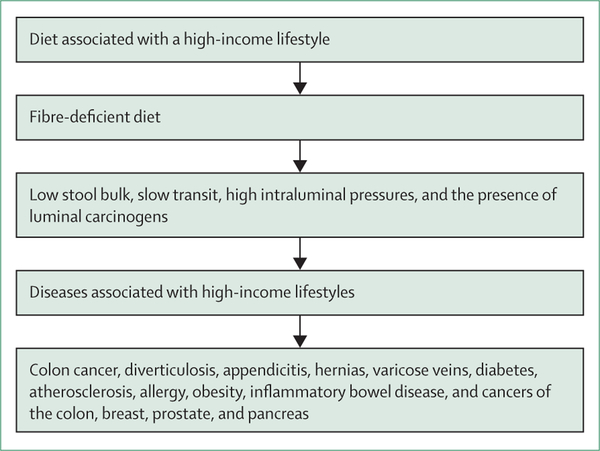
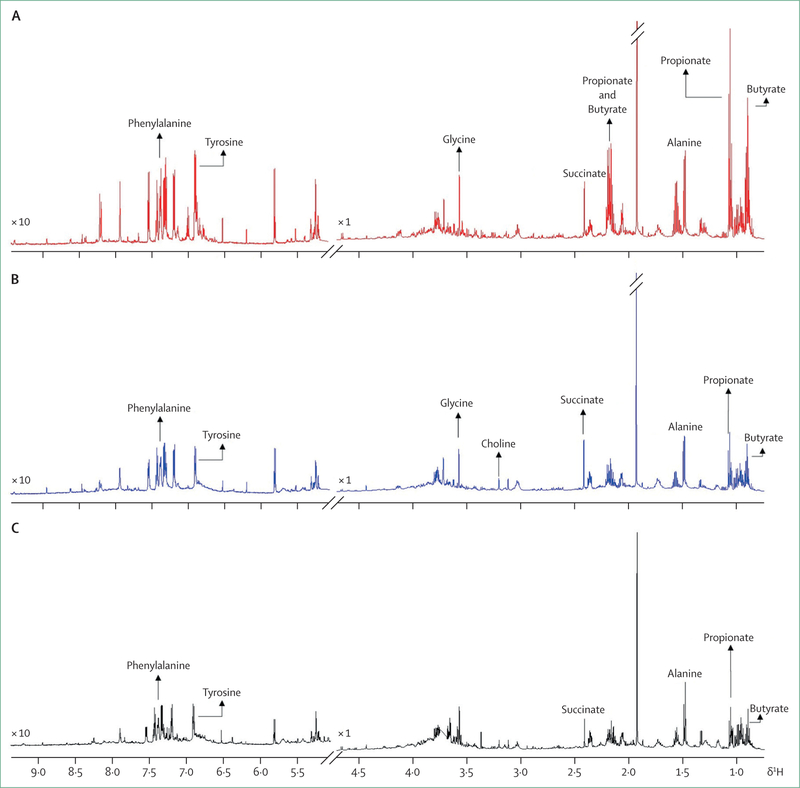
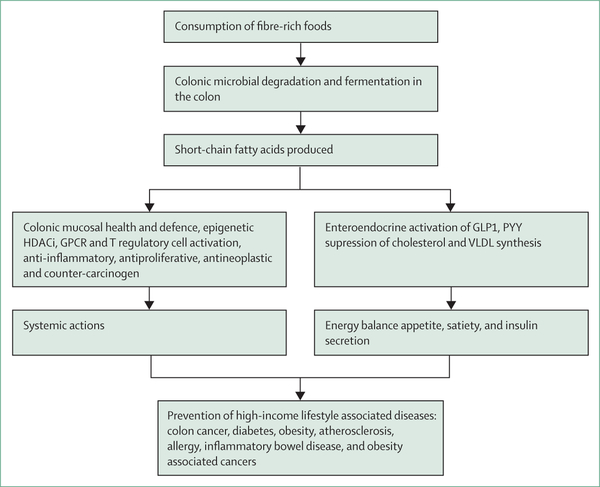
In 1969, Denis Burkitt published an article titled "Related disease-related cause?", which became the foundation for Burkitt's hypothesis. Working in Uganda, he noted that middle-aged people (40-60 years old) had a much lower incidence of diseases that were common in similarly aged people living in England, including colon cancer, diverticulitis, appendicitis, hernias, varicose veins, diabetes, atherosclerosis, and asthma, all of which are associated with lifestyles commonly led in high-income countries (HICs; also known as western diseases). Following Cleave's common cause hypothesis-which suggests that if a group of diseases occur together in the same population or individual, they are likely to have a common cause-Burkitt attributed these diseases to the small quantities of dietary fibre consumed in HICs due mainly to the over-processing of natural foods. Nowadays, dietary fibre intake in HICs is around 15 g/day (well below the amount of fibre Burkitt advocated of >50 g/day-which is associated with diets from rural, southern and eastern sub-Sahalean Africa). Since Burkitt's death in 1993, his hypothesis has been verified and extended by large-scale epidemiological studies, which have reported that fibre deficiency increases the risk of colon, liver, and breast cancer and increases all cancer mortality and death from cardiovascular, infectious, and respiratory diseases, diabetes, and all non-cardiovascular, non-cancer causes. Furthermore, mechanistic studies have now provided molecular explanations for these associations, typified by the role of short-chain fatty acids, products of fibre fermentation in the colon, in suppressing colonic mucosal inflammation and carcinogenesis. Evidence suggests that short-chain fatty acids can affect the epigenome through metabolic regulatory receptors in distant organs, and that this can reduce obesity, diabetes, atherosclerosis, allergy, and cancer. Diseases associated with high-income lifestyles are the most serious threat to health in developed countries, and public and governmental awareness needs to be improved to urge an increase in intake of fibre-rich foods. This Viewpoint will summarise the evidence that suggests that increasing dietary fibre intake to 50 g/day is likely to increase lifespan, improve the quality of life during the added years, and substantially reduce health-care costs.
Copyright © 2019 Elsevier Ltd. All rights reserved.
Figures
References
-
- Burkitt DP. Related disease—related cause? Lancet 1969; 294: 1229–31. - PubMed
-
- Burkitt DP. Relationship as a clue to causation. Lancet 1970; 296: 1237–40. - PubMed
-
- Cummings JH, Engineer A. Denis Burkitt and the origins of the dietary fibre hypothesis. Nutr Res Rev 2018; 31: 1–15. - PubMed
-
- Cleave TL CG. Diabetes, coronary thrombosis and the saccharine disease. Bristol: John Wright and Sons, 1966.
-
- Winkler JT. Pure, white and deadly. Br Med J 2013; 346: e8612.
Publication types
MeSH terms
Substances
Grants and funding
LinkOut - more resources
Full Text Sources
Medical
