


Chromatin remodeling and mismatch repair: Access and excision
- PMID: 31698199
- PMCID: PMC7367450
- DOI: 10.1016/j.dnarep.2019.102733
Chromatin remodeling and mismatch repair: Access and excision
Abstract
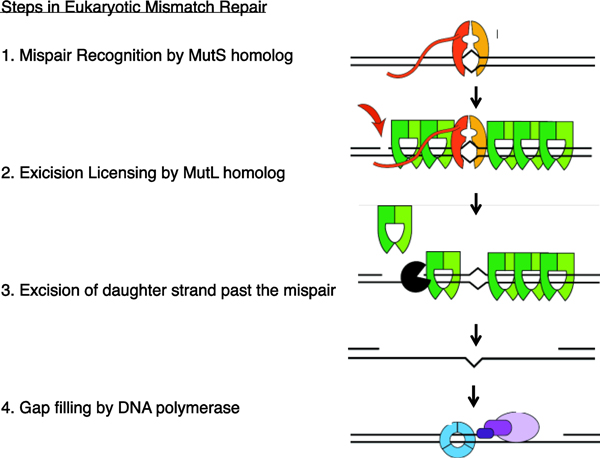
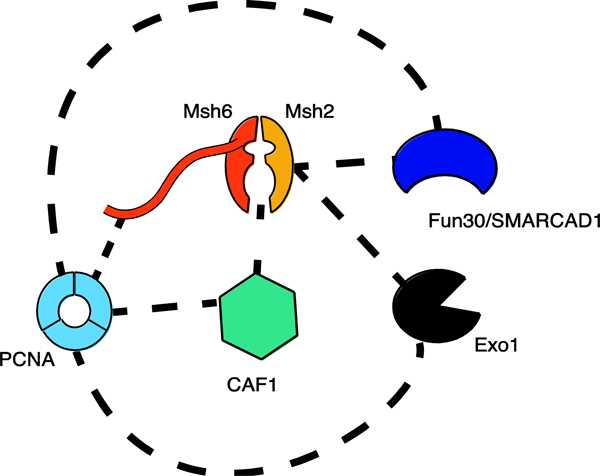
DNA mismatch repair (MMR) increases replication fidelity and genome stability by correcting DNA polymerase errors that remain after replication. Defects in MMR result in the accumulation of mutations and lead to human tumor development. Germline mutations in MMR cause the hereditary cancer syndrome, Lynch syndrome. After replication, DNA is reorganized into its chromatin structure and wrapped around histone octamers. DNA MMR is thought to be less efficient in recognizing and repairing mispairs packaged in chromatin, in which case MMR must either compete for access to naked DNA before histone deposition or actively move nucleosomes to access the mispair. This article reviews studies into the mechanistic and physical interactions between MMR and various chromatin-associated factors, including the histone deposition complex CAF1. Recent Xenopus and Saccharomyces cerevisiae studies describe a physical interaction between Msh2 and chromatin-remodeling ATPase Fun30/SMARCAD1, with potential mechanistic roles for SMARCAD1 in moving histones for both mispair access and excision tract elongation. The RSC complex, another histone remodeling complex, also potentially influences excision tract length. Deletion mutations of RSC2 point to mechanistic interactions with the MMR pathways. Together, these studies paint a picture of complex interactions between MMR and the chromatin environment that will require numerous additional genetic, biochemical, and cell biology experiments to fully understand. Understanding how these pathways interconnect is essential in fully understanding eukaryotic MMR and has numerous implications in human tumor formation and treatment.
Keywords: CAF1; Chromatin; Fun30; Genome instability; Mismatch repair; SMARCAD1.
Copyright © 2019 Elsevier B.V. All rights reserved.
Figures
References
-
- Li GM (2008) Mechanisms and functions of DNA mismatch repair. Cell research 18, 85–98 - PubMed
-
- Kolodner RD, and Marsischky GT (1999) Eukaryotic DNA mismatch repair. Current opinion in genetics & development 9, 89–96 - PubMed
-
- Fishel R, Lescoe MK, Rao MR, Copeland NG, Jenkins NA, Garber J, Kane M, and Kolodner R (1993) The human mutator gene homolog MSH2 and its association with hereditary nonpolyposis colon cancer. Cell 75, 1027–1038 - PubMed
Publication types
MeSH terms
Substances
Grants and funding
LinkOut - more resources
Full Text Sources
Molecular Biology Databases
