


Application of MALDI-TOF MS to rapid identification of anaerobic bacteria
- PMID: 31699042
- PMCID: PMC6836477
- DOI: 10.1186/s12879-019-4584-0
Application of MALDI-TOF MS to rapid identification of anaerobic bacteria
Abstract
Background: Matrix-assisted laser desorption ionization-time of flight mass spectrometry (MALDI-TOF MS) has been rapidly developed and widely used as an analytical technique in clinical laboratories with high accuracy in microorganism identification.
Objective: To validate the efficacy of MALDI-TOF MS in identification of clinical pathogenic anaerobes.
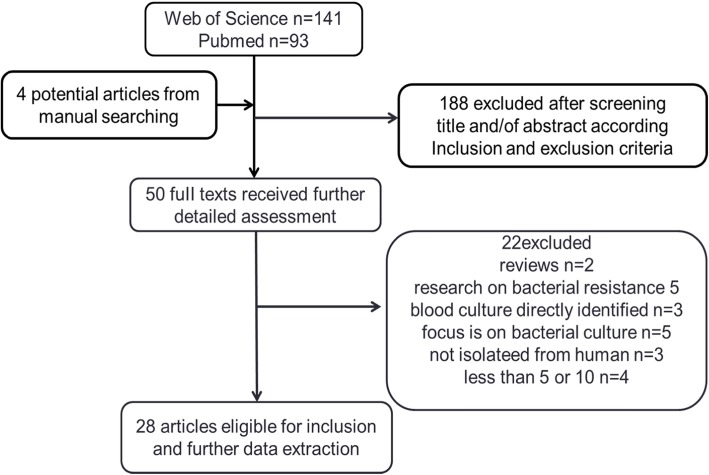
Methods: Twenty-eight studies covering 6685 strains of anaerobic bacteria were included in this meta-analysis. Fixed-effects models based on the P-value and the I-squared were used for meta-analysis to consider the possibility of heterogeneity between studies. Statistical analyses were performed by using STATA 12.0.
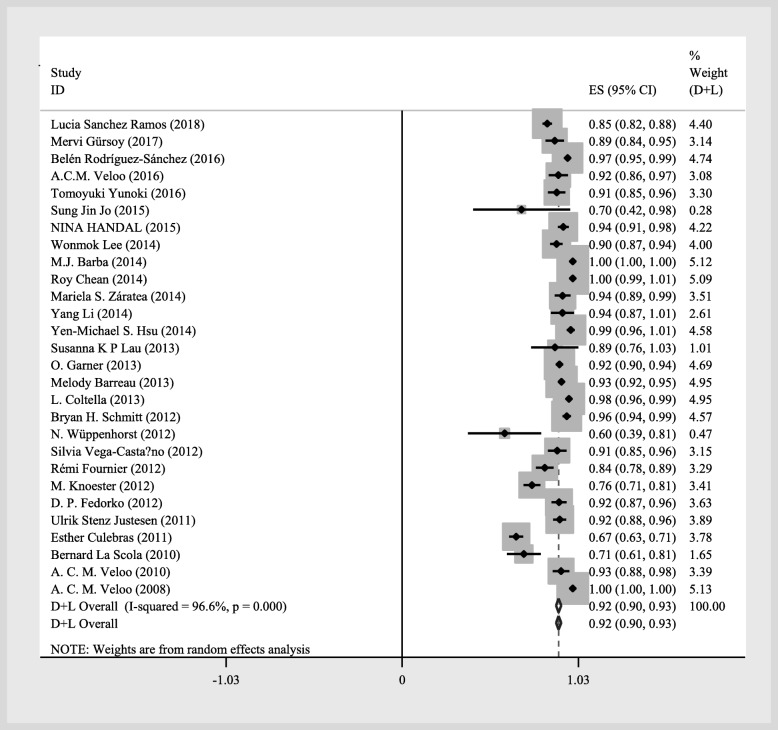
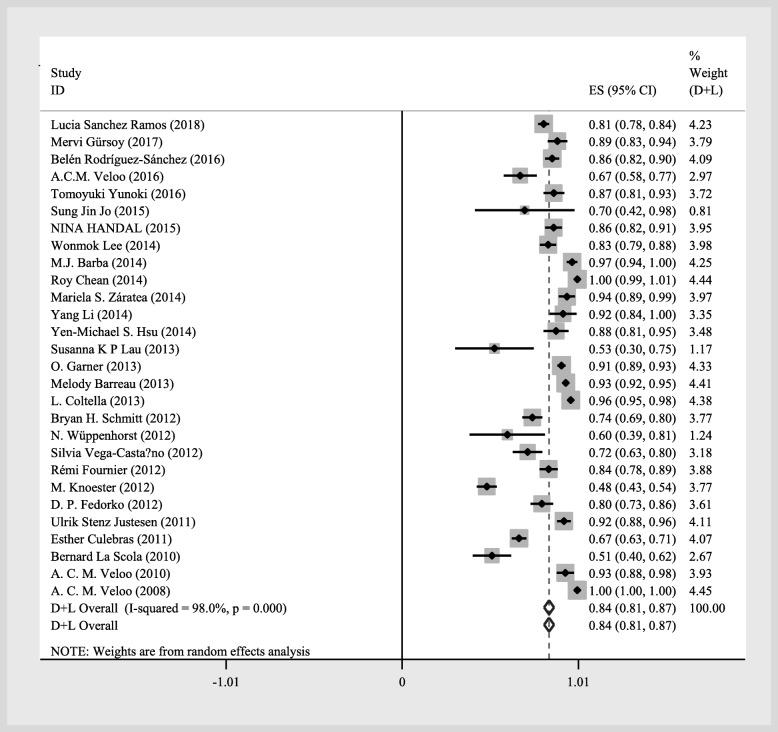
Results: The identification accuracy of MALDI-TOF MS was 84% for species (I2 = 98.0%, P < 0.1), and 92% for genus (I2 = 96.6%, P < 0.1). Thereinto, the identification accuracy of Bacteroides was the highest at 96% with a 95% CI of 95-97%, followed by Lactobacillus spp., Parabacteroides spp., Clostridium spp., Propionibacterium spp., Prevotella spp., Veillonella spp. and Peptostreptococcus spp., and their correct identification rates were all above 90%, while the accuracy of rare anaerobic bacteria was relatively low. Meanwhile, the overall capabilities of two MALDI-TOF MS systems were different. The identification accuracy rate was 90% for VITEK MS vs. 86% for MALDI biotyper system.
Conclusions: Our research showed that MALDI-TOF-MS was satisfactory in genus identification of clinical pathogenic anaerobic bacteria. However, this method still suffers from different drawbacks in precise identification of rare anaerobe and species levels of common anaerobic bacteria.
Keywords: Anaerobes; Bacteria identification; MALDI-TOF MS.
Conflict of interest statement
The authors declare that they have no conflict of interest.
Figures
References
-
- Norin E. How normal is a “normal” flora in animal or man? Anaerobe. 2011;17(6):431–432. - PubMed
-
- Lau SK, Tang BS, Teng JL, et al. Matrix-assisted laser desorption ionization time-of-flight mass spectrometry for identification of clinically significant bacteria that are difficult to identify in clinical laboratories. J Clin Pathol. 2014;67(4):361–366. - PubMed
-
- Petrotchenko EV, Borchers CH. Modern mass spectrometry-based structural proteomics. Adv Protein Chem Struct Biol. 2014;95(2):193–213. - PubMed
-
- Matsuo T, Seyama Y. Introduction to modern biological mass spectrometry. J Mass Spectrom. 2015;35(2):114–130. - PubMed
Publication types
MeSH terms
Grants and funding
- 17KJB360014/Science and Technology Innovative Research Team in Higher Educational Institutions of Hunan Province
- 81871734/the National Natural Science Foundation of China
- BK20151154/Jiangsu Privincial Natural Science Foundation
- ZDRCA2016053/Jiangsu Privincial Medical Talent
- WSN-135/Six talent peaks project of Jiangsu Province
LinkOut - more resources
Full Text Sources
Miscellaneous
