


CYP2C19 Phenotype and Risk of Proton Pump Inhibitor-Associated Infections
- PMID: 31699831
- PMCID: PMC6889971
- DOI: 10.1542/peds.2019-0857
CYP2C19 Phenotype and Risk of Proton Pump Inhibitor-Associated Infections
Abstract
Objectives: Proton pump inhibitors (PPIs) are often used in pediatrics to treat common gastrointestinal disorders, and there are growing concerns for infectious adverse events. Because CYP2C19 inactivates PPIs, genetic variants that increase CYP2C19 function may decrease PPI exposure and infections. We tested the hypothesis that CYP2C19 metabolizer phenotypes are associated with infection event rates in children exposed to PPIs.
Methods: This retrospective biorepository cohort study included individuals aged 0 to 36 months at the time of PPI exposure. Respiratory tract and gastrointestinal tract infection events were identified by using International Classification of Diseases codes in the year after the first PPI mention. Variants defining CYP2C19 *2, *3, *4, *8, *9, and *17 were genotyped, and all individuals were classified as CYP2C19 poor or intermediate, normal metabolizers (NMs), or rapid or ultrarapid metabolizers (RM/UMs). Infection rates were compared by using univariate and multivariate analyses.
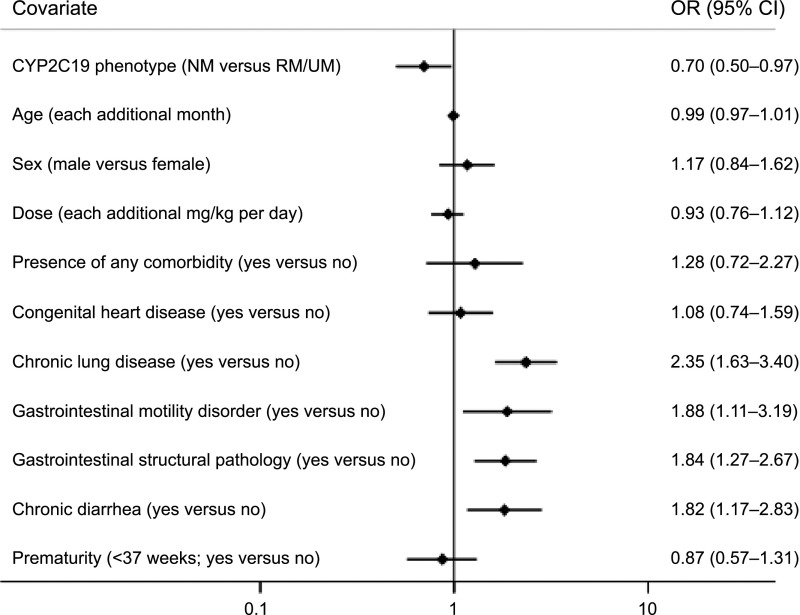
Results: In all, 670 individuals were included (median age 7 months; 44% girls). CYP2C19 NMs (n = 267; 40%) had a higher infection rate than RM/UMs (n = 220; 33%; median 2 vs 1 infections per person per year; P = .03). There was no difference between poor or intermediate (n = 183; 27%) and NMs. In multivariable analysis of NMs and RM/UMs adjusting for age, sex, PPI dose, and comorbidities, CYP2C19 metabolizer status remained a significant risk factor for infection events (odds ratio 0.70 [95% confidence interval 0.50-0.97] for RM/UMs versus NMs).
Conclusions: PPI therapy is associated with higher infection rates in children with normal CYP2C19 function than in those with increased CYP2C19 function, highlighting this adverse effect of PPI therapy and the relevance of CYP2C19 genotypes to PPI therapeutic decision-making.
Copyright © 2019 by the American Academy of Pediatrics.
Conflict of interest statement
POTENTIAL CONFLICT OF INTEREST: The authors have indicated they have no potential conflicts of interest to disclose.
Figures
Comment in
-
Consider If You Will: Proton Pump Inhibitors in Children, Infections, and Precision Medicine.Pediatrics. 2019 Dec;144(6):e20192544. doi: 10.1542/peds.2019-2544. Epub 2019 Nov 7. Pediatrics. 2019. PMID: 31699830 No abstract available.
-
Authors' Response.Pediatrics. 2020 Jun;145(6):e20200867B. doi: 10.1542/peds.2020-0867B. Pediatrics. 2020. PMID: 32471841 No abstract available.
-
CYP2C19 Phenotype and Risk of Proton Pump Inhibitor-Associated Infections.Pediatrics. 2020 Jun;145(6):e20200867A. doi: 10.1542/peds.2020-0867A. Pediatrics. 2020. PMID: 32471842 No abstract available.
References
-
- Agency for Healthcare Research and Quality Prescribed drugs: number of people with purchase in thousands by therapeutic class, United States, 1996–2016. 2019. Available at: https://meps.ahrq.gov/mepstrends/hc_pmed/#plot-tab. Accessed February 18, 2019
-
- Barron JJ, Tan H, Spalding J, Bakst AW, Singer J. Proton pump inhibitor utilization patterns in infants. J Pediatr Gastroenterol Nutr. 2007;45(4):421–427 - PubMed
-
- Blank ML, Parkin L. National study of off-label proton pump inhibitor use among New Zealand infants in the first year of life (2005–2012). J Pediatr Gastroenterol Nutr. 2017;65(2):179–184 - PubMed
-
- Gibbons TE, Gold BD. The use of proton pump inhibitors in children: a comprehensive review. Paediatr Drugs. 2003;5(1):25–40 - PubMed
Publication types
MeSH terms
Substances
Grants and funding
LinkOut - more resources
Full Text Sources
