. 2019 Nov 7;9(1):16232.
doi: 10.1038/s41598-019-52810-5.

Nonlinear relationship between early life stress exposure and subsequent resilience in monkeys

Affiliations

Nonlinear relationship between early life stress exposure and subsequent resilience in monkeys

Karen J Parker et al. Sci Rep. .

Abstract

Retrospective correlational studies of humans suggest that moderate but not minimal or substantial early life stress exposure promotes the development of stress inoculation-induced resilience. Here we test for a nonlinear relationship between early life stress and resilience by comparing varying "doses" of early life stress. Juvenile squirrel monkeys underwent one of five treatment conditions between 17-27 weeks of age: Stress inoculation (SI) with continuous access to mother (SI + Mom; one stress element), SI without continuous access to mother (SI; two stress elements), SI without continuous access to mother and with alprazolam injection pretreatments (SI + Alz; three stress elements), SI without continuous access to mother and with vehicle injection pretreatments (SI + Veh; three stress elements), or standard housing (No SI; zero stress elements). Alprazolam was used to test whether anxiolytic medication diminished SI effects. Subjects exposed to one or two early life stressors subsequently responded with fewer indications of anxiety (e.g., decreased maternal clinging, increased object exploration, smaller cortisol increases) compared to No SI subjects. Subjects exposed to three early life stressors did not differ on most measures from one another or from No SI subjects. These findings provide empirical support for a nonlinear J-shaped relationship between early life stress exposure and subsequent resilience.


Conflict of interest statement

Dr. Schatzberg reports receiving lecture fees from, and owning shares in, Pfizer, Inc. Dr. Parker, Ms. Buckmaster, Ms. Hyde and Dr. Lyons report no biomedical interests or potential conflicts of interest with regard to this report.

Figures
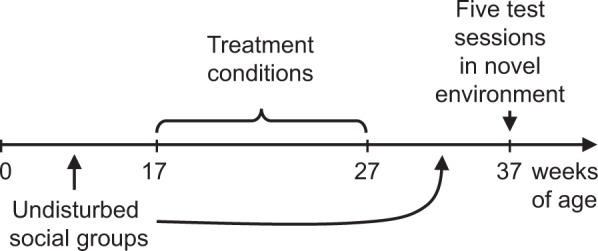
Figure 1
Figure 1
Schematic overview of the experimental design and study timeline. Subjects (N = 62) underwent one of five treatment conditions, with varying stress elements, between 17 and 27 weeks of age. Subjects were assessed 10 weeks later, at 37 weeks of age, for behavioral and neuroendocrine indications of resilience.
Figure 2
Figure 2
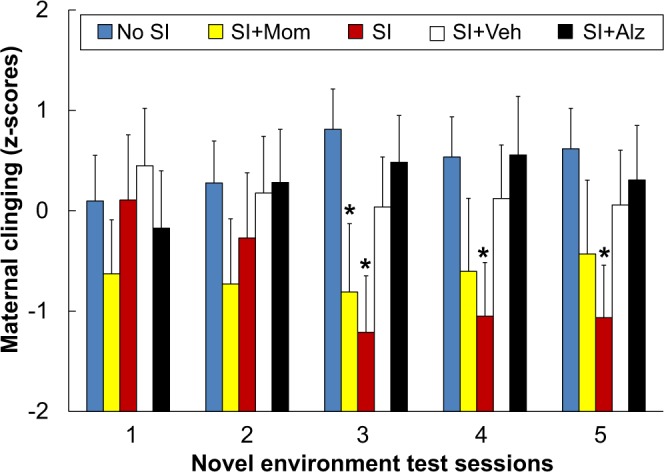
Treatment condition differences in maternal clinging. Maternal clinging scores measured in drug-free conditions during repeated novel environment test sessions are presented as mean ± SEM. Treatment conditions within each test session are ordered in terms of increasing exposure to more stress elements as described in Table 1. Asterisks indicate a significant difference relative to the No SI condition (P < 0.05).
Figure 3
Figure 3
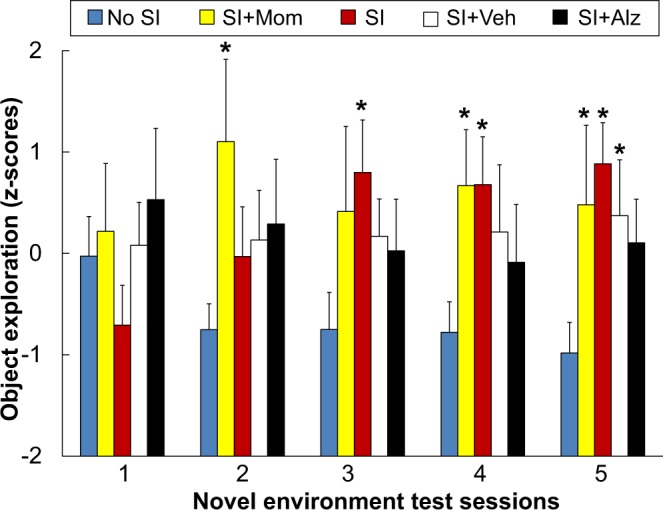
Treatment condition differences in exploration. Object exploration scores measured in drug-free conditions during repeated novel environment test sessions are presented as mean ± SEM. Treatment conditions within each test session are ordered in terms of increasing exposure to more stress elements as described in Table 1. Asterisks indicate a significant difference relative to the No SI condition (P < 0.05).
Figure 4
Figure 4
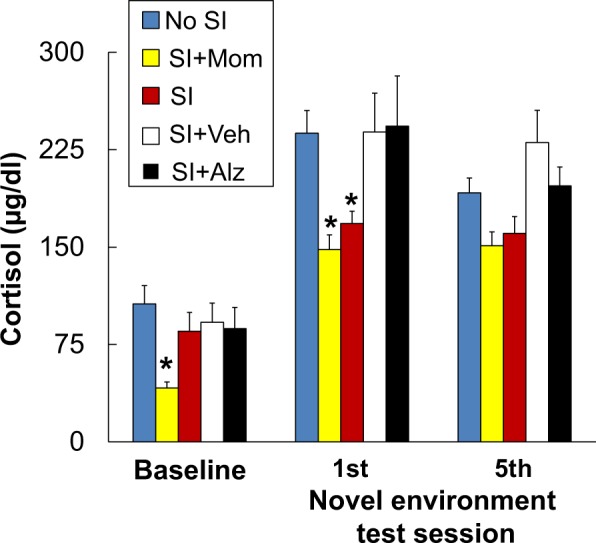
Treatment condition differences in cortisol. Plasma levels of cortisol measured in drug-free conditions before (baseline) and after the first and last novel environment test sessions are presented as mean ± SEM. Treatment conditions are ordered in terms of increasing exposure to more stress elements as described in Table 1. Asterisks indicate a significant difference relative to the No SI condition (P < 0.05).
Figure 5
Figure 5
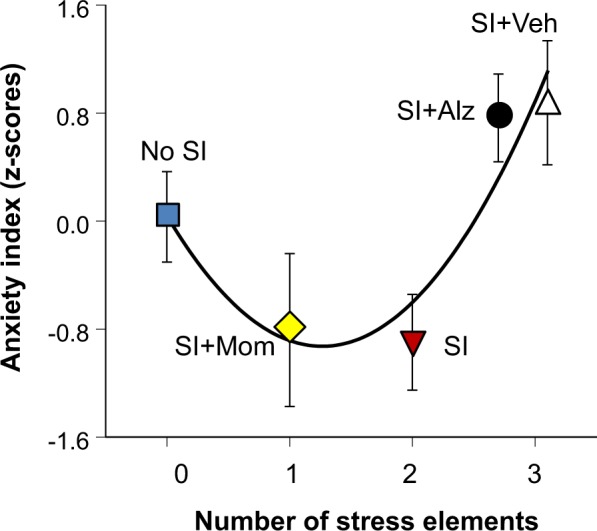
Treatment condition differences in evoked anxiety. Summary measure of anxiety evoked during the novel environment test sessions is plotted against the number of different stress elements in each treatment condition (mean ± SEM). Treatment conditions are ordered in terms of increasing exposure to more stress elements as described in Table 1. The quadratic J-shaped relationship was confirmed by statistical trend analysis (P = 0.001).

References

    1. Heim C, Newport DJ, Mletzko T, Miller AH, Nemeroff CB. The link between childhood trauma and depression: insights from HPA axis studies in humans. Psychoneuroendocrinology. 2008;33:693–710. doi: 10.1016/j.psyneuen.2008.03.008. - DOI - PubMed
    1. Glaser D. Child abuse and neglect and the brain–a review. J Child Psychol Psychiatry. 2000;41:97–116. doi: 10.1017/S0021963099004990. - DOI - PubMed
    1. Walker EA, et al. Adult health status of women with histories of childhood abuse and neglect. The American journal of medicine. 1999;107:332–339. doi: 10.1016/S0002-9343(99)00235-1. - DOI - PubMed
    1. Edge MD, et al. For better or worse? Stress inoculation effects for implicit but not explicit anxiety. Depress Anxiety. 2009;26:831–837. doi: 10.1002/da.20592. - DOI - PMC - PubMed
    1. Gunnar MR, Frenn K, Wewerka SS, Van Ryzin MJ. Moderate versus severe early life stress: Associations with stress reactivity and regulation in 10–12-year-old children. Psychoneuroendocrinology. 2009;34:62–75. doi: 10.1016/j.psyneuen.2008.08.013. - DOI - PMC - PubMed

Publication types