


Continuous Glucose Monitoring Versus Self-monitoring of Blood Glucose in Type 2 Diabetes Mellitus: A Systematic Review with Meta-analysis
- PMID: 31700737
- PMCID: PMC6822918
- DOI: 10.7759/cureus.5634
Continuous Glucose Monitoring Versus Self-monitoring of Blood Glucose in Type 2 Diabetes Mellitus: A Systematic Review with Meta-analysis
Abstract
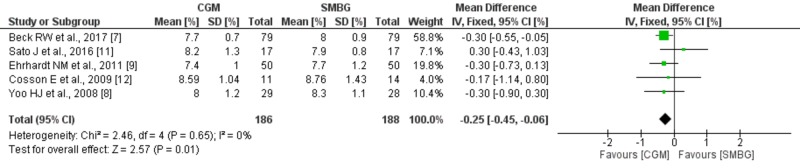
Every eleventh adult has diabetes, and every third has prediabetes. Over 95% of diabetics are of type 2. It is well established that diabetes doubles the risk of heart disease and stroke apart from increasing the risk of microvascular complications. Hence, strict glycemic control is necessary. However, it increases the risk of hypoglycemia, especially in patients with longstanding diabetes. Continuous glucose monitors (CGM) use a sensor to continuously measure the glucose levels in the interstitial fluid every 10 seconds and gives out mean values every five minutes. CGMs are emerging tools in the management of type 2 diabetes. The prime objective of this review is to find out if there is enough supporting evidence, suggesting that continuous glucose monitoring is more effective than self-monitoring of blood glucose (SMBG) in type 2 diabetes. We conducted a systematic literature search in Medline (PubMed) looking for any studies addressing our objective. It is observed that there is a varying level of evidence supporting that employing a CGM can reduce glycated hemoglobin (HbA1c), hypoglycemic events, and increase patient satisfaction. However, some studies reported no significant benefits. This systematic review with meta-analysis concludes that the use of CGM in type 2 diabetes mellitus (T2DM) is beneficial, as it significantly reduces HbA1c compared to the usual method of SMBG. The pooled mean difference in HbA1c was -0.25 (-0.45, -0.06) and statistically significant (at p = 0.01) when comparing CGM to SMBG.
Keywords: continuous glucose monitor; glucose variability; real-time glucose monitoring; self-monitoring of blood glucose; time in range; type 2 diabetes mellitus.
Copyright © 2019, Janapala et al.
Conflict of interest statement
The authors have declared that no competing interests exist.
Figures
References
-
- IDF Diabetes Atlas - 8th edition. [Jul;2019 ];International Diabetes Federation Diabetes Atlas. (2019. https://diabetesatlas.org/key-messages.html 2019
-
- Centers for Disease Control and Prevention - Diabetes Quick facts. [Jul;2019 ];https://www.cdc.gov/diabetes/basics/quick-facts.html 2019
-
- The effect of intensive treatment of diabetes on the development and progression of long-term complications in insulin-dependent diabetes mellitus. Diabetes Control and Complications Trial Research Group, Nathan DM, Genuth S, et al. N Engl J Med. 1993;329:977–986. - PubMed
LinkOut - more resources
Full Text Sources