


Percutaneous Kidney Biopsy and the Utilization of Blood Transfusion and Renal Angiography Among Hospitalized Adults
- PMID: 31701053
- PMCID: PMC6829181
- DOI: 10.1016/j.ekir.2019.07.008
Percutaneous Kidney Biopsy and the Utilization of Blood Transfusion and Renal Angiography Among Hospitalized Adults
Abstract
Introduction: Data on percutaneous kidney biopsy (KBx) incidence and frequencies of hemorrhagic complications among inpatients are limited.
Methods: Using nationally representative US hospitalization discharge data, we report temporal trends in inpatient KBx rates from 2007 to 2014 and estimate frequencies of, and risk factors for, utilization of packed red blood cell (pRBC) transfusion and renal angiography.
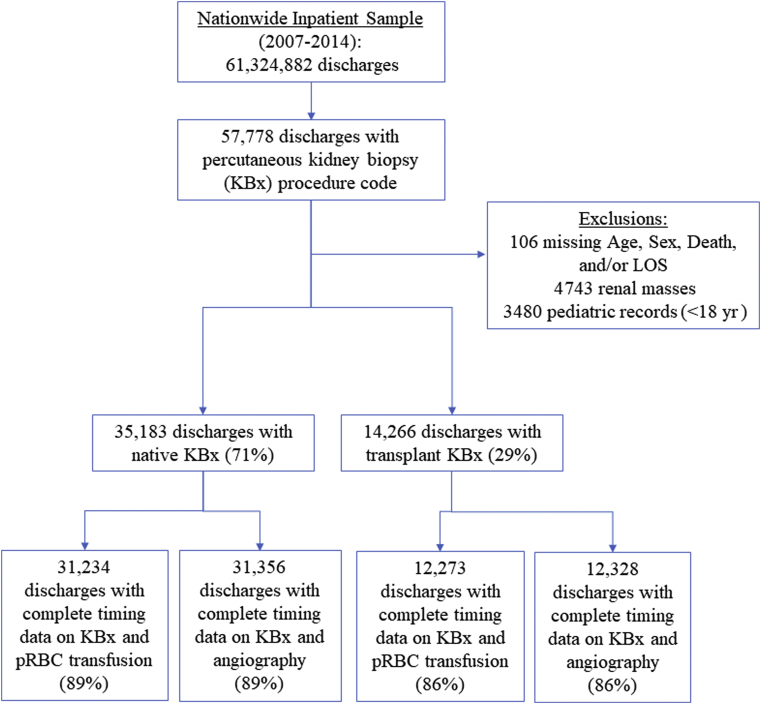
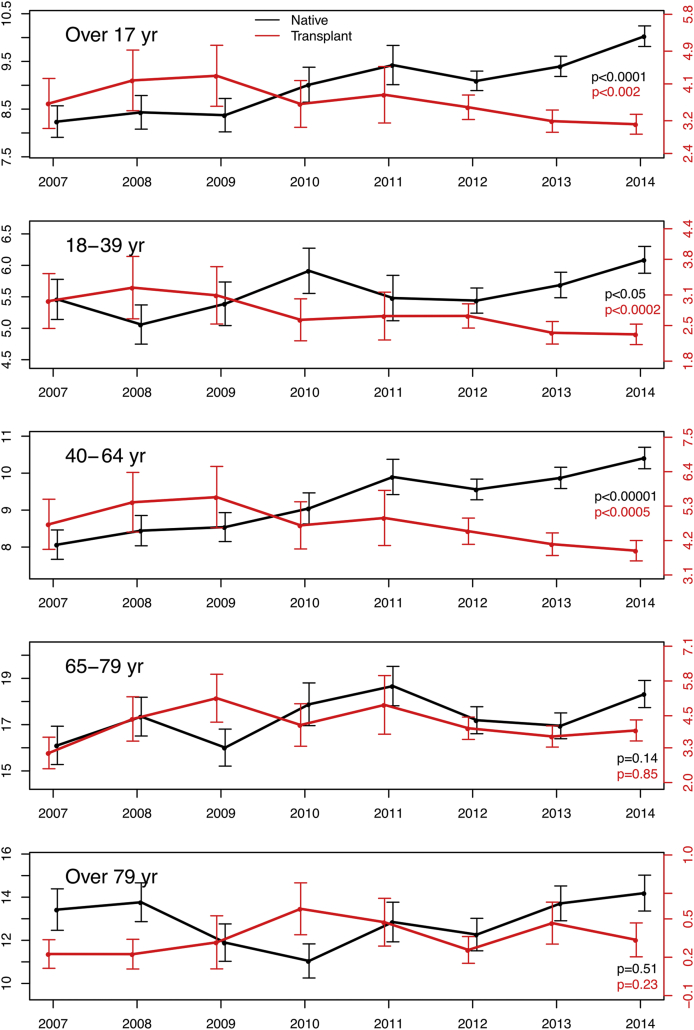
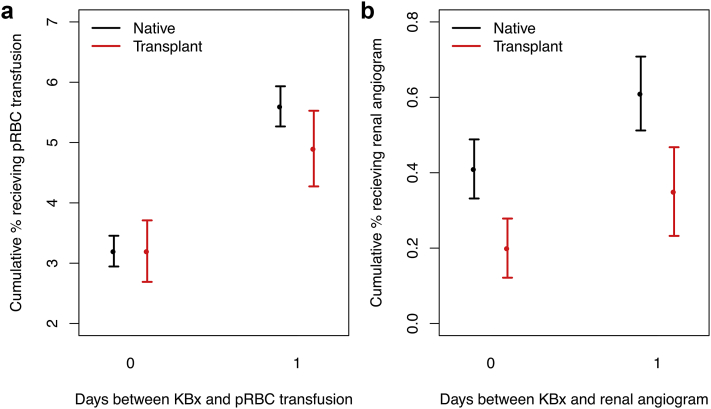
Results: From 2007 to 2014, rates of native KBx among adult inpatients increased from 8.2 to 10.0 per 100,000, while transplant KBx rates declined from 3.6 to 3.1 per 100,000. We studied 35,183 and 14,266 discharge records with native and transplant KBx. We found that 5.7% (95% confidence interval [CI]: 5.3%-6.0%) of inpatients undergoing native KBx and 4.9% (4.2%-5.5%) of those undergoing transplant KBx received a pRBC transfusion within 2 days of biopsy. Similarly, 0.6% (0.5%-0.7%) of inpatients undergoing native KBx and 0.4% (0.2%-0.5%) undergoing transplant KBx received a renal angiogram within 2 days of KBx. For inpatient native KBx, female sex, older age, higher chronic kidney disease stage, acute renal failure, lupus, vasculitis, cirrhosis, multiple myeloma/paraproteinemia, and anemia of chronic disease were independently associated with increased odds of pRBC transfusion; cirrhosis and end-stage renal disease (ESRD) were associated with increased odds, and nephrotic syndrome was associated with decreased odds, of renal angiography.
Conclusions: In this large population-based study of inpatient KBx practices, we demonstrate increasing rates of inpatient native KBx among US adults and provide accurate estimates of the frequencies of, and risk factors for, pRBC transfusion and renal angiography following inpatient KBx.
Keywords: acute kidney injury; glomerular disease; renal biopsy.
© 2019 International Society of Nephrology. Published by Elsevier Inc.
Figures
References
-
- Dhaun N., Bellamy C.O., Cattran D.C., Kluth D.C. Utility of renal biopsy in the clinical management of renal disease. Kidney Int. 2014;85:1039–1048. - PubMed
-
- D’Agati V.D., Mengel M. The rise of renal pathology in nephrology: structure illuminates function. Am J Kidney Dis. 2013;61:1016–1025. - PubMed
-
- Whittier W.L., Korbet S.M. Timing of complications in percutaneous renal biopsy. J Am Soc Nephrol. 2004;15:142–147. - PubMed
-
- Corapi K.M., Chen J.L.T., Balk E.M., Gordon C.E. Bleeding complications of native kidney biopsy: a systematic review and meta-analysis. Am J Kidney Dis. 2012;60:62–73. - PubMed
LinkOut - more resources
Full Text Sources
