


Psychometric Properties of a Fidelity Scale for Illness Management and Recovery
- PMID: 31701294
- PMCID: PMC7547988
- DOI: 10.1007/s10488-019-00992-5
Psychometric Properties of a Fidelity Scale for Illness Management and Recovery
Abstract
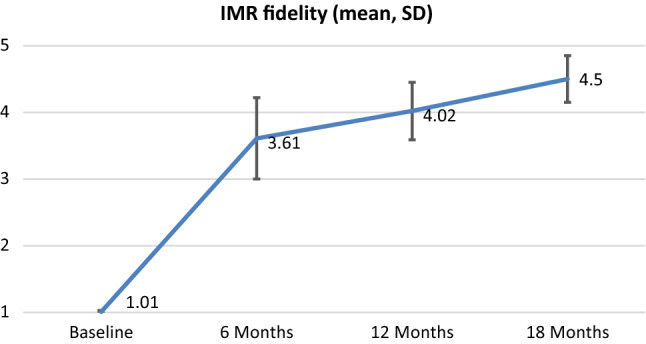
This study examined the psychometric properties and feasibility of the Illness Management and Recovery (IMR) Fidelity scale. Despite widespread use of the scale, the psychometric properties have received limited attention. Trained fidelity assessors conducted assessments four times over 18 months at 11 sites implementing IMR. The IMR Fidelity scale showed excellent interrater reliability (.99), interrater item agreement (94%), internal consistency (.91-.95 at three time points), and sensitivity to change. Frequency distributions generally showed that item ratings included the entire range. The IMR Fidelity scale has excellent psychometric properties and should be used to evaluate and guide the implementation of IMR.Trial registration: ClinicalTrials.gov Identifier: NCT03271242.
Keywords: IMR Fidelity scale; Illness Management and Recovery; Measurement; Psychometric properties.
Conflict of interest statement
The authors declare that they have no conflict of interest.
Figures
References
-
- Bartholomew T, Kensler D. Illness Management and Recovery in state psychiatric hospitals. American Journal of Psychiatric Rehabilitation. 2010;13(2):105–125. doi: 10.1080/15487761003756977. - DOI
-
- Bond G, Becker DR, Drake RE. Measurement of fidelity of implementation of evidence-based practices: Case example of the IPS Fidelity scale. Clinical Psychology: Science and Practice. 2011;18(2):126–141.
-
- Bond G, Drake RE, McHugo GJ, Peterson AE, Jones AM, Williams J. Long-term sustainability of evidence-based practices in community mental health agencies. Administration and Policy in Mental Health and Mental Health Services Research. 2014;41(2):228–236. doi: 10.1007/s10488-012-0461-5. - DOI - PubMed
-
- Bond G, Drake RE, McHugo GJ, Rapp CA, Whitley R. Strategies for improving fidelity in the national evidence-based practices project. Research on Social Work Practice. 2009;19(5):569–581. doi: 10.1177/1049731509335531. - DOI
Publication types
MeSH terms
Associated data
LinkOut - more resources
Full Text Sources
Medical
