


Hydrolyzed Collagen-Sources and Applications
- PMID: 31703345
- PMCID: PMC6891674
- DOI: 10.3390/molecules24224031
Hydrolyzed Collagen-Sources and Applications
Abstract
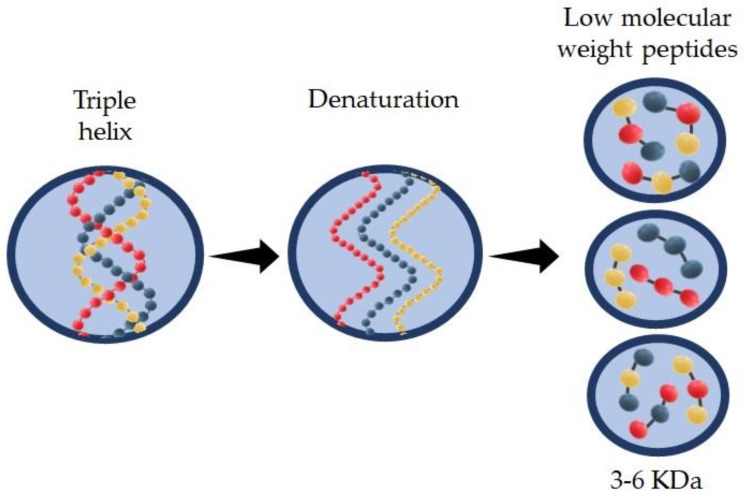
Hydrolyzed collagen (HC) is a group of peptides with low molecular weight (3-6 KDa) that can be obtained by enzymatic action in acid or alkaline media at a specific incubation temperature. HC can be extracted from different sources such as bovine or porcine. These sources have presented health limitations in the last years. Recently research has shown good properties of the HC found in skin, scale, and bones from marine sources. Type and source of extraction are the main factors that affect HC properties, such as molecular weight of the peptide chain, solubility, and functional activity. HC is widely used in several industries including food, pharmaceutical, cosmetic, biomedical, and leather industries. The present review presents the different types of HC, sources of extraction, and their applications as a biomaterial.
Keywords: antioxidant activity; denaturation; hydrolysates; hydrolyzed collagen; peptide.
Conflict of interest statement
The authors declare no conflict of interest.
Figures
References
-
- Schrieber R., Gareis H. Gelatine Handbook. Theory and Industrial Practice. WILEY-VCH Verlag GmbH & Co. KGaA; Weinheim, Germany: 2007. pp. 45–117.
-
- Asghar A., Henrickson R.L. Chemical, Biochemical, Functional, and Nutritional Characteristics of Collagen in Food Systems. In: Chichester C.O., Mrak E.M., Stewart G.F., editors. Advances in Food Research. Vol. 28. Academic Press; Cambridge, MA, USA: 1982. pp. 231–372. - PubMed
-
- Bateman J.F., Lamande S.R., Ramshaw J.A. Collagen superfamily. Extracell. Matrix. 1996;2:22–67.
Publication types
MeSH terms
Substances
Grants and funding
LinkOut - more resources
Full Text Sources
Other Literature Sources
Medical
