Guillain-Barre syndrome observed with adoptive transfer of lymphocytes genetically engineered with an NY-ESO-1 reactive T-cell receptor
- PMID: 31703609
- PMCID: PMC6842215
- DOI: 10.1186/s40425-019-0759-x
Guillain-Barre syndrome observed with adoptive transfer of lymphocytes genetically engineered with an NY-ESO-1 reactive T-cell receptor
Abstract
Background: Adoptive transfer of autologous T-lymphocytes transduced with a high affinity NY-ESO-1-reactive T-cell receptor (NY-ESO-1c259 T-cells) has emerged as a promising therapeutic strategy for patients with refractory synovial sarcoma. Secondary autoimmune T-cell mediated toxicities can occur long after initial adoptive T-cell transfer. We report on the first two cases of the development and management of Guillain-Barre syndrome in synovial sarcoma patients who received NY-ESO-1c259 T-cells.
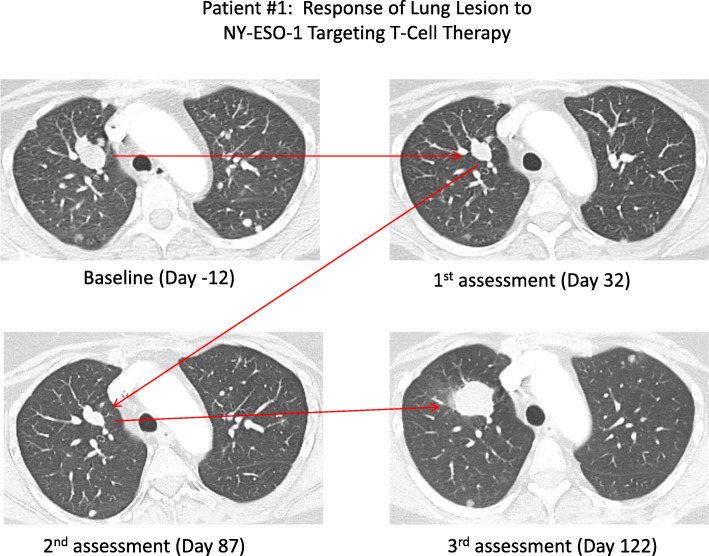
Case presentation: A 47 year-old woman and 39 year-old woman with refractory metastatic SS were treated with fludarabine-cyclophosphamide lymphodepletion followed by adoptive transfer of NY-ESO-1c259 T-cells. On day 42 after adoptive T-cell therapy, patient one presented to the emergency room with a one-week history of numbness, paresthesia, and heaviness to both legs progressing to difficulty walking on the day of presentation. Although MRI brain and lumbar puncture were negative, electromyography (EMG) and nerve conduction studies (NCS) of the lower extremities and right arm performed revealed an abnormal study suggestive of a very mild, distal, motor, axonal polyneuropathy. Patient two presented on day 113 with bilateral foot numbness, left foot drop, unsteady gait, and pain in the left thigh, which progressed over two week to bilateral leg weakness, inability to walk, and numbness bilaterally in the hands, legs, and feet. Both patients received intravenous immunoglobulin (IVIG) 0.4 g/kg/day for 5 days for possible acute inflammatory demyelinating polyneuropathy (AIDP) likely related to NY-ESO-1 targeting T-cell therapy. After 3 and 5 doses, respectively, of IVIG, the patients reported improvement in symptoms and strength, and were later transferred to an inpatient rehabilitation facility to continue gaining strength. At patient one's neurology follow-up on day 95, she reported only mild left lower extremity (LLE) weakness and was gradually successfully regaining independence in motor function. At patient two's 9-month follow-up, the patient had regained normal function and independence.
Conclusions: Given the expanding applications of immunotherapy in cancer management, clinicians should stay vigilant against the potential development of unusual but life-threatening immune-mediated toxicities.
Keywords: Adoptive T-cell transfer; Guillain-Barre syndrome; NY-ESO-1; Synovial sarcoma.
Conflict of interest statement
SPW reports research support from Genentech and Mundipharma. AC receives research support from Ignyta, Iovance, Nektar, and Novartis. All other authors report no disclosures.
Figures
References
-
- Lange SES, Kremer JC, Schenone AD, et al. Current management and molecular targets of synovial sarcoma. Austin J Cancer Clin Res. 2014;1(2):1008.
Publication types
MeSH terms
Substances
Grants and funding
LinkOut - more resources
Full Text Sources
Medical