


Programming emergent symmetries with saddle-splay elasticity
- PMID: 31704934
- PMCID: PMC6841980
- DOI: 10.1038/s41467-019-13012-9
Programming emergent symmetries with saddle-splay elasticity
Abstract
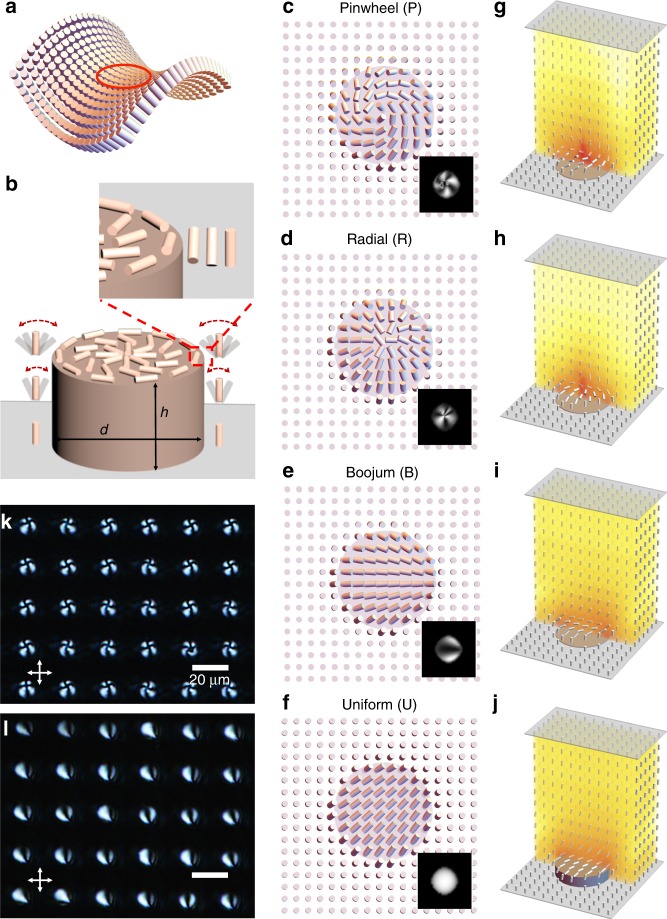
The director field adopted by a confined liquid crystal is controlled by a balance between the externally imposed interactions and the liquid's internal orientational elasticity. While the latter is usually considered to resist all deformations, liquid crystals actually have an intrinsic propensity to adopt saddle-splay arrangements, characterised by the elastic constant [Formula: see text]. In most realisations, dominant surface anchoring treatments suppress such deformations, rendering [Formula: see text] immeasurable. Here we identify regimes where more subtle, patterned surfaces enable saddle-splay effects to be both observed and exploited. Utilising theory and continuum calculations, we determine experimental regimes where generic, achiral liquid crystals exhibit spontaneously broken surface symmetries. These provide a new route to measuring [Formula: see text]. We further demonstrate a multistable device in which weak, but directional, fields switch between saddle-splay-motivated, spontaneously-polar surface states. Generalising beyond simple confinement, our highly scalable approach offers exciting opportunities for low-field, fast-switching optoelectronic devices which go beyond current technologies.
Conflict of interest statement
The authors declare no competing interests.
Figures


References
Publication types
LinkOut - more resources
Full Text Sources
Other Literature Sources
